
(London / UK) – The first companies selected through the government's "HAR1" (Hydrogen Allocation Round) green hydrogen auction have signed funding agreements and can now begin construction on their projects. The UK's Department for Energy, which is leading the initiative, announced that the projects will create more than 700 jobs with the help of government funding. The Department for Energy Security and Net Zero (DESNZ) also hopes that the initiative will mobilize more than £400 million in private capital by 2026.
Of the projects submitted for the 1 HAR2022 tender, 17 initially made it to the final round. Two consortia withdrew their applications. The remaining 15 planned to install an electrolyzer capacity of 243 megawatts (MW), but four were rejected. In December 2023, the government awarded funding to eleven industrial projects with a cumulative capacity of around 125 megawatts.

Kimberly-Clark, a hygiene products manufacturer, is investing a total of £125 million to at least partially replace the natural gas it currently uses with green hydrogen in its factories, including Northfleet's Andrex facility, where toilet paper is manufactured. © Kimberly-Clark UK & Ireland
According to reports, the projects will support British industry in switching from fossil fuels to domestically produced, low-carbon hydrogen to reduce emissions. For example, the old High Marnham coal-fired power station in Newark will be transformed into a clean energy hub using hydrogen. The Cromarty Hydrogen project in northeast Scotland aims to supply local industrial users, including distilleries, with hydrogen from a 3,5-megawatt electrolyzer. Hygiene product manufacturer Kimberly-Clark, together with hydrogen producer Hyro Power and Carlton Power Ltd., is investing a total of £125 million (€143 million) to replace at least part of the natural gas currently used in two factories with green hydrogen ( as previously reported ). The electrolysis capacities listed below are planning figures.
- Barrow Green Hydrogen (21 MW): Carlton Power is developing a hydrogen production facility next to Kimberly Clark's Kleenex factory in Barrow-in-Furness, Cumbria, to partially replace the natural gas currently used.
- Bradford Low Carbon (24,5 MW): Hygen and N-Gen Energy are developing a green hydrogen production facility in Bradford, Yorkshire, for use in the mobility sector. Customers include the Irish bus manufacturer Wrightbus and the construction equipment company JCB.
- Cromarty Hydrogen Project (10,6): Scottish Power and Storegga are using nearby wind farms in Caithness, Sutherland and Easter Ross in northeast Scotland to produce hydrogen for local industries and whiskey distilleries.
- Green Hydrogen 3 (10,6 MW): Hyro is building an electrolysis plant in Northfleet powered by green electricity under a Power Purchase Agreement (PPA) to support a paper mill producing Kimberley-Clark sanitary wipes.
- HyMarnham (9,3 MW): JG Pears & GeoPura are building an electrolysis plant in Newark, Nottinghamshire, to use the hydrogen in a waste disposal facility.
- Langage Green hydrogen (7,0 MW): In South West Devon (Plymouth), Carlton Power is developing an electrolysis plant to use hydrogen as a process gas by companies based at the Langage Energy Park to replace natural gas.
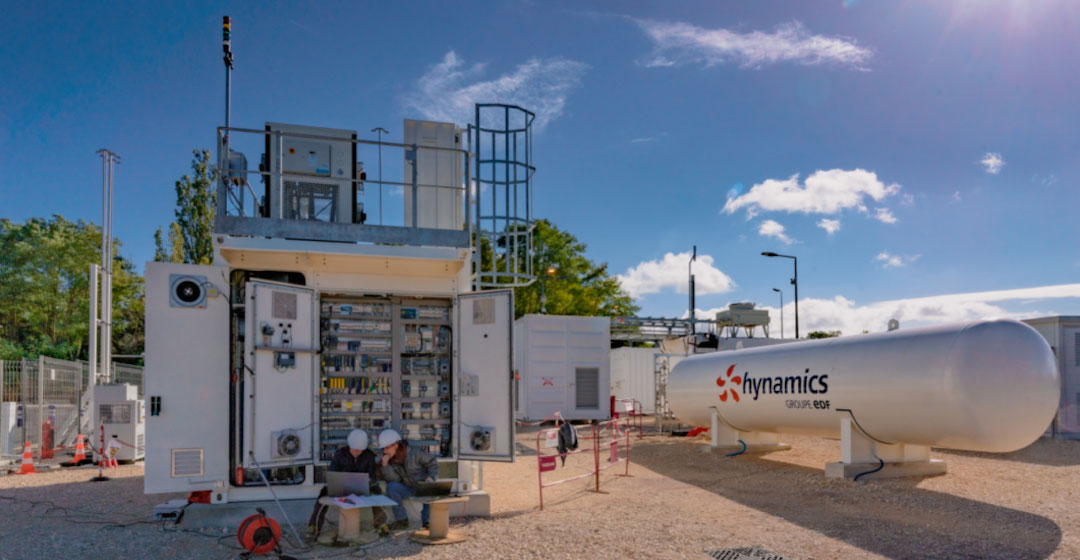
- Tees Green Hydrogen (5,2 MW): The project in Redcar (Teesside) by EDF and its subsidiary Hynamics will use wind power to produce sustainable aviation fuel (SAF Sustainable Aviation Fuel) using hydrogen.
- Trafford Green Hydrogen (10,5MW): Carlton Power is building an electrolysis plant in Stretford/Urmston (Greater Manchester), the output of which will be supplied to local industry.
- West Wales Hydrogen (14,2MW): Morgen Energy and Trafigura are developing a hydrogen production facility in Milford Haven, Wales, from which local customers will purchase the output to decarbonize their manufacturing operations.
- Whitelee Green Hydrogen (7,1): Scottish Power is building an electrolyzer in Kilmarnock / Loudoun, south of Glasgow in Scotland, to produce hydrogen using electricity from the Whitelee wind farm developed by the Spanish parent company Iberdrola SA, which will be sold to local distilleries and logistics companies.
Not yet listed is the HyBont project (5,2 MW) by the Japanese Marubeni subsidiary Marubeni Europower, planned for Bridgend in Wales. This project has been delayed after Bridgend County withdrew its financial support due to budget constraints, although it did not initially question the project's viability. The Welsh government, as the higher authority, later halted the project, but then reversed this decision due to its "exclusively local interest," leaving the final decision to the county, the BBC reported.
For HAR2, 27 candidates are on the shortlist
In April of this year, following a second call for tenders for hydrogen projects (HAR2, Second Hydrogen Allocation Round), the British government selected 27 applicants for the shortlist who want to decarbonize manufacturing and industrial processes with the energy carrier ( we reported ).
In June, the British government also announced £500 million (€587 million) for regional hydrogen transport and storage networks to promote the growth of a “renewable Britain” and unlock further investment in industrial centers, according to the Department for Energy.
DESNZ also recently launched a consultation with the hydrogen industry to examine the potential for blending hydrogen into the UK gas network. The aim is to determine whether injecting this energy carrier into local and national networks, as well as the National Transmission System (NTS), could offer strategic and economic value (as we reported ).
Photo above
EDF is developing a hydrogen production facility in Redcar, Teesside, UK. The energy carrier, produced using wind power, will be supplied to local industry. According to EDF, the electrolyzer is scalable to 300 megawatts. The EDF Group also qualified for the second hydrogen auction (HAR2) this year and is on the shortlist. © EDF



