
(Abu Dhabi / Dubai) – Renewable energies are a key factor for the green hydrogen economy. Critics generally argue that the use of wind and solar power is too expensive, too inefficient, and technologically immature – therefore, green hydrogen cannot be available in sufficient quantities, and the switch to this energy carrier cannot work on a large scale.
New IRENA study: Electricity from new renewable energy power plants is cheaper than from fossil fuels. © IRENA
But current figures refute such claims. Renewable energy remained the cheapest option for electricity generation in 2024, contributing to $467 billion in savings on fossil fuels. Photovoltaic systems were, on average, 41 percent cheaper than the lowest-cost fossil fuel alternatives, while onshore wind projects were 53 percent cheaper. This is the finding of a report by the International Renewable Energy Agency (IRENA).
Measured by levelized cost of electricity (LCOE), 91 percent of newly commissioned utility-scale power plants deliver electricity at a lower cost than the cheapest newly installed fossil fuel-based facility. Last year, new utility-scale onshore wind projects were the cheapest source of renewable electricity, with a global weighted average LCOE of $0,034 per kilowatt-hour (USD/kWh), followed by new solar photovoltaic (PV) projects (USD0,043/kWh) and new hydroelectric power plants (USD0,057/kWh). Battery storage costs fell by 2010 percent from 2024 to 93, from $2.571/kWh to $192/kWh.
However, LCOE for some technologies has increased slightly since 2023: PV by 0,6 percent, onshore wind by 13 percent, offshore wind by 46 percent, and bioenergy by 16 percent. At the same time, costs for CSP (-2 percent), geothermal (-XNUMX percent), and hydropower (-XNUMX percent) decreased.
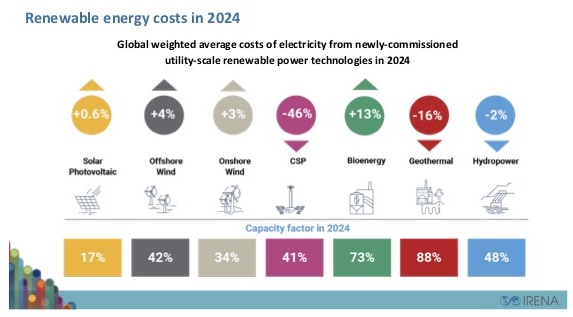
Electricity generation costs (LCOE) were lower compared to fossil fuels. However, LCOE for some technologies has increased slightly since 2023. © IRENA
Total installed costs (TIC) for renewable energy technologies decreased between 2010 and 2024. By 2024, TIC fell to an average of $691 per kilowatt (USD/kW) of installed capacity for PV, $1.041/kW for onshore wind, and $2.852/kW for offshore wind. Over the next five years, global total installed costs are expected to reach approximately $388/kW for PV, $861/kW for onshore wind, and $2.316/kW for offshore wind, according to the authors.
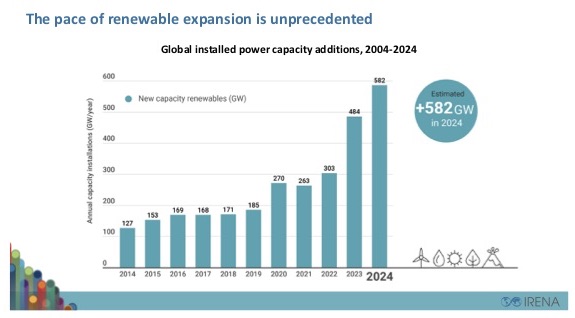
Global renewable energy capacity expansion over the past decade has increased from 127 gigawatts in 2014 to nearly 600 gigawatts of installed capacity last year. © IRENA
According to IRENA forecasts, renewable energy plants with a cumulative capacity of 582 gigawatts were installed last year. This led to significant cost savings and avoided the use of fossil fuels worth approximately $57 billion.
Renewable energies are not only more cost-effective than fossil fuels, but also offer the advantage of reducing dependence on international fuel markets and improving energy security. "The economic case for renewable energies is stronger today than ever," the report states.
Limited network capacities keep costs high in Europe
While further cost reductions are expected with the advancement of technologies and the strengthening of supply chains, short-term challenges remain. Geopolitical changes such as trade tariffs, raw material shortages, and changing production dynamics, particularly in China, pose risks that could temporarily lead to cost increases.
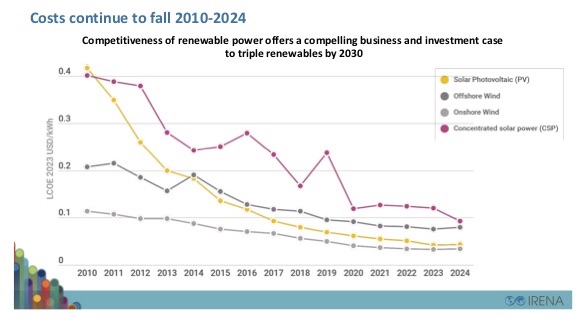
The costs of renewable energy plants have fallen rapidly over the past 15 years. However, due to persistent barriers such as access to finance, permitting delays, and geopolitical risks, greater coordination between policymakers, regulators, and investors is essential. © IRENA
In Europe and North America, costs are likely to remain high due to structural barriers such as delays in construction permits, limited grid capacity, and higher system costs. In contrast, regions with significant renewable energy potential, such as Asia, Africa, and South America, could see significant cost declines.
With renewable energy capacity expected to increase in the coming years to meet climate targets, technologies such as battery storage, digitalization, and hybrid systems are becoming increasingly important for integrating variable renewable energy, improving plant performance, and increasing grid responsiveness. Given the ongoing barriers—such as access to finance, supply chain bottlenecks, and geopolitical risks—greater coordination among policymakers, regulators, and investors is essential to accelerate the energy transition, says UN Secretary-General Antonio Guterres.
The report “Renewable Power Generation Costs in 2024” is available free of charge as a PDF (226 pages).
A Summary: Key takeaways about intuitive eating The report is also available as a PDF (16 pages)
Comment: Wind and sun are plentiful and available everywhere in the world; their use is inexpensive and has been steadily decreasing in price for years. This is admittedly a truism. Yet, it apparently still needs to be repeated constantly to counter the frequently circulated false claims of the fossil fuel and nuclear power factions, who, despite knowing better, obstruct progress at every opportunity. alo
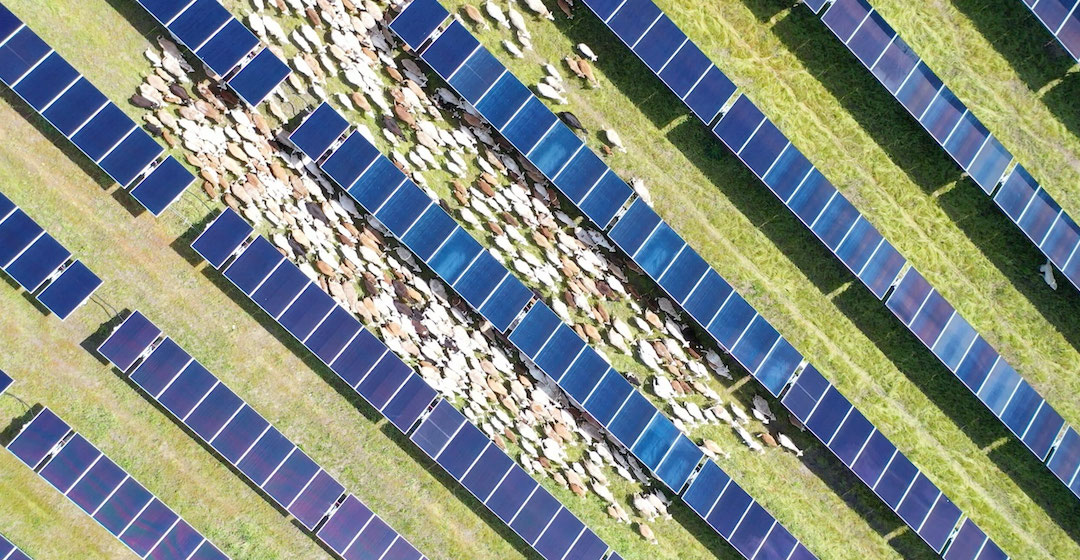
Photo above
Silicon Ranch Corp. solar farm in Tennessee, USA. The independent power producer has PV systems and battery storage in the USA and Canada with a capacity of seven gigawatts, including 3,8 gigawatts under construction. It is owned by Shell, Manulife Investment Management, and TD Asset Management. © Silicon Ranch Corp.



