
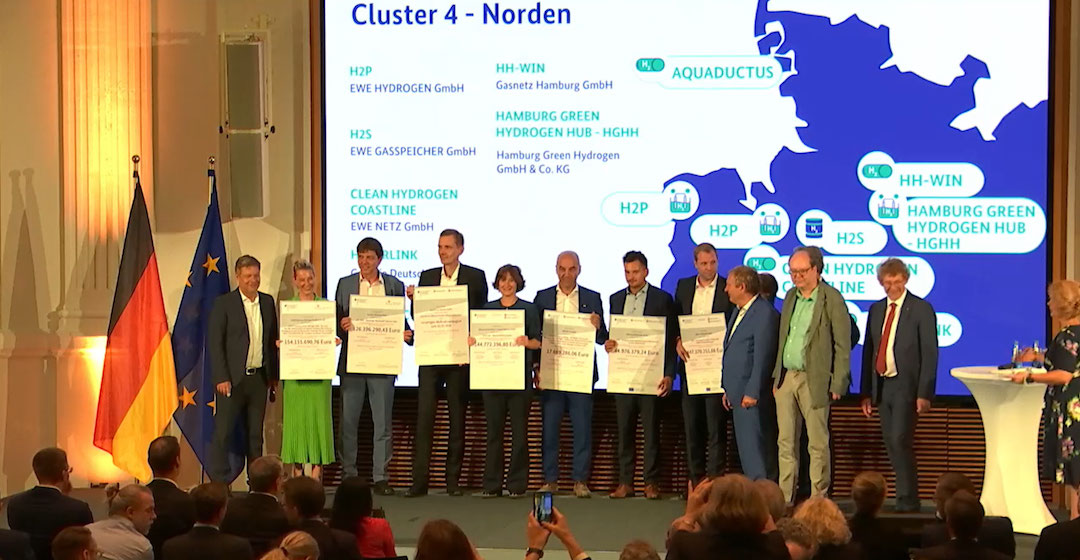
(Berlin / Germany) – Federal Minister for Economic Affairs Robert Habeck, together with several state economic ministers, presented the funding approvals for 23 projects in Germany from the IPCEI hydrogen “Hy2Infra” in Berlin. These “Important Projects of Common European Interest” were approved by the EU Commission in February ( as we reported ).
Investments of 7,9 billion euros
With 30 percent co-financing by the participating federal states, the funding volume is a cumulative 4,6 billion euros. The companies receiving funding are investing an additional 3,3 billion euros themselves, bringing the total investment volume to around 7,9 billion euros. The projects cover the entire hydrogen value chain:
- Production of green hydrogen through electrolysers with up to 1,4 gigawatts generation capacity
- Storage solutions for hydrogen of up to 370 gigawatt hours
- 2.000 kilometers of cable-based Infrastructure for the transport of the energy source
- use of liquid organic hydrogen carriers (liquid organic hydrogen carriers, LOHC) for the transport of about 1.800 tons of hydrogen per year
According to the Federal Ministry for Economic Affairs and Energy (BMWK), one focus is on the interaction of individual projects. Several projects form cross-state clusters of pipeline, storage and generation infrastructure with connections to industrial customers in energy-intensive sectors such as the steel and chemical industries. In addition, connections to neighboring countries such as the Netherlands should enable pipeline-based hydrogen imports to Germany in the future. The projects:
- ESE-ECoEG: Enertrag Elektrolysekorridor Ost GmbH & Co. KG wants to set up large-scale production, storage and distribution of green hydrogen with an electrolysis capacity of 185 megawatts (MW) in Brandenburg and Mecklenburg-Western Pomerania.
- CHC-H2-PIN (Clean Hydrogen Coastline – H2 Pipeline Infrastructure Northwest): EWE Netz GmbH is planning to build a hydrogen infrastructure in Lower Saxony with pipelines 56 kilometers long, of which 28 kilometers are new construction and 28 kilometers are conversions of existing natural gas pipelines.
- GOSpeicher (Green Octopus Central Germany): VNG Gasspeicher GmbH will upgrade and operate a cavern storage facility for hydrogen with a storage volume of 50 million cubic meters in Saxony-Anhalt.
- HH-WIN (Hamburg Hydrogen Industry Network): Gasnetz Hamburg GmbH plans to build and operate 40 kilometers of new hydrogen pipelines in Hamburg.
- Get H2 Storage: RWE Gas Storage West is upgrading and operating cavern storage facilities with a cumulative volume of 28 million cubic meters in Gronau-Epe, North Rhine-Westphalia. The two caverns are intended to buffer the fluctuating hydrogen production from wind and solar power; the first hydrogen will be fed into the grid in 2026.
- GET H2 Thyssengas: Thyssengas GmbH is using the funding to build and operate 73 kilometers of hydrogen pipelines in Lower Saxony and North Rhine-Westphalia, of which 61 kilometers will be newly built and XNUMX kilometers will be repurposed.
- MosaHYc: Creos Deutschland Wasserstoff GmbH is building a hydrogen infrastructure in Saarland on the German-French border. This includes 41 kilometers of pipeline, of which 18,5 kilometers will be newly built and 22,5 kilometers will be repurposed.
- Aqua Ductus: Aqua Ductus Pipeline GmbH is building 203 kilometers of new offshore hydrogen pipelines in Lower Saxony, as well as 92 kilometers of onshore pipelines.
- GrueH2Ro (Green hydrogen from Rostock): GHS 2 GmbH is building and operating an electrolysis capacity of 100 megawatts in Mecklenburg-Western Pomerania.
- GreenMotionSteel: Air Liquide Deutschland GmbH is installing electrolyzers in North Rhine-Westphalia to produce green hydrogen with an output of 120 megawatts.
- GET H2 nucleus: RWE Nukleus Green H2 GmbH plans to build and operate 300 megawatts of electrolysis capacity at its Lingen site in Lower Saxony. The plants are to be installed in 2027-megawatt increments by 100, with the first going into operation in 2025.
- LGH2 (Lingen Green Hydrogen): Lingen Green Hydrogen GmbH & Co. KG is installing a 100 MW electrolysis plant in Lower Saxony.
- HyPerLink: Gasunie Deutschland Transport Services GmbH is building 407 kilometers of hydrogen pipelines in Bremen and Lower Saxony, of which 53 kilometers will be newly built and 354 kilometers will be repurposed.
- H2P: With the funds, EWE Hydrogen GmbH will install and operate 370 megawatts of electrolysis capacity in Bremen and Lower Saxony.
- H2S: EWE Gasspeicher GmbH is receiving funding for the large-scale storage of hydrogen in a salt cavern in Lower Saxony with a volume of 17 million cubic meters that is to be upgraded.
- HGHH (Hamburg Green Hydrogen Hub): Hamburg Green Hydrogen GmbH & Co. KG will install a 100 MW electrolyzer to produce green hydrogen at the former Hamburg-Moorburg power plant site, and will also build a trailer station to transport the energy source.
- GET H2 OGE: Open Grid Europe GmbH is building and operating 85 kilometers of hydrogen pipelines in Lower Saxony and North Rhine-Westphalia (35 kilometers of new construction / 50 kilometers of conversion).
- Hydrohub-Fenne: Hydrohub Fenne GmbH is building and operating a 55-megawatt electrolysis plant at the Völklingen-Fenne power plant site in Saarland.
- GET H2 Nowega: Nowega GmbH builds and operates hydrogen pipelines with a length of 158 kilometers (16 kilometers new construction / 142 kilometers repurposing) in Lower Saxony and North Rhine-Westphalia.
- GH@BD (Green Hydrogen @ Blue Danube): LOHC Infra Bavaria GmbH plans to build and operate two R&D LOHC hydrogenation plants and one industrial dehydrogenation plant in Bavaria.
- Doing Hydrogen: As part of this project, Ontras Gastransport GmbH plans to build and operate hydrogen pipelines with a total length of 618 kilometers (442 kilometers new construction / 176 kilometers repurposing) across four federal states (Brandenburg, Mecklenburg-Western Pomerania, Saxony, Saxony-Anhalt).
- HyTechHafen-Rostock: Rostock Energy Port Cooperation GmbH plans to build a 100 MW electrolyzer in the port of Rostock (Mecklenburg-Western Pomerania), which will produce green hydrogen from 2027. This will be made available to local consumers and fed into the Germany-wide hydrogen core network currently being built. The operating company includes Rostock Port GmbH, Rhein Energie AG, EnBW Neue Energien AG and RWE Generation SE.
- GO (Green Octopus Central Germany): Ontras Gastransport GmbH will build and operate 301 kilometers of hydrogen pipelines across Lower Saxony, Saxony and Saxony-Anhalt, including 106 kilometers of new construction and 195 kilometers of conversion.
"Hy2Infra" was prepared and registered by France, Germany, Italy, the Netherlands, Poland, Portugal and Slovakia. The seven member states are providing up to 6,9 billion euros in public funds. This in turn is expected to release 5,4 billion euros in private investment, a total of over twelve billion euros. 32 companies with activities in one or more member states are involved, working on 33 projects. The funding of the German projects is part of the National Hydrogen Strategy, which was updated by the federal government in 2023.
“Hy2Infra”: Third IPCEI of the hydrogen wave
This was preceded by "Hy2Tech", which focused on the development of hydrogen technologies for end users (approved in July 2022), and "Hy2Use", which focused on hydrogen applications in industry (September 2022). In June of this year, the European Commission approved the fourth IPCEI "Hy2Move", which focuses in particular on projects in the areas of mobility and transport.
Editor's note: In the next few weeks, we will be presenting some of the IPCEI projects funded by the federal and state governments.
Photo above
Almost half of all IPCEI projects in Germany are planned in the northern German states: Federal Minister of Economics Robert Habeck handed over ten decisions with a financial volume of 1,28 billion euros to large-scale projects in northern Germany in Berlin. Six projects for pipeline infrastructure, three large-scale electrolysis projects and a project to convert a cavern storage facility to large-scale hydrogen storage are being funded. 30 percent of the funds, i.e. almost 384 million euros, are coming from Lower Saxony. © Climate Protection and Energy Agency Lower Saxony GmbH



