

(Canberra, Australia) – The Australian government has published its “National Hydrogen Strategy 2024” as a framework for the production, use, and export of hydrogen. This will “position the continent to become a world-leading hydrogen producer,” according to the lead Department of Climate Change, Energy, the Environment and Water.
Australia has updated its National Hydrogen Strategy. © Australian Government
The 106-page paper is an update of the "National Hydrogen Strategy 2019". The focus is now on accelerating the growth of the clean hydrogen industry. "Australia is ready to take a global leadership role in this," said Energy Minister Chris Bowen at the presentation.
The focus is on manufacturing incentives announced as part of the $22,7 billion and currently hotly debated 10-year “Future Made in Australia” plan. The strategy identifies four main objectives supported by 34 measures:
- Care: Supply of hydrogen at globally competitive costs
- Demand: Activating the most promising domestic demand sectors for hydrogen-based decarbonisation
- Non-profit status: Municipalities and regions benefit from hydrogen use
- Trade: Building a large-scale distribution network and leveraging international partnerships.
Australia already has a significant pipeline with more than 100 projects announced since 2019. According to the International Energy Agency (IEVA), 20 percent of all projects announced worldwide were from Down Under.
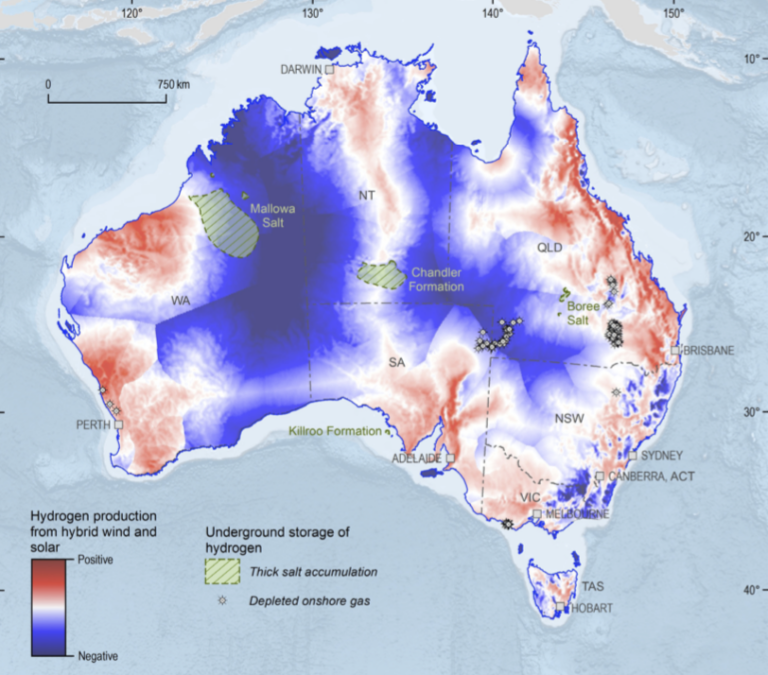
Potential: The strategy sees good conditions for the production of hydrogen using electricity from wind and PV systems, particularly on the east and west coasts, as well as in the south and in a central north-south corridor. © Geoscience Australia (screenshot from the National Hydrogen Strategy 2024)
Most of the projects are still in the feasibility or planning phase. "This pipeline is larger than in any other country." It accounts for about half of all export-oriented projects announced worldwide. The pipeline is predominantly focused on the production of renewable hydrogen, as Australia's extensive wind and solar resources form the basis for the cost-effective production of renewable hydrogen, the strategy paper says. Its value is currently $225 billion or more.
1. Strengthen supply
Australia's hydrogen industry is globally competitive and can produce sufficient quantities of hydrogen at a price that attracts domestic and international buyers. However, the cost of producing renewable hydrogen is currently still high and the industry is in its early stages.
Renewable energy accounts for the majority of hydrogen costs, so reducing these costs through public investment is an essential prerequisite for building Australian hydrogen companies. The continent aims to produce at least 15 million tonnes of hydrogen per year, with a potential of 30 million tonnes annually by 2050. To achieve this, a number of measures are planned, including:
- Tax incentive for hydrogen production of two dollars per kilogram
- The "Hydrogen Headstart Program“ closes the financial gap between current production costs and the sales price of renewable hydrogen.
- "Future Made in Australia“ finances the introduction of innovative technologies and facilities.
- Development of regional “Hydrogen hubs“ through government funding as a building block on the way to a large-scale hydrogen industry.
- The Australian Renewable Energy Agency (ARENA) is a financing institution that supports research, development and the use of clean hydrogen technologies.
In addition, the approval procedures at all levels of government are to be streamlined and prioritized, and cooperation with states and territories in analyzing infrastructure is to be strengthened. Workforce and their training are also key to the growth of the hydrogen industry.
2. Activate demand
Specific support is to be provided for individual sectors. The strategy focuses on applications that are currently the most promising.
- Green Metals: Hydrogen could be a clean source of industrial process heat for processing raw materials and promote the export of green iron and steel.
- Ammonia: Green hydrogen is a viable way to produce and export this energy source and also use it as fuel in the maritime industry.
- Long-distance transport: Hydrogen is expected to play a role in the decarbonisation of long-distance road, air and maritime transport by producing low-carbon liquid fuels.
In addition, hydrogen produced from surplus renewable energy offers the possibility of storing the yields from solar and wind energy and converting them back into electricity during peak demand periods.
3. Benefits for the community
State and territory governments should plan appropriate infrastructure and create a regulatory framework for jobs and environmental protection.
- Participation of First Nations: Communities living near projects are provided with access to advisory services to promote cooperation.
- Australian energy infrastructure: An independent energy infrastructure commissioner will support industry and government in the planning and operation of projects.
A voluntary code of conduct will be developed for industry to encourage collaboration with communities near new energy projects. A new national initiative will coordinate planning for the sustainable use of water to meet demand, including in connection with hydrogen.
4. Promote trade and investment
The continent is well positioned internationally in the developing hydrogen markets. "But our renewable resources alone will not be enough, as other countries that also have solar and wind resources enter the global competition." Therefore, extensive and lasting trade relations must be established.
- Export destination for 2030 is 0,2 million tonnes of renewable hydrogen with a potential of 1,2 million tonnes per year.
- International investments are needed to develop new industries. The state trade commission (Austrade) and a new agency, the Net Zero Economic Authority (NZEA), are playing an active role in attracting investors.
- Expansion of the Proof of origin (Guarantee of Origin, GO) to measure and verify the emission intensity of the hydrogen produced. Verification of products produced using hydrogen, such as green metals and low-carbon fuels, must also be possible.
These and other projects and goals are underpinned by regular reviews by politicians. There is also an annual report ("State of Hydrogen Report") and an assessment of progress. A more detailed review of the strategy takes place every five years to update the national strategy.
The Australian " National Hydrogen Strategy 2024 " is available as a PDF (104 pages). A summary is also available as a PDF .
Photos above
Australia is updating its “National Hydrogen Strategy”: The continent will be “positioned to become a world-leading hydrogen producer.” © Australian Government (former Department of Industry, Science, Energy and Resources)



