

(Berlin, Germany) – The Canadian energy sector is considered one of the largest in the world. Driven by strong political influences, the country's traditional oil and gas industry is increasingly being steered towards greater environmental responsibility and long-term sustainability. Biofuels and green hydrogen are considered "key building blocks for Canada's transition to a net-zero emissions economy," according to a target market analysis by the Export Initiative Energy of the Federal Ministry for Economic Affairs and Energy (BMWi).
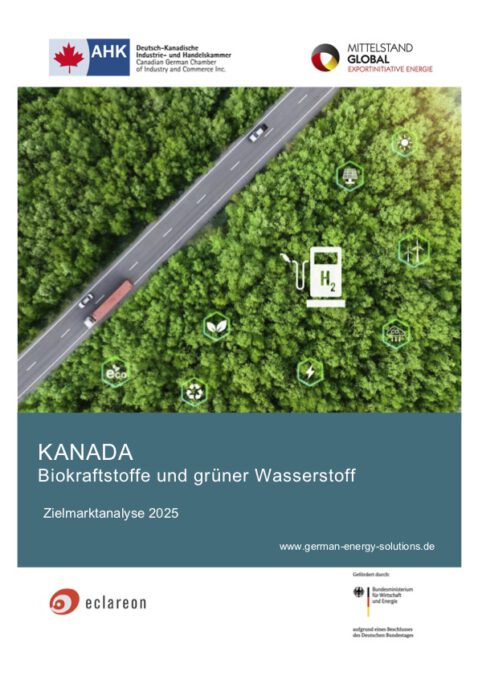
German companies can enter the hydrogen and biofuels market. © BMWE
Government support programs and targeted regulatory measures have consequently accelerated "extensive investments as well as innovation and development in the field of clean fuels." There are ambitious expansion targets and a close energy partnership with Germany. According to the information provided, the Canadian biofuel sector plans a significant expansion of its production capacity from the current three billion liters annually to 8,5 billion liters by 2030. Canada's production capacity for low-carbon fuels is also expected to grow considerably: from the current 3.450 tons per year to five million tons in the coming years.

Historic photograph: German Chancellor Olaf Scholz and Prime Minister Justin Trudeau in Toronto in the summer of 2022, on the eve of the official program of the German visit to Canada. The following day, German Federal Minister for Economic Affairs and Energy Habeck and Federal Minister for Energy Wilkinson, in the presence of the former heads of government, signed a German-Canadian hydrogen agreement to establish a transatlantic supply chain. © German Federal Government/Denzel
The study concludes that active cooperation between Canada, the EU, and Germany offers German companies in the biofuels and green hydrogen sectors "promising opportunities to help shape the Canadian clean fuels market from its early stages of development and actively support its path to global leadership." German companies could also contribute their expertise in biofuels, particularly in the further development of synthetic fuels and innovative conversion technologies, and "play a key role in actively shaping Canada's transformation towards a sustainable, future-oriented energy economy," explains the German-Canadian Chamber of Industry and Commerce. Concrete entry opportunities exist along the entire value chain: "from providing innovative conversion technologies to developing efficient storage and transport systems for hydrogen."
Target market analysis Canada “Biofuels and green hydrogen” It is available free of charge as a PDF (German, 30 pages). It is published by the German-Canadian Chamber of Industry and Commerce (AHK Canada, Toronto).
Additionally, there is a "Factsheet Canada: Wind, solar and storage technologies in Western Canada" (February 2024; 4 pages).
We are presenting the country analyses for hydrogen markets from the Export Initiative Energy of the German Federal Ministry for Economic Affairs and Energy (BMWi) in a loose series. So far, the following have been published: Norway; Great Britain ; Vietnam ; Jordan.
Photo above
TES Canada wants to produce synthetic methane (e-NG) from hydrogen in order to decarbonize industries that are difficult to supply with low-carbon fuels, such as shipping. © TES Canada H2 Inc.



