

Australia: Rio Tinto tests low-emission steel production with hydrogen +++ Germany: Stablegrid plans to develop 710 megawatts of electrolyzer capacity with ITM Power +++ Japan: Yamaha unveils hydrogen-powered golf caddy +++ Germany: Energy ministers demand an end to the "energy policy chaos" from Economics Minister Reiche +++ Japan: Kawasaki's ship coupling for liquid hydrogen transport certified +++ Germany: EU funds the Baltic Sea Hydrogen Collector project with 15 million euros +++ Germany: LBC and Duisport plan to develop a new ammonia terminal +++ Netherlands: Plug Power begins installing a 5 MW electrolysis system for H2 Hollandia +++ Germany: Uniper and Thyssenkrupp agree to use ammonia splitting technology +++ France: Plug Power and Hy2gen sign a letter of intent for the delivery of a 5 MW PEM electrolyzer
A selection of PtX topics summarized at the end of the week
+ + + + +

Calix's demonstration plant will use iron ore from Rio Tinto's Pllbara mines to produce directly reduced iron using electricity and hydrogen. © Calix Ltd.
(Australia) The Anglo-Australian mining company Rio Tinto plans to test the "Zero Emissions Steel Technology" (Zesty) developed by the Australian technology company Calix Ltd. in Kwinana, south of Perth (Western Australia) . Rio Tinto will invest more than 35 million Australian dollars (19,9 million euros) in a "Zesty Green Iron Demonstration Plant," which will also receive a further 44,9 million dollars in funding from the Australian Renewable Energy Agency (ARENA). The plant is designed to produce up to 30.000 tonnes of hydrogen-direct reduced iron (H2-DRI) or hot briquetted iron (HBI) from various iron ore sources and to utilize lower-grade iron ore from the Pllbara mines. Support is also coming from the state. Roger Cook, Premier of Western Australia, said that his government has an approach to major government projects that considers the preferential sourcing of green steel. “The world needs low-emission steel if it wants to decarbonize,” says Matthew Holcz, CEO of Rio Tinto Iron Ore. The project is currently in the detailed planning phase, and an investment decision is expected in 2026.
+ + + + +
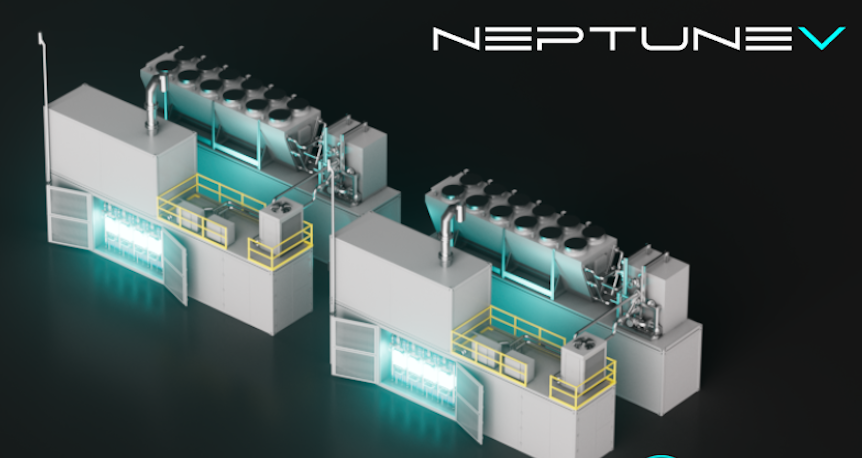
Stablegrid plans to use ITM-Power's "Neptune" technology for electrolyzers with a capacity of 710 MW in Germany. © ITM Power plc
(Germany) Hamburg-based project developer Stablegrid Group has selected British company ITM Power plc as its technology partner and supplier for two infrastructure projects in Germany with a combined electrolysis capacity of 710 megawatts. In the first project in Rüstringen, ITM Power will supply a 30-megawatt green hydrogen plant based on its "Neptune V" containerized electrolysis system. Stablegrid Group expects the final investment decision (FID) in 2026. The second project involves the installation of 680 megawatts. Stablegrid and ITM Power will begin pre-FEED work in January 2026, with the FID expected in 2028. Both projects include stabilizing the electricity grid and utilizing caverns as hydrogen storage to compensate for potential grid congestion (predispatch). The hydrogen will be produced using fluctuating renewable energy sources, stored, and converted back into electricity as needed. Background: When electricity production is high, for example in northern Germany due to wind turbines, the excess energy cannot be transported to energy-intensive industries in the south of the country because the expansion of the electricity grid has been neglected in recent years. As a result, wind farms in the north are temporarily taken offline, and expensive reserve coal-fired power plants in the south are brought online instead. Wind farm operators must be compensated for this, while coal-fired power plant operators receive payments for keeping their plants ready for operation. The annual cost is approximately three billion euros.
+ + + + +

Yamaha presented a hydrogen-powered golf trolley at the SEMA trade show in Las Vegas. © Yamaha Motor Corporation, USA
(Japan) Yamaha Motor Corporation, USA, unveiled a hydrogen-powered golf trolley at a trade show in Las Vegas. The model is based on Yamaha's "Drive2 Concierge," a four-seat golf cart primarily sold in the United States. The concept model, developed in collaboration with Toyota, features two 25-liter high-pressure hydrogen tanks positioned under the driver's seat and on the rear seatback. The company's subsidiary, Yamaha Golf-Car Company, based in Kennesaw, Georgia, specializes in vehicles for the golf industry.
+ + + + +

Energy ministers from Baden-Württemberg and six other German states are urging Federal Minister for Economic Affairs Reiche to maintain the pace of renewable energy expansion and the hydrogen rollout. © Ministry for the Environment, Climate and Energy Baden-Württemberg
(Germany) The energy ministers of the German states of Baden-Württemberg, Schleswig-Holstein, Lower Saxony, Rhineland-Palatinate, Hamburg, North Rhine-Westphalia, and Bremen believe that the federal government's "key decisions for the energy transition" are "inadequately prepared." In a position paper, they call for a "clear direction" and reliable "groundbreaking decisions" that would enable investments in climate protection and infrastructure. They argue that a successful transformation requires "a systematic focus on sustainable, cost-efficient, and innovative technologies." Federal Economics Minister Katherina Reiche, they claim, created considerable uncertainty in the first months of her term and made proposals with her 10-point plan that are only "supposed to bring about greater cost efficiency." Cuts to the expansion of renewable energies, setbacks in the electrification of transport and heating, and "a resignation regarding the development of the hydrogen economy" will not bring cost efficiency but will jeopardize sustainable prosperity in our country. In contrast, the monitoring report commissioned by the ministry "very clearly recommends maintaining the current pace of renewable energy expansion." “We urge Ms. Reiche to follow these recommendations. Anything else would be a risk to Germany as a business location,” said the state energy ministers. “The fact that the federal government is making flying cheaper by lowering the air traffic tax while bus and train travel is becoming more expensive is emblematic of the federal government’s misguided regulatory and energy policy.” A consistent transition to renewable energies is not a cost risk, but rather a gain in stability. The position paper is available on the Baden-Württemberg website.
+ + + + +

The Japanese classification society ClassNKZ has certified two Kawasaki ship couplings for handling liquid hydrogen in ports. © Kawasaki Heavy Industries, Ltd.
(Japan) A ship shore coupler jointly developed by Kawasaki Heavy Industries, Ltd. and TB Global Technologies Ltd. for the port handling of liquid hydrogen (LH2) has been certified by Nippon Kaiji Kyokai (ClassNK). This type of flanged coupler is used to easily connect the lines for handling liquefied hydrogen cargo ships to a loading arm on the dock. It must be usable under cryogenic conditions at minus 253 degrees Celsius. Corresponding tests with liquefied hydrogen were conducted at the Noshiro Rocket Testing Center of the Japan Aerospace Exploration Agency (JAXA). The ClassNK qualification of the couplers is "a significant step towards the commercial maritime transport of liquefied hydrogen." The 6-inch coupler is intended for use in the "Liquefied Hydrogen Supply Chain Commercialization Demonstration Project" of Japan Suiso Energy, Ltd. A 16-inch flange has been developed to meet the anticipated future demand for liquefied hydrogen.
+ + + + +

Baltic Sea Hydrogen Corridor: Route of the planned pipeline from Germany to Finland with potential further connections. © Gascade Transport GmbH
(Germany) The Baltic Sea Hydrogen Collector (BHC) project is receiving €15,3 million in EU funding to support preparatory work for a future cross-border hydrogen infrastructure. Gasgrid Finland, Copenhagen Infrastructure Partners (CIP), and Gascade Gastransport GmbH plan to connect the Finnish and German renewable hydrogen markets with the offshore pipeline. The funds will be used primarily for studies and pre-project planning (Pre-FEED) to examine potential routes between Finland and Germany. An extension of the hydrogen transport corridor to Sweden will be considered in a later project phase.
+ + + + +

A new terminal for handling ammonia and CO2 is planned for the northern Rhine quay in Duisport. The ammonia will be cracked on-site to recover hydrogen. © Duisburger Hafen AG / Hans Blossey
(Germany) LBC Tank Terminals Group BV, a specialist in liquid bulk storage (LBC), and Duisburger Hafen AG (Duisport) plan to develop a new terminal for handling ammonia and CO2. The terminal will be located at Rheinkai Nord in Duisburg-Hochfeld, with commissioning planned for 2030. It will serve as a satellite facility for LBC's flagship project in Vlissingen, Netherlands. There, LBC is currently developing a large hub for the import, storage, and cracking of ammonia. The Duisburg terminal will create a direct connection between the Netherlands and the Ruhr region, making it easier for customers to obtain ammonia and hydrogen. The facility will be equipped to receive ammonia by inland waterway vessel from Vlissingen. Dedicated infrastructure is planned on-site to enable the cracking of ammonia into hydrogen. Simultaneously, the terminal will serve as a storage facility for CO2 generated from industrial processes. The goal is to later store the CO2 permanently under the seabed (offshore sequestration).
+ + + + +

Plug Power is installing a 5 MW electrolyzer at the Vloeivelden Hollandia solar park, which will be powered directly by solar energy. © Novar Nederland BV
(Netherlands) Plug Power Inc. has begun installing a five-megawatt electrolysis system for the "H2 Hollandia" project. This decentralized green hydrogen hub in Nieuw-Buinen is currently being developed by Novar Nederland BV and the Avitec Group. It will eventually connect the 115-megawatt Vloeivelden Hollandia solar park to Plug Power's electrolysis system. Because the system is directly connected to the adjacent solar park, it can convert excess solar energy directly into hydrogen without using the power grid. The hydrogen will be stored and distributed to industrial customers via trailer. The investment decision was made in October 2025, and commissioning is scheduled for 2026. Annual production is projected at 300.000 kilograms.
+ + + + +

Rendering of a potential marine ammonia cracker. © Uniper SE
(Germany) Uniper SE and Thyssenkrupp Uhde AG have signed a framework agreement for the construction of commercial ammonia cracking plants. The agreement covers up to six large-scale plants with a total capacity of 7.200 tons of ammonia per day. Uniper intends to use the technology at its hydrogen import terminal in Wilhelmshaven. The license package includes engineering and service work, as well as the supply of main equipment and catalysts. The pre-FEED (Front-End Engineering and Design) study is currently being prepared. The start of the FEED phase is planned for the end of next year. In spring 2025, Uniper and Thyssenkrupp Uhde announced the construction of a demonstration plant with a capacity of 28 tons of ammonia per day at Uniper's power plant site in Gelsenkirchen-Scholven. The direct transport of hydrogen is technically and economically very complex. Ammonia, on the other hand, is suitable as a transport and storage medium because it can be liquefied relatively easily and shipped in large quantities.
+ + + + +
(France) The US electrolyzer manufacturer Plug has signed a letter of intent with project developer Hy2gen for the delivery of a five-megawatt PEM electrolyzer. This will be installed at the "Sunrhyse" project in Signes. According to the company, Plug will also support the transport and distribution of the hydrogen. Further details, such as the timeframe and investment costs, were not disclosed.
+ + + + +
Photo above
iStock / © Danil Melekhin



