

India: NTCP commissions green hydrogen filling station in Ladakh +++ Switzerland: EH Group and NIM collaborate on H2 propulsion systems for ships +++ Germany: Thyssenkrupp sticks to DRI plant despite crisis +++ India: Topsoe to produce ammonia under license for Hygenco +++ China: EPD plans to develop hydrogen projects in Hong Kong +++ Germany: Hamburg makes room for hydrogen production +++ China: Hydrexa expands in Malaysia +++ Australia: GE Vernova to supply four turbines for hydrogen power plant +++ Germany: Stuttgart port project receives €5 million in funding +++ Germany: Tesa plant in Hamburg plans to connect to the HH-WIN hydrogen network
A selection of PtX topics summarized at the end of the week
+ + + + +

The filling station in Ladakh was inaugurated by Energy Minister Shri Manohar Lal (right with flag), who then drove to the airport twelve kilometers away in one of the new hydrogen buses. © Union Ministry of Power, Housing and Urban Affairs
(India) A hydrogen refueling station has been commissioned in the Ladakh region of the Himalayas – reportedly the highest in the world. It is located in the Leh administrative district. Its capacity of 80 kilograms per day is expected to be sufficient to power five new hydrogen buses, each capable of traveling 300 kilometers on a 25-kilogram tank. The project, dubbed "Green Hydrogen Mobility," is situated at an altitude of approximately 3.650 meters above sea level and includes a 1,7-megawatt solar power plant, whose electricity is used on-site to produce the hydrogen. According to the project developer, Amara Raja Infra, which will also operate and maintain the station for three years, this pilot project will be used to test and modify equipment that must withstand temperature fluctuations from +30 to -25 degrees Celsius. The experience gained can then be applied to other stations of this type. The nine-meter-long buses, manufactured by Ahok Leyland and powered by 120-kilowatt engines, operate on behalf of the state-owned energy company NTCP Ltd. They have three hydrogen tanks and a high-voltage battery with a capacity of 71 kilowatt hours.
+ + + + +

Want to jointly research fuel cell systems in the maritime sector and integrate them into ships (from left): Mardit Matian, founder of the EH Group, NIM-CSO Marc Freriks, and EH-CEO Christopher Brandon. © EH Group
(Switzerland) The Dutch marine engineering company NIM BV and the Swiss fuel cell company EH Group have agreed to a collaboration. The companies plan to jointly research and implement hydrogen-based propulsion systems specifically tailored to the maritime industry. They will focus on adapting and standardizing fuel cell systems, along with the operational and safety requirements of seagoing vessels. The maritime sector is ripe for "disruptive decarbonization," which can only be achieved by combining powerful technologies with extensive industry experience, says Mardit Matian, founder of EH Group. By combining the EH-Trace fuel cell system with NIM's expertise in system integration, they aim to accelerate the transformation of energy management applications on board ships, said Marc Freriks, Chief Security Officer (CSO) of NIM.
+ + + + +

Thyssenkrupp Steel wants to stick to its plan for green steel production despite cutting thousands of jobs. In the summer of 2023, the EU Commission approved two billion euros to decarbonize the group. © Thyssenkrupp Steel AG
(Germany) The Executive Board of Thyssenkrupp Steel Europe AG has reaffirmed in a "Key Points Paper for Industrial Future Concepts" that the company intends to adhere to its plan for climate-neutral steel production. The direct reduction plant, currently under construction, is to be completed. Furthermore, the company is conducting "constructive discussions with the relevant authorities to ensure the economic viability of this major investment project under the rapidly changing conditions." By 2030, blast furnaces 8 and 9 in Duisburg are to be replaced by the direct reduction plant and two planned remelters with a total capacity of 2,2 million tons per year. In the long term, another blast furnace could be replaced by an electric arc furnace. However, the paper states that the company's total production capacity of 11,5 million tons is to be reduced by two to three million tons, and plants will be sold or closed. By 2030, 5.000 administrative jobs would be lost, and a further 6.000 jobs would be lost through the sale of business activities or outsourcing to external service providers.
+ + + + +

Hygenco selects Danish company Topsoe as licenser for its green ammonia plant. © Hygenco Green Energies Pvt Ltd.
(India) Danish technology provider Topsoe A/S will build a green ammonia plant in Gopalpur, Odisha, under license from Hygenco Green Energies Pvt Ltd. Hygenco intends to construct a large-scale green ammonia project in the industrial park there, with operations scheduled to begin by 2027. Last month, Hygenco signed a letter of intent with the Indian state-owned company REC Ltd. for US$280 million in debt financing. Headquartered in Gurgaon, Hygenco develops and operates large-scale green hydrogen and green ammonia plants. Earlier this year, Hygenco inaugurated India's first green hydrogen project in Hisar and plans to invest US$2,5 billion in green hydrogen over three years.
+ + + + +
(China) The Environmental Protection Department of the Hong Kong Special Administrative Region (EPD) and the China Petroleum & Chemical Corporation (Sinopec) signed a memorandum of understanding on the development of a hydrogen industry. According to the agreement, Sinopec will build a green hydrogen production plant on a remediated landfill owned by the EPD and will also support the Hong Kong government in public relations and education about hydrogen technology.
+ + + + +
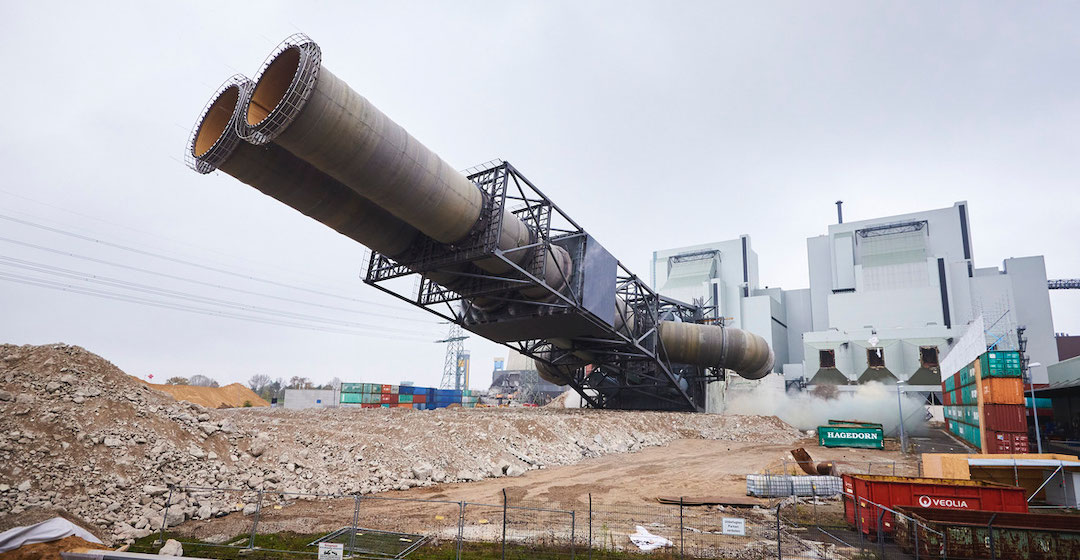
Space for something new: The Hagedorn company has demolished the 2.300 ton and 130 meter high chimneys of the flue gas desulphurisation plant in Moorburg. © Hagedorn Group
(Germany) In Hamburg, land was cleared in November for hydrogen production. On the site of the former Moorburg coal-fired power plant, the chimneys of the former flue gas desulfurization plant were demolished to make room for the construction of a green hydrogen infrastructure. The Hamburg Green Hydrogen Hub (HGHH) project plans to begin construction next year on a 100-megawatt electrolysis plant for green hydrogen. This is intended to contribute to the decarbonization of the port and industry. Hamburg's energy company, Hamburger Energiewerke, acquired the Moorburg power plant in March 2023; its previous operator was the Swedish state-owned company Vattenfall. The dismantling by the Hagedorn Group and the project itself are being managed by Energie Hub Moorburg GmbH, a subsidiary of Hamburger Energiewerke.
+ + + + +

Hydrexia continues to expand in Asia. © Hydrexia Holding Ltd.
(China) Hydrexia Holding Limited, a Chinese provider of integrated hydrogen solutions, has signed a Memorandum of Understanding with Worldwide Energy Development SDN BHD (WEDSB) through its subsidiary Hydrexia SDN BHD to develop the hydrogen market in Malaysia. The planned collaboration includes the construction of a hydrogen infrastructure, encompassing production, transportation, storage, and refueling stations by Hydrexia. Hydrexia and WEDSB will also collaborate with the Institute of Sustainable Energy at Tenaga Nasional University (UNITEN) and UNI10 Energy SDN BHD (UESB), an engineering services provider in Malaysia. Since the beginning of 2024, Hydrexia has expanded its business activities in Asia through strategic partnerships and joint ventures ( as previously reported ). Worldwide Energy is the energy development arm of Worldwide Holdings Berhad (WHB), a subsidiary of the State Development Corporation of Selangor (PKNS), the government of the state of Selangor, which operates in various sectors.
+ + + + +

Rendering of the Whyalla Power Station in Southern Australia. © Office of Hydrogen Power Southern Australia (OHPSA
(Australia) GE Vernova Inc. has received an order from Atco Australia to supply four LM6000 VELOX turbines. These will be installed at the Whyalla power station in the Upper Spencer Gulf in the state of Southern Australia and will be powered by 100 percent green hydrogen, which will be produced directly at the Whyalla complex using surplus electricity from solar and wind power plants . The installed power plant capacity is 200 megawatts. Commissioning is planned for early 2026. The contract was signed on the sidelines of COP 29 in the presence of Ramesh Singaram, President and CEO of Asia, Gas Power, GE Vernova; Peter Malinauskas, Premier of South Australia; and John Ivulich, CEO and Country Chair, Atco Australia. "With more than 70 percent renewable energy, South Australia is well on its way to becoming a global leader in the production and use of renewable hydrogen," believes John Ivulich.
+ + + + +

The municipal utilities are building a hydrogen production facility at the Stuttgart port, including transport infrastructure to the customers. © Hafen Stuttgart GmbH
(Germany) Stuttgart's municipal utility company (SWS) has received an additional five million euros in funding for the "Green Hydrogen Hub Stuttgart" (GH2S) hydrogen project. The funds were provided by the Stuttgart Region Association for the "HydroPulse" sub-project. This funding will enable the construction of a new hydrogen refueling station and the securing of the hydrogen supply infrastructure for an existing station in the Neckar Valley. Both stations will be connected to the planned "H2 GeNeSiS" pipeline. Furthermore, the project includes the procurement of three fuel cell transport vehicles and the installation of a high-temperature fuel cell at the new energy campus in Stuttgart-Wangen. GH2S is being built in the Port of Stuttgart ( as previously reported ), with construction scheduled to begin in spring 2025. Electrolyzers with an annual capacity of 1.000 tons of green hydrogen are expected to be operational there by the end of 2026. The overall project comprises three components: GH2S, "H2 GeNeSiS," and "HydroPulse." The investment volume for “HydroPulse”, which is scheduled to be completed in December 2026, amounts to around eleven million euros.
+ + + + +

Tesa wants to integrate green hydrogen into production at its Hamburg site. © Tesa SE
(Germany) The chemical company Tesa SE plans to use hydrogen at its Hamburg production site starting in 2027. The company has now commissioned the planning for its connection to the Hamburg Hydrogen Industry Network ( HH-WIN ). According to reports, Hamburger Energienetze GmbH is designing a gas pressure regulating and metering station with a connection capacity of 25 megawatts, which will supply hydrogen directly at the Tesa site. Energienetze is designing a building with the necessary plant technology and, prior to construction, is conducting the required site investigations, soil analyses, and route planning for the network connection line. The Tesa plant in Hamburg employs around 700 people and produces single- and double-sided adhesive tapes. The energy-intensive production process is to be powered in the future by climate-neutral renewable electricity and green hydrogen. Construction of the Hamburg Hydrogen Industry Network began in August with IPCEI funding. In October, the Federal Network Agency and the Federal Ministry for Economic Affairs and Energy included HH-WIN in the nationwide core hydrogen network. HH-WIN is scheduled to go into operation in 2027 and then be expanded to a line length of 60 kilometers by 2032.
+ + + + +
Photos
iStock / © Danil Melekhin



