

Germany: Coalition committee wants new gas-fired power plants with 12 gigawatts of capacity +++ Belgium: EU Commission launches expression of interest procedure for hydrogen +++ Belgium: Air Liquide commissions ammonia cracker in the port of Antwerp-Bruges +++ Norway: Nel receives PEM order worth more than 50 million dollars +++ Germany: Applications for large-scale battery storage with 661 gigawatt-hours were submitted for 2024 +++ Finland: P2X Solutions supplies green hydrogen for Finland's first eSAF pilot project +++ Germany: Drees & Sommer takes over project management for 100 MW large-scale electrolyzer in Hamburg
A selection of PtX topics summarized at the end of the week
+ + + + +

The coalition plans to put out to tender new gas-fired power plants with a capacity of twelve gigawatts. © German Bundestag / Florian Gaertner / Photothek
(Germany) The German government's coalition committee has committed to building new gas-fired power plants with a cumulative capacity of twelve gigawatts as part of its power plant strategy. Ten gigawatts are to be put out to tender in 2026 and connected to the grid by 2031, eight of which will be hydrogen-ready. This is the "basis for a secure electricity supply for Germany and thus for the competitiveness of our industry," says Economics Minister Katherina Reiche (CDU). The news magazine "Der Spiegel" quotes Chancellor Friedrich Merz as saying that the EU Commission has already signaled its approval. During the discussions, the parties apparently overlooked the fact that a more affordable security of supply can also be achieved with inexpensive renewable energies and battery storage on an industrial scale, as some countries are currently demonstrating and as is now also being implemented in Germany (see ticker below on "Large-Scale Battery Storage").
+ + + + +

The European Commission launches an expression of interest process for hydrogen. © European Commission / Bogdan Hoyaux
(Belgium) To connect potential suppliers with buyers of hydrogen and its derivatives, the European Commission has launched an expression of interest procedure. "By linking buyers and sellers, this hydrogen mechanism will help us create a cleaner and more competitive future for our energy and our economy," says EU Commissioner Dan Jørgensen, responsible for energy and housing. As a first step, interested parties and suppliers can submit their offers and requests until January 2, 2026. These will be published anonymously on January 19. The actual expression of interest procedure will then take place from January 19 to March 20, 2026. The results will be communicated to the participants in a teleconference on March 31, 2026. The Regulation on the internal market for renewable gas, natural gas and hydrogen (EU/2024/1789) tasked the Commission last year with establishing and operating a mechanism within the framework of the European Hydrogen Bank to support the market development of hydrogen for a limited period until the end of 2029. Further information and links to the procedure can be found on the European Commission's website .
+ + + + +

Air Liquide commissions an ammonia cracker with a daily capacity of 30 tons in the port of Antwerp-Bruges. © Air Liquide
(Belgium) US industrial gas manufacturer Air Liquide Inc. has commissioned what it claims is "the world's first pilot plant for industrial-scale ammonia cracking." Located in the port of Antwerp-Bruges, the plant can convert 30 tons of ammonia into hydrogen per day. This technology enables access to low-carbon and renewable hydrogen for the decarbonization of industry and mobility. Ammonia (NH3) can be produced cost-effectively in regions rich in renewable energy sources. A well-established global infrastructure already exists for the large-scale production, transport, and use of ammonia. This allows for export from energy-rich regions to end users worldwide, where it is then cracked back into hydrogen.
+ + + + +

Nel ASA receives PEM contract worth more than $50 million. © NEL ASA
(Norway) Nel Hydrogen US, a subsidiary of Nel ASA, has received orders from the Norwegian companies Kaupanes Hydrogen AS and HyFuel AS for the delivery of containerized MC 500 PEM systems. Each system has a capacity of 20 megawatts. The total order value is reportedly more than $50 million. According to the company, this is Nel's second-largest order to date and the largest for its PEM equipment. Both projects are being developed by Hydrogen Solutions AS (HYDS) in cooperation with the other owners: The HyFuel project is owned by HYDS, Sogn og Fjordane Energi AS, and Fjord Base Holding AS. The hydrogen production plant is being built in Florø, Kinn municipality. HyFuel has received support of 180 million kroner (15,5 million euros) from the Norwegian economic development agency Enova. The second project belongs to a consortium of HYDS, Dalane Energi AS, and Eigersund Næring og Havn KF. The plant is being built in the Kaupanes industrial park in the municipality of Eigersund and is being funded by Enova with 206 million kroner (17,6 million euros). Deliveries of the systems will begin in the second half of 2026 and continue into 2027, with commercial operation scheduled to commence in early 2028. The stacks will be manufactured in the automated factory in Wallingford, USA. HYDS is a Norwegian company based in Leirvik, Stord, that develops, owns, and operates plants for the production of green hydrogen from renewable energy.
+ + + + +

Battery storage capacity in gigawatt hours: requests, requests under review, and commitments in 2024. © Federal Network Agency
(Germany) Amid the current controversy surrounding the need for additional gas-fired power plants – including hydrogen-capable ones – to ensure a stable electricity supply, the Federal Network Agency (BNetzA) has now published figures for the first time on connection requests and commitments for battery storage systems. According to these figures, a total of 9.710 connection requests for battery storage systems at the medium-voltage level and above were submitted to grid operators in 2024. This figure does not include residential storage systems installed by private individuals. The requested systems have a combined planned output of approximately 400 gigawatts and a storage capacity of around 661 gigawatt-hours (GWh). Currently, 921 battery storage systems connected to the medium-voltage level or above are in operation. These systems have a net rated output of approximately 2,3 gigawatts and a storage capacity of approximately 3,2 GWh. In 2024, grid operators issued around 3.800 connection commitments. The promised battery storage systems have a combined output of approximately 25 gigawatts and a storage capacity of around 46 gigawatt-hours. To put this in perspective: battery storage systems that already have a grid connection commitment could, with their total capacity of 46 GWh, supply the entire city of Munich – around 750.000 households – with electricity for about six days. "The battery storage market is currently in a dynamic development phase – numerous projects are being planned, built, or expanded," according to the Federal Network Agency. This could also give the debate a new direction if, for example, electricity from renewable energy sources is extensively buffered in large-scale industrial storage systems and also contributes to grid stabilization, as companies are currently demonstrating worldwide, particularly in Australia and China; provided the Federal Government, specifically the Minister for Economic Affairs and Energy, takes note. Details on inquiries and commitments can be found on the Federal Network Agency's website.
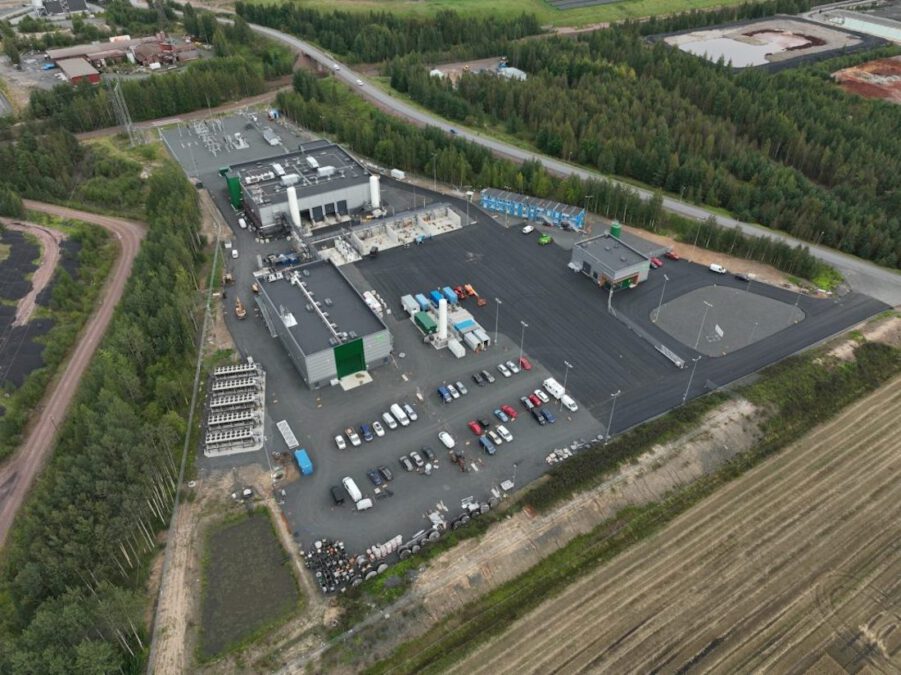
P2X Solutions is supplying green hydrogen for Finland's first eSAF pilot project. Image: The company's hydrogen plant in Harjavalta. © P2X Solutions Oy
+ + + + +
(Finland) P2X Solutions Oy will supply green hydrogen for Finland's first pilot project for the production of synthetic kerosene (eSAF). The company says this hydrogen can be used in current aircraft without significant modifications, utilizing existing infrastructure. Finnair, Finavia, Fortum, and ABB are participating in the pilot project, which is led by the technology company Liquid Sun. "Around 46 million tons of kerosene are consumed annually across Europe, and Finland is in an excellent position to produce eSAF," says Herkko Plit, founder and CEO of P2X Solutions. "We have access to abundant zero-emission electricity, clean water, biogenic carbon dioxide, and growing expertise in the production of next-generation fuels." The European Union mandates that 1,2 percent of the kerosene used must be eSAF by 2030. This share is to increase to 35 percent by 2050.
+ + + + +

Commercial hydrogen production is scheduled to begin in 2027 at the site of the former Moorburg coal-fired power plant. © Drees & Sommer SE
(Germany) Drees & Sommer SE, a Stuttgart-based company specializing in construction, real estate, and infrastructure, is responsible for project, construction, and engineering management for the Hamburg Green Hydrogen Hub (HGHH), which will feature a 100-megawatt large-scale electrolyzer, on behalf of consortium partners Luxcara and Hamburger Energiewerke. According to the company, this includes coordinating various trades, from structural and civil engineering to process engineering and electrical engineering, as well as automation and commissioning preparation. "We are directly benefiting from our experience with other large-scale projects, such as a 320-megawatt electrolysis plant in Emden and an e-fuel test platform for the German Aerospace Center (DLR) in Leuna, in optimizing interfaces and processes," says Alexander Stubinitzky, Head of Hydrogen and Synfuels at Drees & Sommer. The facilities of the former power plant in Hamburg-Moorburg were demolished by explosives last November. Preparatory construction work for the large-scale electrolyzer has been underway on the site since mid-2025. Commercial hydrogen production is scheduled to start in 2027 and will eventually produce 10.000 tons of green hydrogen annually using renewable energy.
+ + + + +
iStock / © Danil Melekhin



