

Austria: Verbund AG halts ammonia project in Linz +++ Germany: Bayernets can build hydrogen pipeline "HyPipe one" +++ Sweden: Depenbrock orders green steel from SSAB +++ Germany: OHG opens hydrogen training center +++ Mauritania: Hynfra wants to develop green ammonia project +++ Germany: Lingen can become a green hydrogen region +++ Norway: Wison New Energies and H2Carrier want to build floating hydrogen and ammonia factory +++ Germany: Public hydrogen filling station opens in Kiel +++ Germany: H2 Mobility offers assistance with GHG quota trading for filling station operators
A selection of PtX topics summarized at the end of the week
+ + + + +
Verbund AG and LAT Nitrogen complain about "inadequate public funding commitments" and are halting ammonia projects. © Verbund AG
(Austria) Energy supplier Verbund AG and project partner LAT Nitrogen Austria GmbH are halting their joint project for the large-scale production of green hydrogen. They will not pursue "Green Ammonia Linz – GrAmLi" further in the current economic climate. The current economic situation is slowing investments in research, production, and infrastructure development. Against this backdrop, the 60 MW electrolysis project is being terminated. The goal was to use green hydrogen in Linz for the industrial production of fertilizers, melamine, and technical nitrogen products. "Despite the significant progress and maturity of the project," the companies stated, "economic implementation is not possible at this time due to insufficient public funding commitments." However, they added that a resumption at a later date under changed economic and regulatory conditions is not out of the question.
+ + + + +
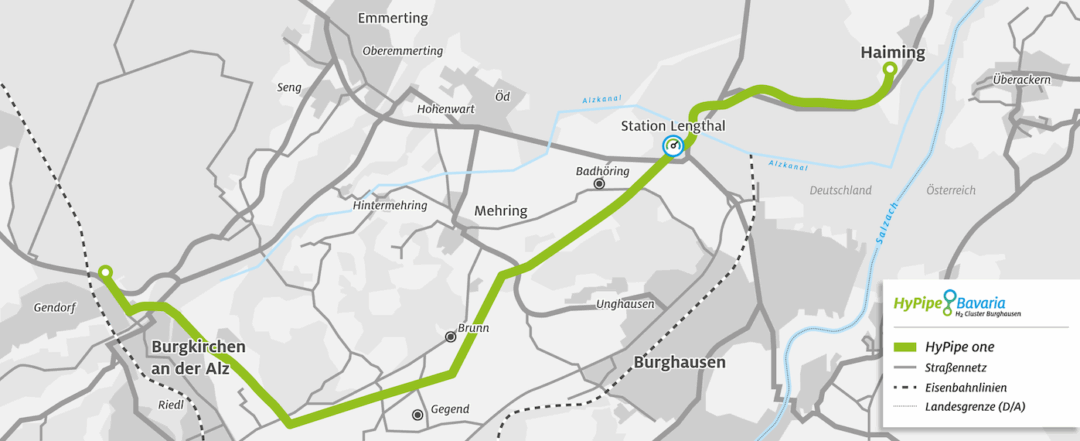
"HyPipe one" is the first expansion stage for the "SouthH2" corridor to Africa. © Bayernets GmbH
(Germany) The long-distance gas pipeline operator Bayernets GmbH has received approval for the construction of the hydrogen pipeline "HyPipe one." The conversion of existing natural gas pipelines is scheduled to begin this year. The project is part of the national core hydrogen network and has a total length of approximately 15 kilometers. The pipeline is located near the border crossing point to Austria, thus connecting the region to hydrogen import corridors such as "SoutH2 ." In addition to Bayernets, the gas transmission and infrastructure operators Società Nazionale Metanodotti SpA (Snam, Italy) and the two Austrian companies Trans Austria Gasleitung GmbH (TAG) and Gas Connect Austria GmbH (GCA) are also involved in this project. "HyPipe one" is the first phase of the expansion. The total length of Bavaria's pipeline allocation is 300 kilometers.
+ + + + +
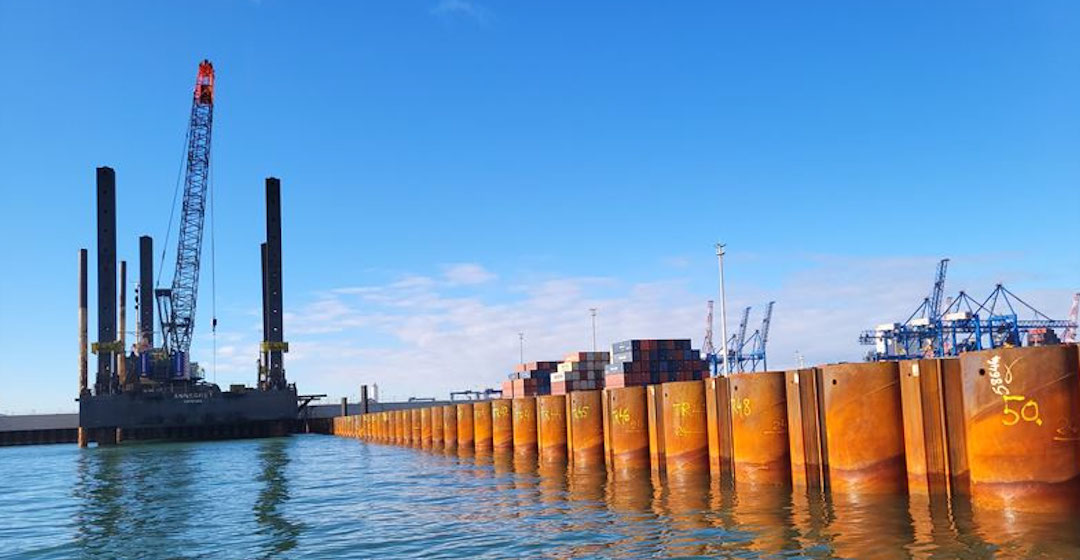
Depenbrock also plans to use green steel for its engineering and hydraulic projects in the future. © SSAB
(Sweden) The technology company Depenbrock Ingenieur- und Wasserbau from Stemwede (North Rhine-Westphalia) plans to source green steel from SSAB Svenskt Stal AB in the future. In addition to its engineering and hydraulic engineering division, Depenbrock also works on projects in building construction and civil engineering. Neither company disclosed details of the cooperation, such as the start of deliveries or the volume. In 2021, the Swedish-American steel manufacturer produced the first fossil-free steel as a proof of concept using its so-called Hybrid technology, which utilizes hydrogen-reduced sponge iron. The joint venture, called "Hybrit Development AB"—comprising SSAB, the mining company LKAB, and the state-owned energy supplier Vattenfall AB—launched the project in 2016 with the goal of developing iron and steel production using fossil-free electricity and hydrogen.
+ + + + +
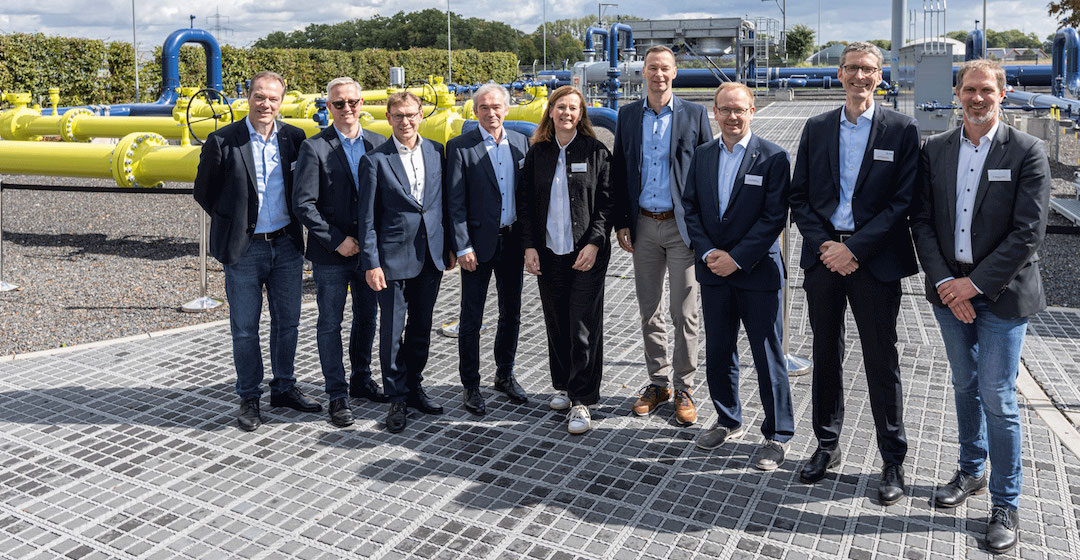
Inauguration of the training track in Werne (from left): Rolf Albus (Gas and Heat Institute Essen e. V., GWI), Matthias Stiller (Werne Economic Development Agency), Mayor Lothar Christ, Jürgen Hambrecht (Operations Manager OGE), Katja Sagurna (GWI), Thomas Hüwener (CEO OGE), Sven Spurmann (Ministry of Economic Affairs North Rhine-Westphalia), Detlef Brüggemeyer (CTO OGE), Markus Lermen (DVGW). © OGE GmbH
(Germany) The long-distance pipeline operator Open Grid Europe GmbH (OGE) from Essen has opened a hydrogen training center in Werne (North Rhine-Westphalia). The facility allows for hands-on training in handling hydrogen under realistic conditions and for practicing operational procedures. "We have installed all the key components for hydrogen transport here, enabling us to practice workflows under realistic conditions," says Technical Director Detlef Brüggemeyer. The training courses are designed in several modules. The first module focuses on assembly, maintenance, and inspection to simulate the safe decommissioning and recommissioning of pipeline sections, plant components, and assemblies. A further module provides training on the safe handling of hydrogen in pipelines and systems. The modules are certified by the German Technical and Scientific Association for Gas and Water (DVGW). The investment totaled ten million euros. Starting in the fall, the training courses will also be available to external companies.
+ + + + +
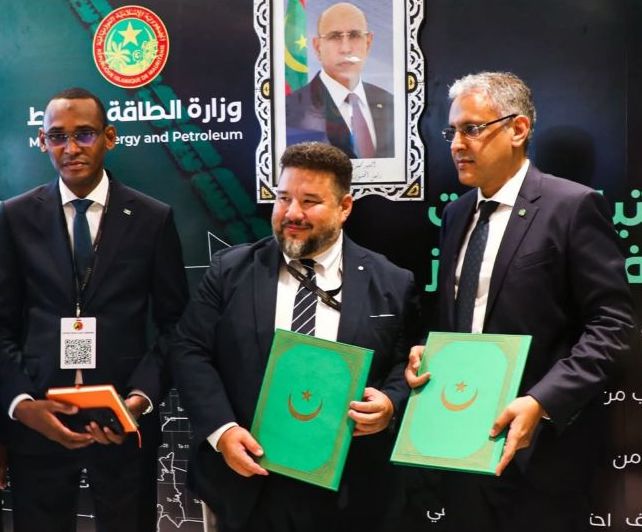
Polish project developer Hynfra has signed an agreement with the government of Mauritania to produce green hydrogen. © Hynfra PSA
(Mauritania) Polish project developer Hynfra PSA has signed a framework agreement with the Mauritanian government for a $1,5 billion green ammonia project. The plan calls for the construction of an integrated plant that will produce 100.000 tons of green ammonia annually starting in 2030. The plant will be located at a wind farm owned by the state-owned utility Société Mauritanienne d'Electricité (Somelec), with exports handled through Mauritania's largest port, Port de l'Amitié. The project includes photovoltaic and wind farms, electrolyzers, an ammonia plant, and infrastructure such as water desalination, energy storage, and export logistics. "Thanks to the combination of high solar irradiance and strong, stable winds, Mauritania has some of the best conditions in the world for the development of renewable energies," says Hynfra CEO Tomoho Umeda.
+ + + + +
The Fraunhofer Institute for Systems and Innovation Research has conducted a short study on the Lingen hydrogen region. © ISI
(Germany) The city of Lingen (Ems) can strategically position itself as a green hydrogen region. To achieve this, structures for hydrogen projects should be established, waste heat from electrolysis should be used for energy supply, and research into hydrogen-based drive technologies and synthetic fuels should be further advanced. This is the conclusion of a study by the Fraunhofer Institute for Systems and Innovation Research (ISI) commissioned by the Lingen Economic Development Agency. According to the study, the construction of electrolyzers by RWE and BP in the Emsland region has laid the foundation for the industrial production of green hydrogen. The connection to the electricity and hydrogen grid contributes to the fact that large quantities of green electricity and hydrogen can already be generated, stored, and distributed there. Furthermore, the city promotes and coordinates hydrogen activities in the region, including through the H2-Region Emsland network. Additional structural measures could help to position the city in the hydrogen market in the coming years, including a regional test center for hydrogen technologies. A hydrogen campus at the university, offering practice-oriented study programs, an endowed professorship, laboratories, and doctoral programs, could also provide support for research and development. The study "H2 Innovate: Strategies for the Local Integration of Hydrogen Applications" is available free of charge as a PDF (25 pages).
+ + + + +
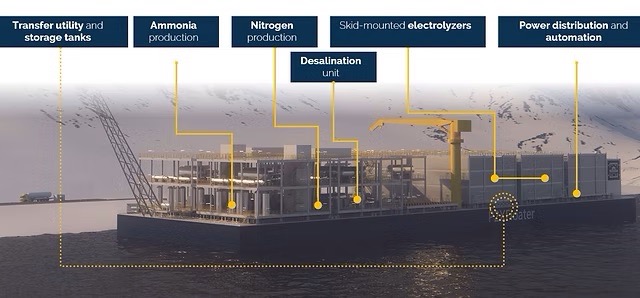
The Norwegian company H2Carrier developed the "P2X Floater," a vessel for producing hydrogen and ammonia. DNV certified the concept as feasible. © DNV
(Norway) The Chinese technology company Wison New Energies Ltd. and the Norwegian company H2Carrier AS aim to reduce the cost of producing green ammonia. Their goal is to build a 500-megawatt floating production, storage, and offloading facility (FPSO) in northern Norway, called the "P2X Floater," to produce green hydrogen and ammonia at sea. The FPSO would draw energy from a wind farm or other renewable source to provide electricity for the electrolysis of seawater. The hydrogen would then be further processed into ammonia using the Haber-Bosch process. Tankers could dock directly at the platform without a land terminal and take on the energy carrier. The concept is based on the conversion of an existing Very Large Gas Carrier (VLC). The P2X Floater design received its Design in Progress (AiP) from the certification company DNV in 2022, confirming its technical feasibility. H2 Carrier was founded in 2020 by a team from the offshore oil and gas production, offshore wind power and hydrogen sectors.
+ + + + +
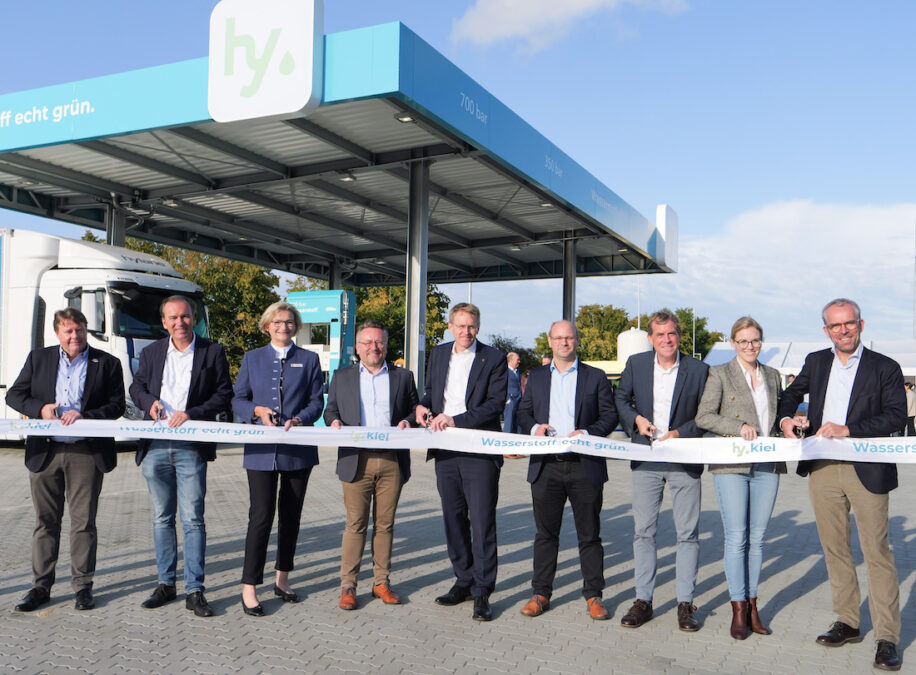
Minister-President Daniel Günther (center) cuts the ribbon to open the hydrogen filling station with HY.Kiel shareholders, partners, and customers. © HY.Kiel
(Germany) Schleswig-Holstein's Minister-President Daniel Günther has (as announced) opened the state's first public hydrogen filling station. After several years of planning, construction took only one year. The first refuelings at the 350-bar and 700-bar pumps have already taken place. The subsequent test operation will provide regionally produced green hydrogen for buses, trucks, and cars. Plans include the deployment of two fuel cell buses from DB subsidiary Autokraft in the Rendsburg-Eckernförde district for public transport. Other regional logistics and commercial companies have already expressed interest in using hydrogen-powered vehicles. The two-megawatt electrolysis plant can produce up to 180 tons of green hydrogen annually. This is enough to refuel 20 trucks, five buses, and ten cars daily. The operator is HY.Kiel GmbH & Co. KG.
+ + + + +
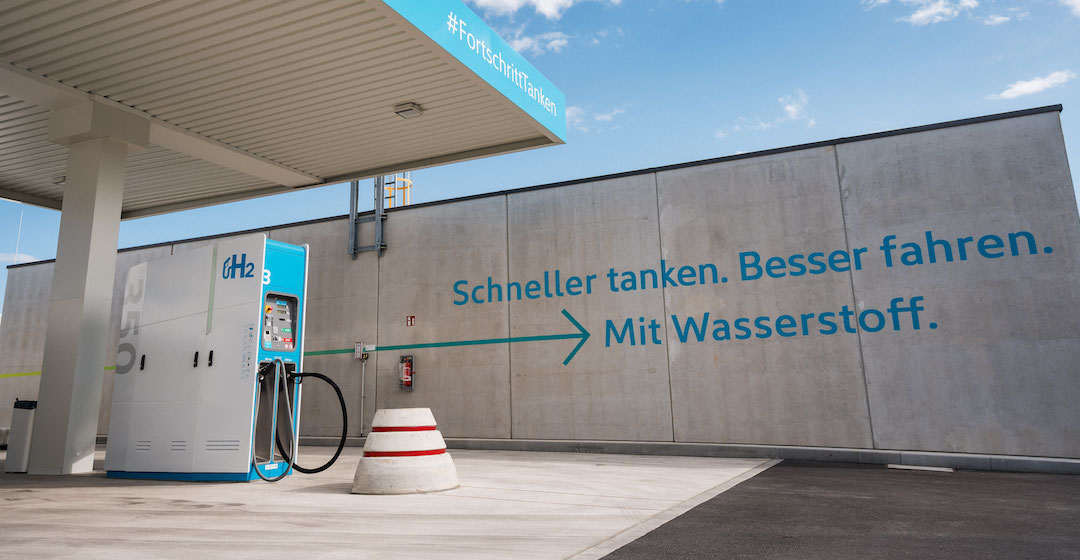
H2 Mobility hydrogen filling station in Düsseldorf © H2 Mobility
(Germany) H2 Mobility, a developer and operator of hydrogen refueling stations and infrastructure, is offering a new service in the greenhouse gas (GHG) sector, providing refueling station operators with access to quota trading. This initiative addresses the complexity of trading greenhouse gas savings, which poses significant challenges for many hydrogen refueling station operators. Furthermore, the company states that "market access is sometimes blocked due to difficult-to-achieve minimum GHG savings targets." The service includes marketing the emission savings, documentation, regular price updates, and a modular service structure. A key aspect is "pooling the GHG savings of various operators and selecting a strategic sales point to improve their negotiating position." This allows operators who previously lacked access to the GHG market due to a lack of expertise or small volumes to participate. GHG quota trading is a government instrument for promoting sustainable mobility. It obligates petroleum companies to gradually reduce their CO2 emissions or purchase corresponding certificates. Operators of hydrogen filling stations can sell the greenhouse gas emissions they save. Contact information is available via the H2 Mobility website .
+ + + + +
Photo above
iStock / © Danil Melekhin



