

Norway: Norwegian Hydrogen and GreenIron cooperate on fossil-free metal production +++ Germany: Federal Cabinet approves draft law for CO2 storage and utilization +++ Saudi Arabia: Hyundai completes test with fuel cell bus in Neom +++ Germany: Hamburg energy networks upgrade natural gas pipeline for hydrogen +++ Poland: Consortium aims to further research and develop SOEC technology +++ Germany: Four hydrogen buses for the Lindau district +++ Germany: Rolls-Royce plans to use electricity from climate-neutral eFuels by Ineratec for data centers +++ Germany: Consortium researches formate salts as a hydrogen storage medium
A selection of PtX topics summarized at the end of the week
+ + + + +
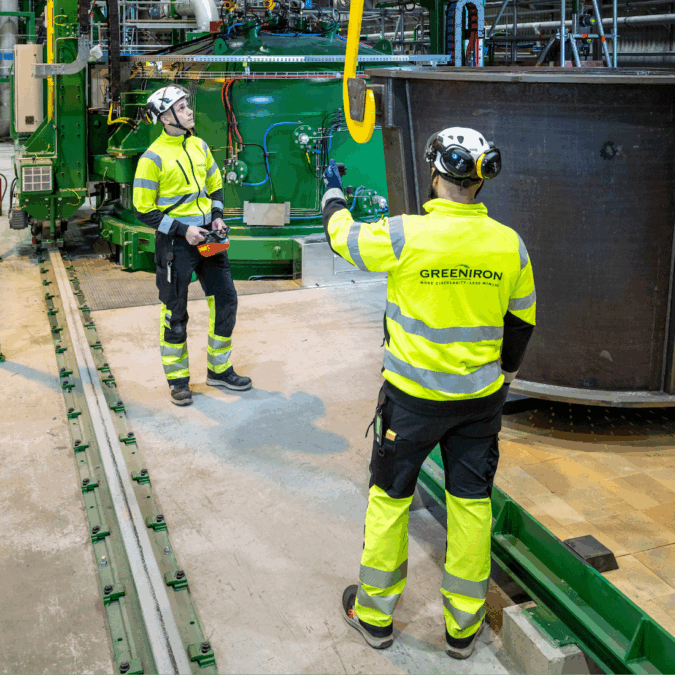
Norwegian Hydrogen and GreenIron strengthen cooperation in fossil-free metal production using hydrogen. © Greeniron H2 AB
(Norway) Norwegian Hydrogen AS and the Swedish company GreenIron H2 AB are expanding their collaboration in fossil-free metal production and have signed a strategic agreement for the construction of green hydrogen production facilities and direct reduction furnaces. Last October, the companies announced a partnership to supply green hydrogen from Norwegian Hydrogen's production plant in Hellesylt, Norway, to GreenIron's first large-scale furnace in Sandviken, Sweden. The expanded collaboration also creates opportunities "for broader use of hydrogen in surrounding industries."
+ + + + +
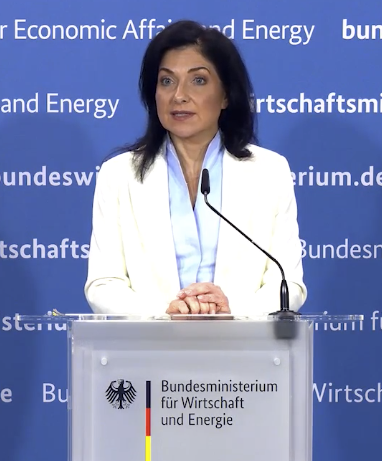
Katherina Reiche, Federal Minister for Economic Affairs and Energy: The Federal Cabinet wants to enable the use of CCS (Carbon Capture and Storage) and CCU (Carbon Capture and Utilization), as well as the transport and storage of CO2. © BMWE
(Germany) The Federal Cabinet has approved the draft law amending the Carbon Dioxide Storage Act. This will regulate, among other things, CCS (Carbon Capture and Storage) and CCU (Carbon Capture and Utilization), as well as the transport and storage of CO2. According to the Federal Ministry for Economic Affairs and Energy, which is leading the legislation, this will enable industry to capture and store process-related CO2 emissions that are very difficult or impossible to avoid, such as those produced in cement and lime. The amendment also creates a legal framework for the construction of CO2 pipelines and storage facilities. Projects are generally limited to the continental shelf and the exclusive economic zone. This does not include the territorial sea. Storage in marine protected areas is also prohibited. Land-based carbon dioxide storage will not be permitted nationwide, with the exception of research storage facilities. However, individual states may permit the permanent storage of carbon dioxide on their territory. The draft is available on the Federal Ministry for Economic Affairs and Energy's website (PDF, 74 pages).
+ + + + +
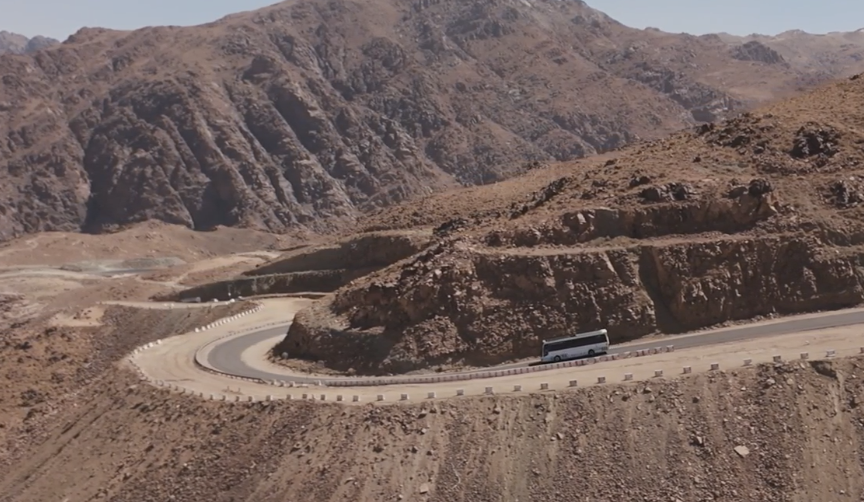
Hyundai's fuel cell bus climbed gradients of up to 24 percent in the Neom Mountains. © Hyundai Group (screenshot from a project video)
(Saudi Arabia) The Hyundai Motor Group has completed tests of its "Universe" fuel cell-powered coach in the Saudi Arabian city of Neom. As part of the mobility study, the vehicle navigated altitudes of up to 2.080 meters and gradients of up to 24 percent in the mountainous Trojena region, the company said. The test drives were conducted under an agreement signed in September 2024. The bus operated as a simulation of local public transport from October to December of last year. Enowa, Neom's energy and water subsidiary, installed the region's first hydrogen refueling station.
+ + + + +
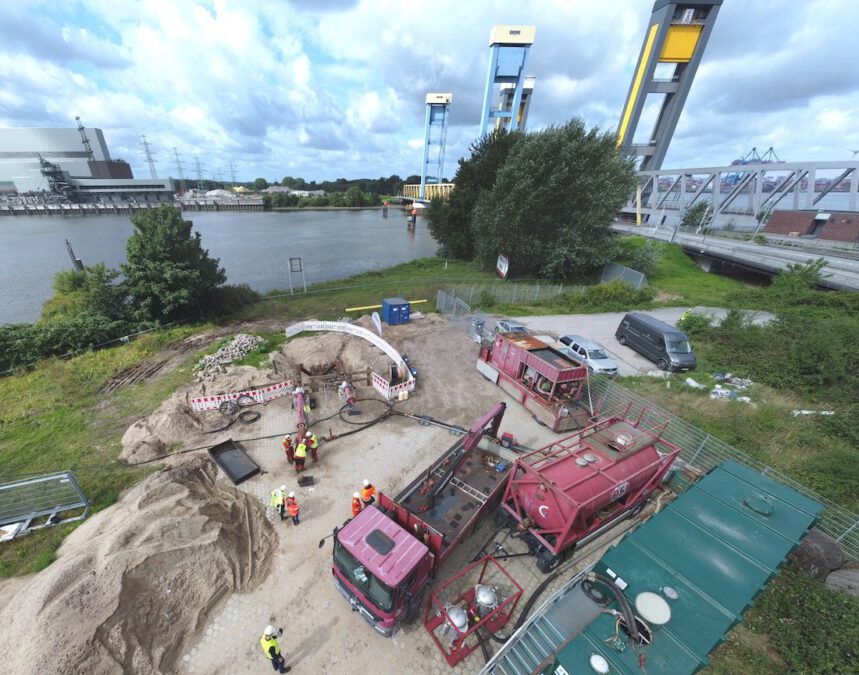
At Hamburg's Kattwyk Bridge, a gas pipeline crosses the Southern Elbe River approximately five meters below ground level. The pipeline is being cleaned and inspected with special equipment and will transport hydrogen in the future. © Hamburger Energienetze GmbH
(Germany) Hamburger Energienetze GmbH has begun cleaning and inspecting an existing natural gas pipeline. It runs approximately five meters below the riverbed of the Süderelbe. The underpass, known as a "culvert," consists of concrete-encased steel pipes, one of which transports natural gas and the other of which will be used for hydrogen in the future. A specialized company cleaned the approximately 450-meter-long pipeline and inspected its condition and material properties. Hamburger Energienetze used compressed air to send so-called "pigs" through the approximately 30-centimeter-thick steel pipes. First, the inner walls of the pipes were cleaned of deposits. Two subsequent measuring pigs equipped with ultrasonic sensor technology provided a highly precise electronic image of the steel wall thickness and used magnetic resonance technology to assess the corrosion. After evaluating the measurement data, any necessary repairs will be initiated. The hydrogen is scheduled to cross the Süderelbe in 2027.
+ + + + +
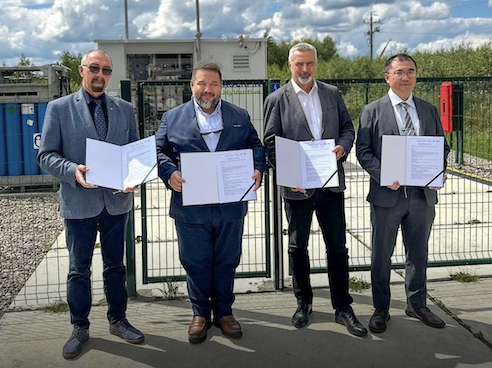
A Polish consortium plans to further develop SOEC technology for ammonia production with Japanese stack supplier Niterra. © Hynfra
(Poland) A consortium of science and industry partners aims to further research and develop SOEC (Solid Oxide Electrolysis Cell) technology for the production of green hydrogen and green ammonia. The consortium includes the Polish project developer Hynfra PSA, the Polish Łukasiewicz University of Applied Sciences – INS (Instytut Nowych Syntez Chemicznych), the technology company Rockfin SA, and the Japanese company Niterra Co. The initial plan is to build an SOEC demonstration plant at INS in Puławy in 2026 to test the efficiency and integration potential of this technology with the Haber-Bosch process (for ammonia synthesis). This is "a crucial step towards making green hydrogen a practical and scalable solution for the chemical and fertilizer industries while achieving competitive production costs," said Hynfra CEO Tomoho Umeda.
+ + + + +
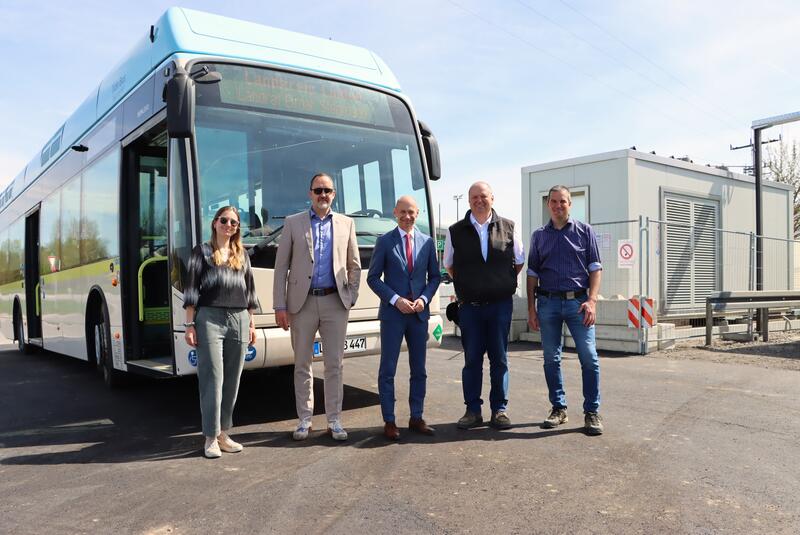
Lindau will receive four hydrogen buses (from left): Vanessa Gasser, Erik Jahn (both from the Lindau district), District Administrator Elmar Stegmann, Klaus Burkhard, and Mayor Stephan Höß. © Lindau (Lake Constance) District Office
(Germany) The district of Lindau on Lake Constance is integrating four hydrogen-powered regional buses into its public transport network. The acquisition of the vehicles is based on a public transport concept launched in December 2023. To offset the higher purchase costs compared to diesel buses, the district applied for federal funding. This enabled the financing of the four fuel cell buses, covering 80 percent of the additional costs. According to reports, the annual subsidy of €115.200 will be transferred to the bus company Burkhard-Reisebüro e. K., which is responsible for the procurement and operation of the buses on some routes. The buses will cover approximately 383.000 kilometers annually on three main routes. This corresponds to 22 percent of the total public transport service in the Lindau district. After deducting the subsidy, the district will finance this operation with approximately €2,7 million annually. The buses, manufactured by VEG Industrieservice GmbH from Malsch, are expected to be delivered in autumn 2025 and will then replace the currently used interim vehicles. The bus company has opened a mobile refueling station, supplied with green hydrogen by the technical gas manufacturer Sauerstoffwerk Friedrichshafen GmbH. Long-term plans include the construction of a large hydrogen filling station with multiple pumps for buses, trucks, and cars, as well as local hydrogen production using electricity from photovoltaic systems.
+ + + + +
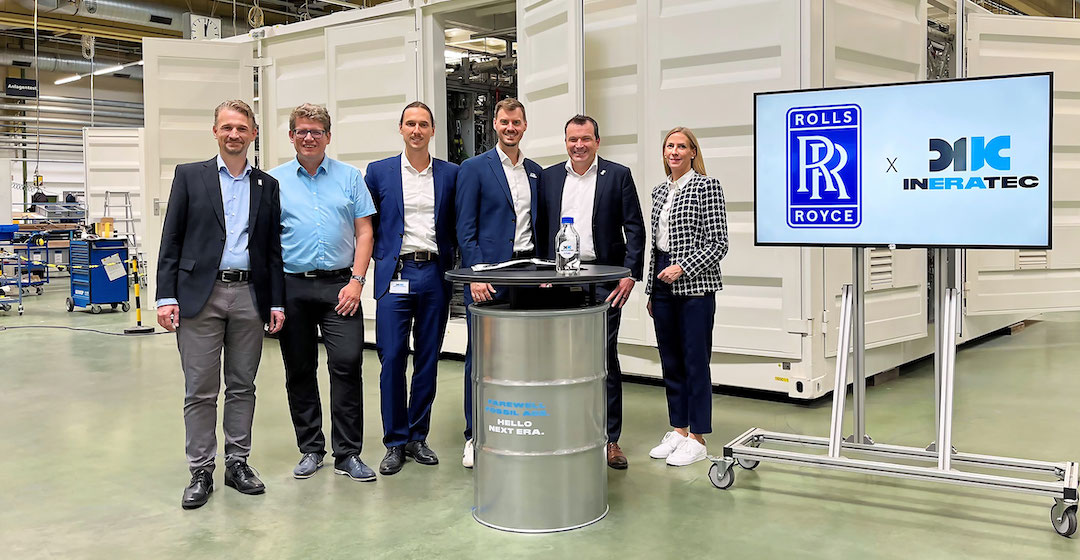
Executives agree to collaborate: Rolls-Royce and Ineratec plan to jointly use synthetic eDiesel as a replacement for fossil diesel in emergency power generators. The initial focus will be on German data centers. © MTU Solutions
(Germany) Rolls-Royce Power Systems plans to use climate-neutral eFuels from Karlsruhe-based Ineratec GmbH in the emergency power systems of data centers. Data centers are among the fastest-growing energy consumers, particularly due to the increasing use of artificial intelligence. At the same time, data centers, some of which are part of critical infrastructure, must be protected against power outages. The generators are supplied by Rolls-Royce subsidiary MTU and are approved for operation with sustainable fuels. The initial focus for the use of synthetic eDiesel made from green hydrogen and CO2 as a replacement for fossil diesel is on German data centers. Production takes place at Ineratec's "Era One" site in Frankfurt.
+ + + + +
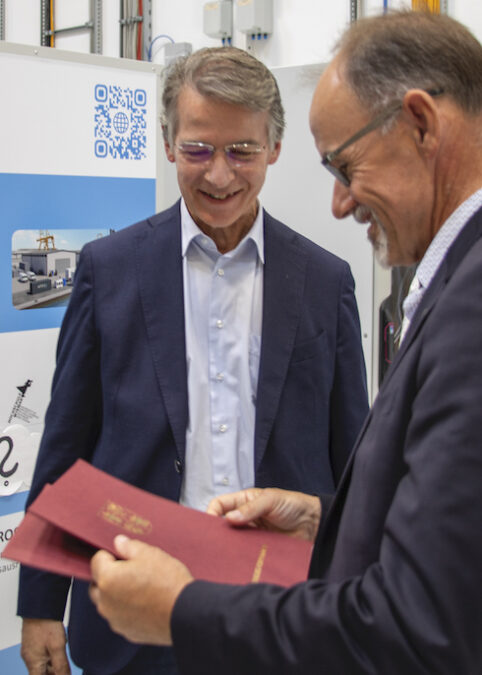
Presentation of the funding notices for the Formaport project (from right): Wolfgang Blank, Minister of Economic Affairs of Mecklenburg-Western Pomerania, and Mathias Wilichowski, Wismar University of Applied Sciences. © Wismar University of Applied Sciences / kb
(Germany) Wismar University of Applied Sciences has received approximately €1,1 million in funding to research hydrogen storage based on formate salts. The aim is to develop an economically and technologically efficient system for the safe transport of hydrogen. Formate, as a chemical energy carrier, is characterized by its environmental compatibility and, with the help of catalytic processes, enables both the safe storage and on-demand release of hydrogen, according to the university. The total budget for the collaborative project "Formaport – Development of a novel hydrogen transport medium based on formate salts" is approximately €4,4 million. Project partners include Akros Energy GmbH (lead; development of demonstration plants for storing hydrogen in formate salts) and the Leibniz Institute for Catalysis e.V. V. (Research into specific catalysts for hydrogenation and dehydrogenation processes), Wismar University of Applied Sciences (Investigation of the crystallization, solid-liquid separation and solid handling of formate and bicarbonate salts), TAB GmbH (Conception and construction of an energy-efficient crystallizer for isolating the chemical hydrogen storage from the aqueous reaction mixture).
+ + + + +
Photos
iStock / © Danil Melekhin



