

Germany: EKPO supplies fuel cells for Climate Impulse +++ Austria: Vienna buys minibuses with fuel cell drive +++ USA: Celly H2 acquires CNE +++ Canada: Nikola opens H2 filling station for heavy goods vehicles +++ Europe: Air Products plans to build a network of H2 filling stations +++ Canada: Source3 and SIDP develop hydrogen hub in British Columbia +++ Germany: Bavaria funds electrolyzers with 55 million euros +++ DISCOUNT promotion: Your advertisement on the PtX portal
A selection of PtX topics summarized at the end of the week
+ + + + +
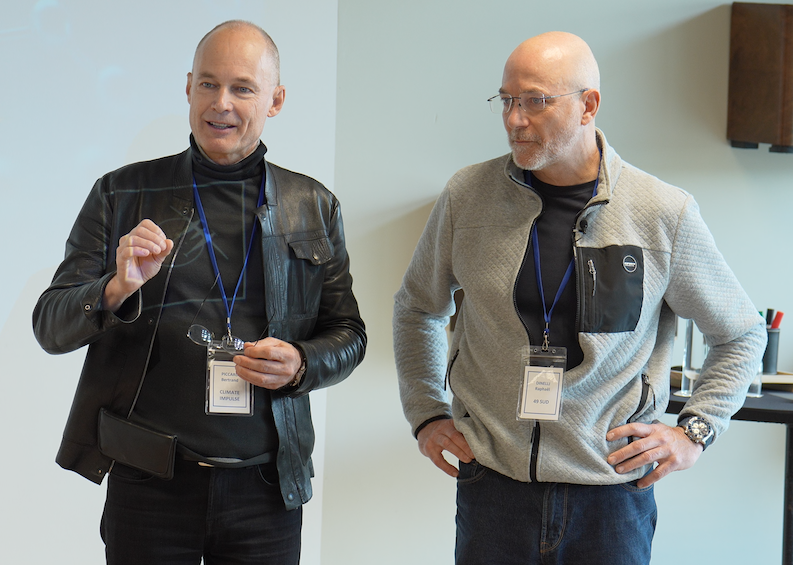
Want to fly around the world in a hydrogen plane in 2028: Bertrand Piccard (left) and Raphaël Dinelli. © Climate Impulse
(Germany) EKPO Fuel Cell Technologies GmbH will supply the fuel cell stacks for the first round-the-world flight in a hydrogen-powered aircraft. As part of the "Climate Impulse" project, announced in February, the aircraft is scheduled to fly 40.000 kilometers around the Earth without refueling. The estimated flight time is nine days. The aircraft will be powered by two 200-kilowatt electric motors, enabling a cruising speed of approximately 180 kilometers per hour. The necessary electricity will be supplied by EKPO's PEM stacks, a Franco-German joint venture between ElringKlinger and Plastic Omnium. The green hydrogen will be carried in liquid form in two tanks, each with a capacity of approximately eleven cubic meters. The French engineering firm 49 SUD is responsible for the design and manufacture of the aircraft; other project partners include Airbus and Ariane. The flight is scheduled to begin in 2028. Pilots Bertrand Piccard and Raphaël Dinelli will be at the controls. Piccard had already led the Solar Impulse project several years ago and, together with André Borschberg, circumnavigated the Earth in a solar-powered aircraft with several stopovers in 2016.
+ + + + +
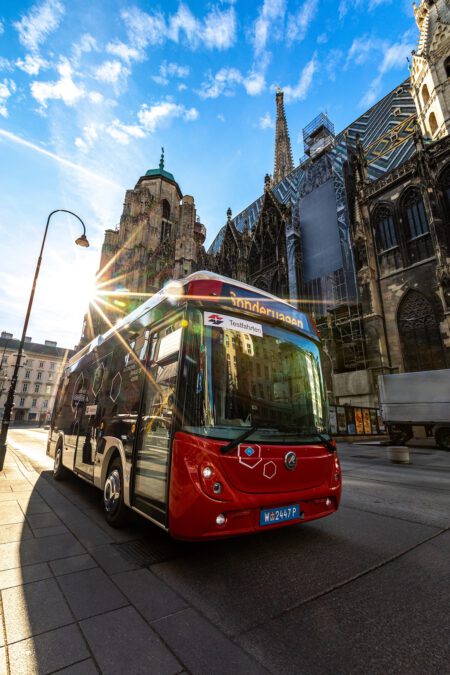
A battery-hydrogen bus from Rampini in front of St. Stephen's Cathedral in Vienna. © Wiener Linien / Manfred Helm
(Austria) The public transport operator "Wiener Linien" is acquiring battery-hydrogen buses for its local public transport network. The vehicles, manufactured by the Italian company Rampini Carlo SpA, are scheduled to replace the electric buses currently in service on two routes starting in mid-2025, as these have reached their mechanical limits. The new buses will be powered by both hydrogen and electricity. While the current buses and their successors are similar in size and appearance, the battery-hydrogen bus represents a significant technological innovation in the minibus segment. The Rampini "Hydron Range Extender" features a 230-kilowatt electric motor powered by a 170-kilowatt-hour battery. A 30-kilowatt fuel cell generates electricity while the bus is in operation, allowing it to run all day without recharging. This eliminates the need for charging infrastructure in the city center and allows the fleet for these routes to be reduced from twelve to ten buses. The new, fully air-conditioned vehicles will be refueled and charged at a hydrogen filling and charging station operated by Wien Energie and Wiener Netze. The green hydrogen will be produced locally in Vienna. The three tanks, each with a capacity of five kilograms, are located on the roof. Wiener Linien, together with the Ministry for Climate Action and the EU, is investing around twelve million euros in the purchase and maintenance of the new Rampini buses. From 2025, in addition to the new Rampini minibuses, ten pure hydrogen buses from the Portuguese manufacturer Caetano Bus will also be deployed.
+ + + + +
(USA) Celly H2 LLC, a US provider of hydrogen infrastructure solutions, has acquired Chemtec New Energies (CNE). "This acquisition is an important milestone as we further expand our portfolio in the renewable energy market," said Austin Terry, founder and CEO of Celly. The company now aims to offer "comprehensive services ranging from procurement, logistics, storage, and delivery to innovative modular refueling stations." The offering is targeted at municipalities, transit agencies, fleet owners, industrial users, refineries, ports, and other businesses. Chemtec New Energies, a division of Chemtec Energy Services LLC, provides modular infrastructure solutions for hydrogen refueling and storage.
+ + + + +
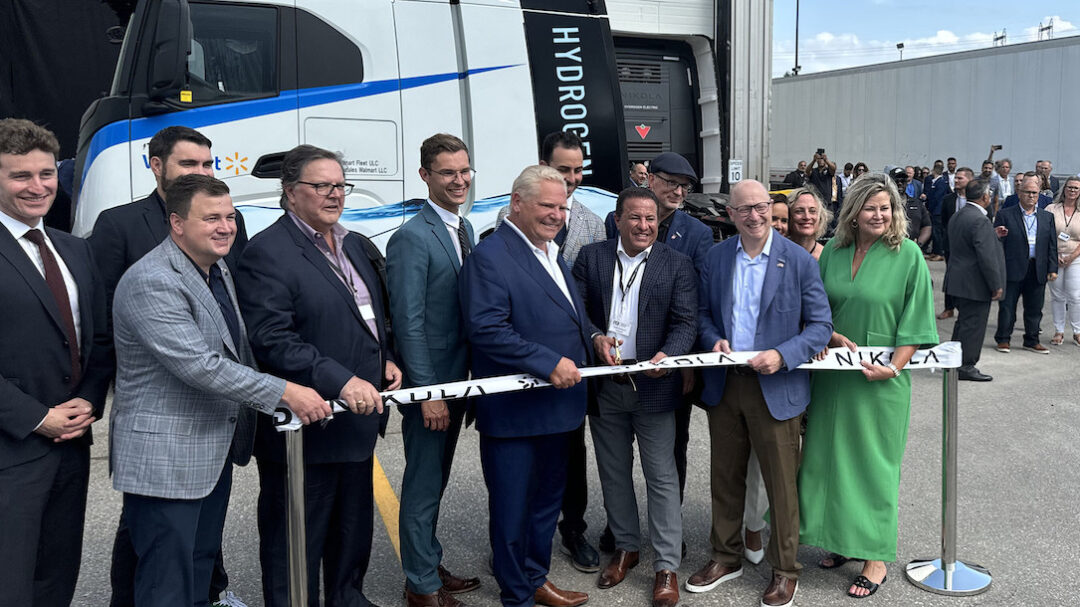
Nikola opens first H2 filling station for heavy-duty trucks in Ontario. © Nikola Corp.
(Canada) Nikola Corporation, through its HYLA brand, has opened the first commercial hydrogen refueling station for heavy-duty vehicles in Ontario, in partnership with ITD Industries Inc. Located at ITD Industries' headquarters in Etobicoke, near Highways 401, 427, and the Queen Elizabeth Highway, the station also allows for the refueling of Nikola's fuel cell trucks. "This refueling station is a significant step toward a comprehensive hydrogen infrastructure in North America," said Steve Girsky, CEO of Nikola. The station is "the first of several that ITD plans to build with Nikola across Ontario to create a hydrogen refueling corridor between Windsor and Montreal," said Philip Turi, COO of ITD Industries. Earlier this year, the first commercial hydrogen refueling station in the Canadian province of Alberta was inaugurated (as previously reported).
+ + + + +
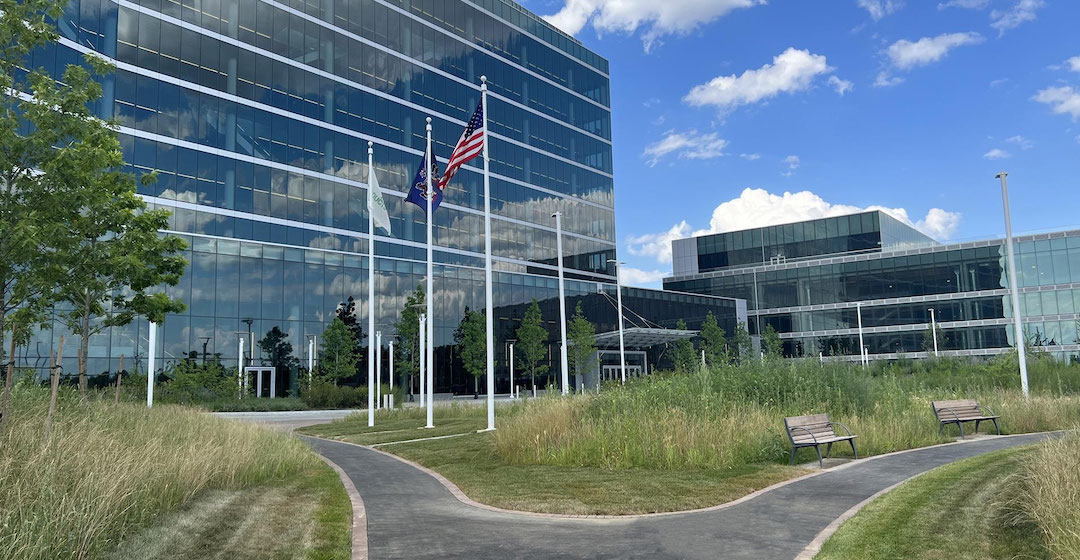
Air Products headquarters in Pennsylvania. © Air Products & Chemicals Inc.
(Europe) US industrial gas manufacturer Air Products & Chemicals Inc. has unveiled plans to build a network of permanent commercial hydrogen refueling stations (HRS). These stations will be located along key transport corridors near the Trans-European Transport Network (TEN-T) and will help connect sites across Europe. The stations will offer "improved refueling technology, multiple pressurized refueling options, and on-site liquid hydrogen storage." The HRS will be supplied with renewable hydrogen from Air Products' network. In addition, the company is building a second hydrogen liquefaction plant in Rotterdam, which—once operational—will double the total liquid hydrogen capacity in Europe. The European Commission has already granted subsidies for a number of existing and planned refueling stations. These included the Rotterdam (Netherlands) and Hürth (Germany) sites, which are currently in the commissioning phase, an HRS (High-Refueling Station) on the Volvo Group's premises in the Port of Ghent (Belgium), and another in the Port of Zeebrugge (Belgium). Air Products also received funding from the Ministry of Economic Affairs of the State of North Rhine-Westphalia to build two publicly accessible hydrogen refueling stations in Meckenheim and Duisburg. In addition to the European hydrogen refueling network, Air Products announced plans in June to establish a network of hydrogen refueling stations stretching from Northern California to Southern California in the USA, and also between Edmonton and Calgary in Alberta, Canada.
+ + + + +

The Skeena Clean Hydrogen Hub is expected to produce 50.000 tonnes of hydrogen annually. © Source3X
(Canada) Source3 Energy X Inc. and the Skeena Industrial Development Park (SIDP) plan to jointly develop a center called the "Skeena Clean Hydrogen Hub" for the production of clean hydrogen and its derivatives. The hub will be located in Terrace, British Columbia. The energy carrier will be produced using "renewable energy and other energy sources." According to the company, the center would produce "up to 50.000 tons of carbon-free hydrogen and downstream products" such as clean ammonia, e-fuels, and sustainable aviation fuels annually. Terrace is "a key hub for energy, road, and rail transportation in Pacific Canada," says Ayaz Khokhar, President and CEO of Source3X. The company, headquartered in Oakville, Ontario, Canada, is currently developing projects in British Columbia, Atlantic Canada, and Ontario.
+ + + + +
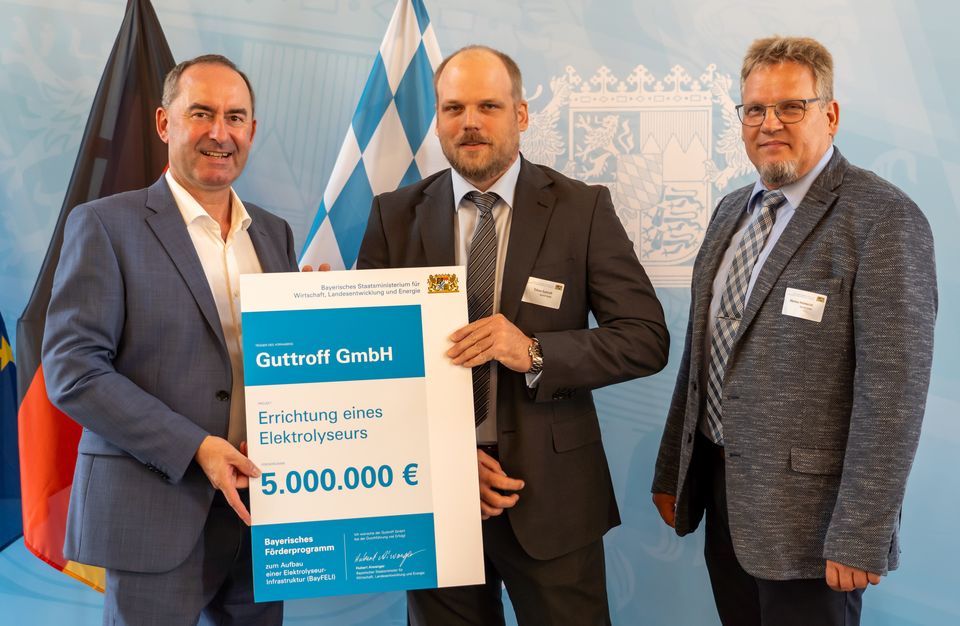
Guttroff GmbH in Dettelbach is one of eleven recipients of funding from the Bavarian electrolyzer funding program, which was presented by Bavaria's Energy Minister Hubert Aiwanger (left). © StMWi / E. Neureuther
(Germany) Bavaria is awarding approximately €55 million in funding for the installation of electrolyzers. Eleven green hydrogen production projects with capacities ranging from five to 8,5 megawatts will each receive €5 million. Recipients include N-Ergie (Nuremberg), Guttroff (Dettelbach), Nahkraft (Feuchtwangen), Energiepark Ried (Markt Indersdorf), Westfalen (Weißenhorn), Energiepark Osterhofen, Erik Walther (Uffenheim), Erneuerbare Energien Essenbach, Tyczka Hydrogen (Kösching), Maier & Korduletsch (Pöcking), and the Bayreuth municipal utility. The grants come from the Bavarian Electrolyzer Financing Program (BayFELI). The first call for proposals was oversubscribed by a factor of 3,5. The application deadline for the second call is August 9, 2024.
+ + + + +
DISCOUNT promotion: Your ADVERTISING on the PtX portal
Photos
iStock / © Danil Melekhin



