

USA: Hyundai's Xcient truck commercially available +++ Germany: LBEG approves search for salts and caverns at the Elbe estuary +++ Spain: PLOCAN leads construction of offshore electrolysis plant off the Canary Islands +++ Germany: DLR opens virtual hangar, also featuring hydrogen-powered aircraft +++ Oman: Sultanate launches third tender round for green hydrogen +++ Germany: H2APEX receives funding for further expansion of hydrogen production +++ Germany: Industry launches new initiative for hydrogen infrastructure
A selection of PtX topics summarized at the end of the week
+ + + + +

The fuel cell truck, announced last year, is now commercially available in the US market. © Hyundai Motor Company
(USA) Hyundai Motor Company unveiled its new Xcient Fuel Cell Class-8 Heavy-Duty Truck (up to 40 tons) for the US market at the Advanced Clean Transportation (ACT) Expo 2025 in Anaheim, California. The vehicle has been undergoing testing in North America since 2021 for various applications, including at the ports of Oakland and Richmond. The tractor unit features a 180-kilowatt fuel cell system and is equipped with two 90-kilowatt stacks and a 72-kilowatt-hour battery pack. According to the company, it has a range of 450 miles (725 kilometers). The ten hydrogen tanks have a combined capacity of 68 kilograms. The improved interior design includes a 12,3-inch touchscreen infotainment system with physical buttons integrated into the center console. Technically, it offers a range of driver assistance systems, such as collision avoidance, lane keeping assist, and blind spot warnings. The concept for the model, specifically developed for the North American market, was first presented at ACT Expo 2024. Since its market launch in 2020, the Xcient Fuel Cell has been in operation in 13 countries, initially being delivered to Switzerland.
+ + + + +

The "Brunsbüttel-Burg" permit area extends between the two towns of the same name, Sankt Michaelisdonn and Landscheide. © LBEG
(Germany) The Lower Saxony State Authority for Mining, Energy and Geology (LBEG) has granted BaMa Primary Renewable Energies GmbH & Co. KG permission to explore for "rock salts, potash, magnesia, and borate salts, along with salts occurring in the same deposit" in an area of approximately 82 square kilometers between Brunsbüttel and Landscheide in the south and Sankt Michaelisdonn and Burg in the north. The company sees potential in the area for the leaching of caverns for hydrogen storage. The permit, valid for two years until April 30, 2027, gives BaMa Primary Renewable Energies the fundamental right to conduct exploration. However, further measures may only be taken "after the approval of mining operating plans, for which, among other things, a separate public participation process is required," according to the LBEG, which is responsible for Schleswig-Holstein, Lower Saxony, Hamburg, and Bremen. A mining permit is the fundamental right to access a specific raw material (for example, rock salt) in a defined area. To extract salt from salt caverns, the permit to do so is required.
+ + + + +

Graphic representation of the planned offshore hydrogen production facility. © Plataforma Oceánico de Canaria (PLOCAN)
(Spain) The Plataforma Oceánico de Canaria (PLOCAN) is leading the construction of Spain's first offshore renewable hydrogen production facility off the Canary Islands. The project aims to promote the decarbonization and energy independence of the archipelago, which currently relies on fossil fuels for 95 percent of its energy needs. The renewable hydrogen plant will be installed on a marine platform located 1,5 kilometers off the coast of Gran Canaria. The system includes an electrolyzer with a production capacity of 15.000 kilograms per year, a fuel cell to convert the stored hydrogen back into electricity when needed, and batteries for energy storage. The facility will also feature a hydrogen refueling station for ships and other maritime vehicles. The initiative is part of the H2VERDE project, which is co-financed by the Canary Islands and the EU. PLOCAN is a consortium founded in 2008 by the Spanish government and the government of the Canary Islands, which operates a range of maritime infrastructures for marine research.
+ + + + +

Concept of the D150-BWB: The aircraft has a wide, flat fuselage and carries two engines on its back. © DLR (CC BY-NC-ND 3.0)
(Germany) The German Aerospace Center (DLR) has launched a virtual hangar. It currently contains seven aircraft models with ranges between 600 and 4.630 kilometers and passenger capacities of nine to 250. Some are powered by fossil or synthetic kerosene, others by hydrogen. Clicking on an aircraft reveals information such as its design features, differences from current aircraft, and existing challenges. The external structure can be rotated and viewed from all sides in a 3D model. The aircraft models are from the EXACT (Exploration of Electric Aircraft Concepts and Technologies) research project, one of the most comprehensive studies on climate-friendly and competitive aviation, according to the DLR. "The Digital Hangar is like a library for different configurations and will be continuously expanded," says Björn Nagel, head of the DLR Institute of System Architectures in Aviation. The Digital Hangar can be found on the website.
+ + + + +

Oman has received investment commitments totaling over $49 billion in two previous auction rounds. The projects would generate more than 30 gigawatts of renewable energy. © Hydrom
(Oman) The Sultanate has launched its third auction round for green hydrogen. A land block of up to 300 square kilometers is being offered in the region around the port city of Duqm. Investors are invited to submit proposals for projects with a minimum size of 100 square kilometers. Bidders will have nine months to prepare before submitting their bids, allowing sufficient time for comprehensive project planning. In addition to producing green hydrogen and its derivatives, developers could also consider selling surplus renewable energy to the national grid and benefit from competitive advantages, including access to shared infrastructure, a stable legal framework, and strategic proximity to demand centers in Europe and Asia. In two previous rounds, Oman awarded eight large-scale green hydrogen projects in Duqm and Dhofar, securing investment commitments of over $49 billion aimed at achieving a total annual production capacity of over one million tons of green hydrogen by 2030. The projects would be powered by more than 30 gigawatts of renewable energy. The Sultanate aims to establish itself as a "world-leading center for the production and export of green hydrogen" and also plans to develop a 2.000-kilometer hydrogen pipeline and a liquid hydrogen export corridor to connect the country with the Netherlands, Germany, and further into Europe ( as previously reported ). Qualified bidders will be invited to submit proposals in early 2026 and can find more information on the website of the state-owned hydrogen company Hydrogen Oman LLC (Hydrom).
+ + + + +
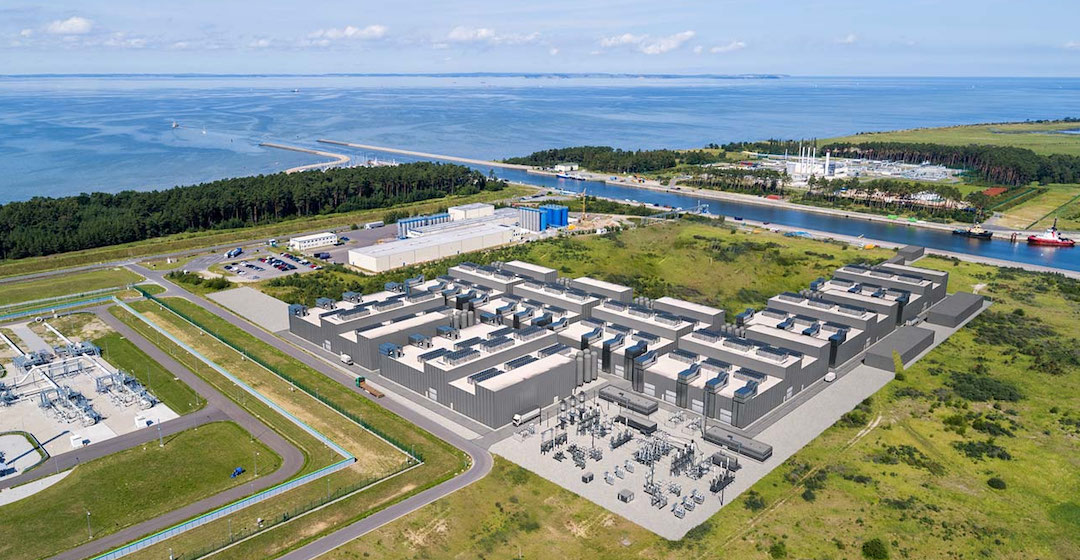
H2APEX is building a large-scale electrolysis plant with a capacity of up to 600 megawatts on the site of the former nuclear power plant in Lubmin and has now also acquired Lubminwerk GmbH from the insolvent HH2E AG. © Graphic: H2APEX
(Germany) The Luxembourg-based H2APEX Group SCA has concluded a loan agreement for €20 million with its shareholder, Active Ownership Fund SICAV SIF SCS. An investor from the Atlan Group has also provided a letter of comfort for a further €15 million. Part of the funds will be used for the acquisition of the recently acquired HH2E Lubmin Werk GmbH hydrogen project in Mecklenburg-Western Pomerania, from the Hamburg-based company HH2E (as previously reported). The plan is to build 1.000 megawatts of electrolysis capacity there. Furthermore, the development of the existing hydrogen project in Lubmin, which has been operating since 2022 (600 megawatts in its final stage), will be supported. H2APEX is also preparing a capital increase for June 2025 with targeted gross proceeds of €30 million.
+ + + + +

TransHyDE 2.0 Founding Board (from left): Mario Ragwitz (Fraunhofer Research Institution for Energy Infrastructures and Geotechnologies IEG), Friederike Eggert (Securing Energy for Europe GmbH, SEFE), Anne Bendzulla (Enertrag SE), Jimmie Langham (Clean World Hydrogen Consulting GmbH) © Enertrag / Jürgen Sendel
(Germany) An industry initiative called "TransHyDE 2.0" will launch in Berlin on May 6, 2025, with the goal of advancing European hydrogen infrastructure and derivative projects. According to the organizers, the initiative aims to provide a consulting platform for policymakers, businesses, and society as a "network along the hydrogen value chain." The focus will be on initiatives for gaseous and liquid hydrogen, derivatives such as ammonia and methanol, and energy carriers like liquid organic hydrogen carriers (LOHC) and dimethyl ether (DME). Energy supplier Enertrag SE, part of the founding consortium, also cites the development of accompanying research platforms in the areas of system analysis, standardization and safety, market and regulation, and public acceptance as further tasks. TransHyDE 2.0 will launch with twelve members from research, industry, and business, with support from the Federal Ministry for Economic Affairs and Climate Action. Contact: TransHyDE 2.0 Initiative e.V. (in formation), verein@transhyde-2-0.de.
+ + + + +
Photo above
iStock / © Danil Melekhin



