

A selection of PtX topics summarized at the end of the week
+ + + + +
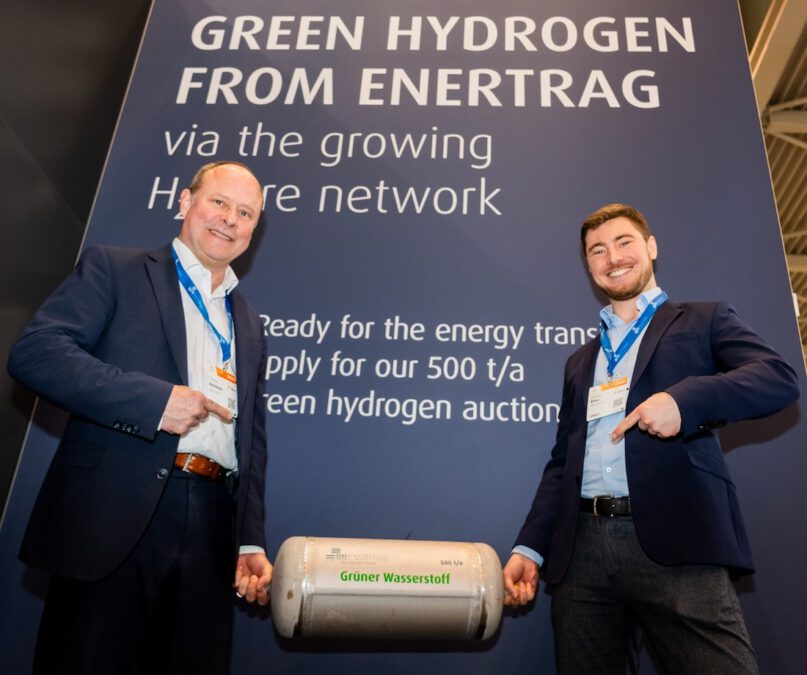
Enertrag is launching an auction for 2025 tons of green hydrogen during the “E-World 500” trade fair. © Enertrag SE
(Germany) Enertrag SE has launched an auction for 500 tons of green hydrogen. A 10-megawatt electrolysis plant is currently under construction in Osterweddingen near Magdeburg and is scheduled to go into operation at the end of 2025. The plant is projected to produce around 900 tons of green hydrogen annually. Roughly half of this is now up for auction. According to the company, the electricity for the process will come primarily from its own wind farms. "With 500 tons of hydrogen, we can produce around 5.000 tons of green steel, provide fuel for H2 buses or trucks for around five million kilometers, or produce 2.500 tons of green methanol," the company stated in a press release. "With this auction, we are sending a clear signal for the beginning of a new era in energy supply," said Thomas Barkmann, Head of H2 Sales at Enertrag. The company is developing hydrogen plants at numerous other locations along its core H2 network. This will result in the construction of two new hydrogen plants in Brandenburg and Mecklenburg-Western Pomerania, with a total electrolysis capacity of 185 megawatts. Annual yields from 2028 onwards will be a cumulative 17.000 tons. Further information about the auction can be requested by email at wasserstoff@enertrag.com.
+ + + + +
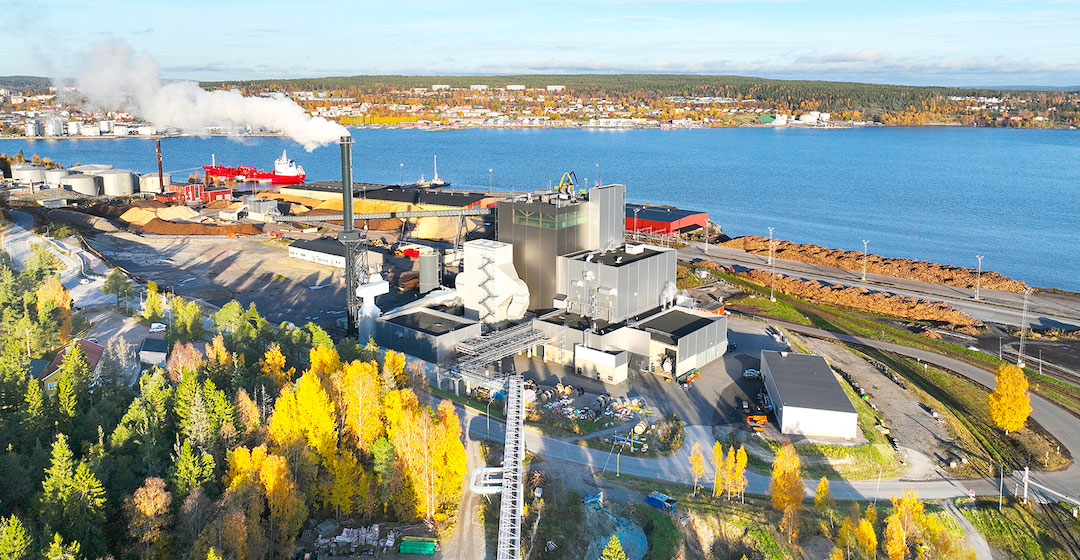
Combined heat and power plant of Övik Energi in the High Coast Innovation Park. © Övik Energi AB
(Sweden) Liquid Wind AB, a developer of eFuel plants, is set to build what it claims will be "one of the largest eFuel production plants in Europe" in close collaboration with the energy provider Övik Energi AB. The plant is designed for an annual capacity of 100.000 tons of eMethanol. It will be located in Örnsköldsvik, with production scheduled to begin in spring 2025. The company plans to develop a total of ten projects by 2027. Liquid Wind is backed by investors including Alfa Laval, Carbon Clean, Elyse Energy, HYCAP, Samsung Venture Investment, Siemens Energy, Topsoe, and Uniper. "We see strong demand for the transition to sustainable fuels," says Claes Fredriksson, CEO and founder.
+ + + + +
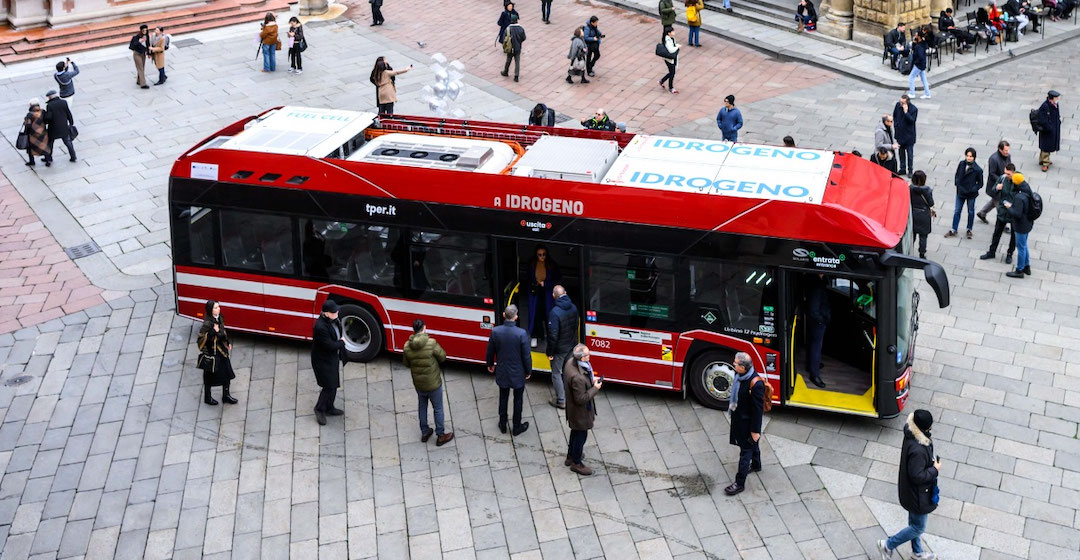
Bologna and Ferrara will receive 137 hydrogen buses of the type “Urbino 12” from Solaris, the first of which have now been delivered. © Solaris Bus & Coach sp. z oo
(Italy) Polish vehicle manufacturer Solaris Bus & Coach has announced the delivery of 37 of its 137 ordered hydrogen buses to Bologna and Ferrara in Italy. This marks the first phase of the major order placed by the public transport operator TPER in the Emilia-Romagna region at the end of 2023. The "Urbino 12" buses draw hydrogen for their 70-kilowatt fuel cells from five roof-mounted tanks with a total capacity of 37,5 kilograms. The Bologna fleet consists of two versions: 70 three-door buses for urban routes and 67 two-door buses for city and suburban routes connecting the cities with the metropolitan area.
+ + + + +
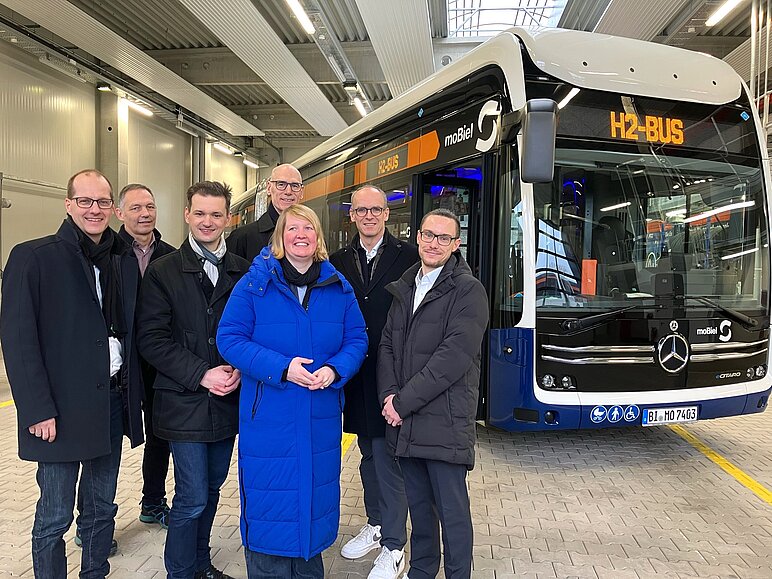
The Bielefeld public transport company has received the first “eCitaro Fuelcell” from Mercedes-Benz (from left): Arne Petersen, Ralf Schönenberg, Dominic Hallau, Rainer Müller, Wiebke Esdar, Martin Uekmann and Oliver Hoch. © Stadtwerke Bielefeld
(Germany) The Bielefeld transport company "Mobiel" has taken delivery of the first new "eCitaro Fuelcell" buses from Mercedes-Benz. The company announced that nine of the vehicles could be put into regular service in the coming weeks. The current fleet comprises 132 vehicles, 29 of which will be powered by hydrogen in the future. Four vehicles have been undergoing testing since mid-2022. The new vehicles can be powered by both hydrogen and electricity. Thanks to the larger battery, the buses generally have a greater range and can also operate fully electrically if hydrogen is unavailable. A total of 25 buses are being delivered: eight 12-meter buses and seventeen 18-meter articulated buses with 34 and 46 seats, respectively. Toyota fuel cells are installed on the roof. The hydrogen tanks, also located on the roof, can hold 25 or 30 kilograms of hydrogen. The range with battery capacities of 300 and 400 kilowatt-hours is more than 400 kilometers. The nine articulated buses that have already arrived will enter regular service after test drives starting in early March; the remaining buses will be delivered in the first half of the year. According to Mobiel, the company has invested a good ten million euros of its own funds, supplemented by 8,7 million euros in subsidies from the Federal Ministry of Transport. A hydrogen filling station and a depot with a workshop already exist at the depot; another depot with particularly powerful charging stations will follow in the coming months, and an electrolyzer is also planned.
+ + + + +
The Czech Republic is promoting the construction of electrolyzers and storage facilities. © EU Commission
(Czech Republic) A new funding program aims to accelerate the construction of electrolyzers. According to Germany Trade & Invest (GTAI), approximately €120 million is available in the first round of applications. Funding will be provided for new electrolyzers for the production of green hydrogen as well as hydrogen storage facilities. The funding rate is up to 65 percent for the development of H2 production and up to 55 percent for storage technology. The Ministry of Industry and Trade (MPO) updated the Czech Republic's hydrogen strategy in the summer of 2024. According to the strategy, around 20.000 tons of green hydrogen are to be produced annually in the country by 2030. The ramp-up of the hydrogen economy will take place in three phases. The first phase will focus on the former coal-mining regions of Karlovy Vary, Ústí nad Labem, and Moravian-Silesian Region. GTAI states that one-third of the project funds are earmarked for this phase. Applications can be submitted until June 30, 2025. The marketing agency Germany Trade and Invest – Gesellschaft für Außenwirtschaft und Standortmarketing mbH ( GTAI ) is owned by the Federal Government and assigned to the Federal Ministry for Economic Affairs and Climate Protection.
+ + + + +

Development postponed: The concept of the world's first climate-neutral, emission-free commercial aircraft with hydrogen propulsion was to be implemented by 2035, it was said in 2020. © Airbus
(France) According to media reports, the aerospace company Airbus is postponing the development of hydrogen-powered aircraft. The reason, according to NDR , citing the company, is that "the technology is progressing more slowly than expected." The aerospace group presented three concepts for hydrogen-powered commercial aircraft in 2020 ( as we reported ). At the time, Airbus CEO Guillaume Faury considered his "ZEROe" approach "extraordinarily promising" and saw it as "likely a solution for the aerospace industry and many other sectors" to achieve their climate goals. According to this plan, emission-free flight with hydrogen should have been possible by 2035.
+ + + + +
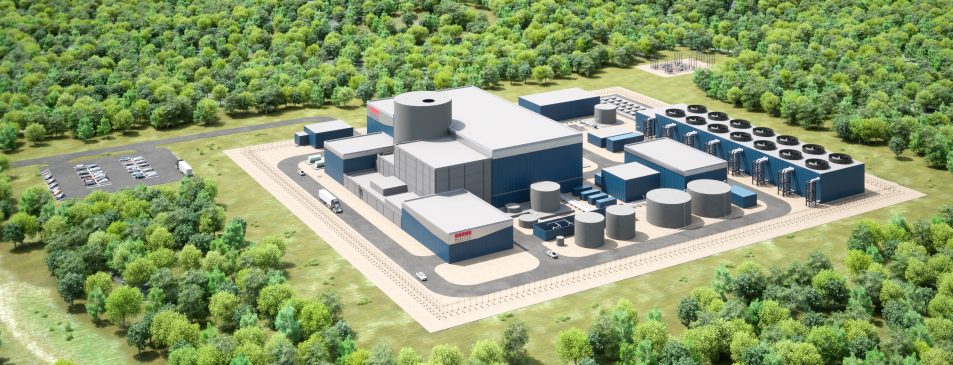
Rendering of an "SMR-300" from Holtec International (USA). In the summer of 2024, the subsidiary Holtec Britain completed the first part of an approval process (Generic Design Assessment process, GDA) for the 300-megawatt reactor type, according to which it can be built and operated in accordance with the safety, security and environmental protection standards required in Great Britain. This confirms that Holtec Britain is qualified to carry out large nuclear power projects in the United Kingdom. © Holtec International
(Great Britain) The British nuclear energy consultant Equilibrion Ltd. has been commissioned to investigate how nuclear power can be used for hydrogen production and how this low-carbon energy carrier can then be fed into the gas networks. The clients are the two gas distribution network operators Northern Gas Networks Holding Ltd. (NGN) and Wales & West Utilities (WWU), with support from the Energy Innovation Centre (EIC), a consortium of nine British energy companies. The study, called "ShyNE" (Study on Hydrogen Nuclear Energy), will identify potential new sites for nuclear power plants along the entire value chain – particularly for new small modular reactors (SMRs) and advanced modular reactors (AMRs) – and analyze infrastructure, demand centers, and financing. Furthermore, the study will examine the extent to which nuclear power plants, in combination with hydrogen production, can support the grid and thus stabilize the electricity networks.
+ + + + +
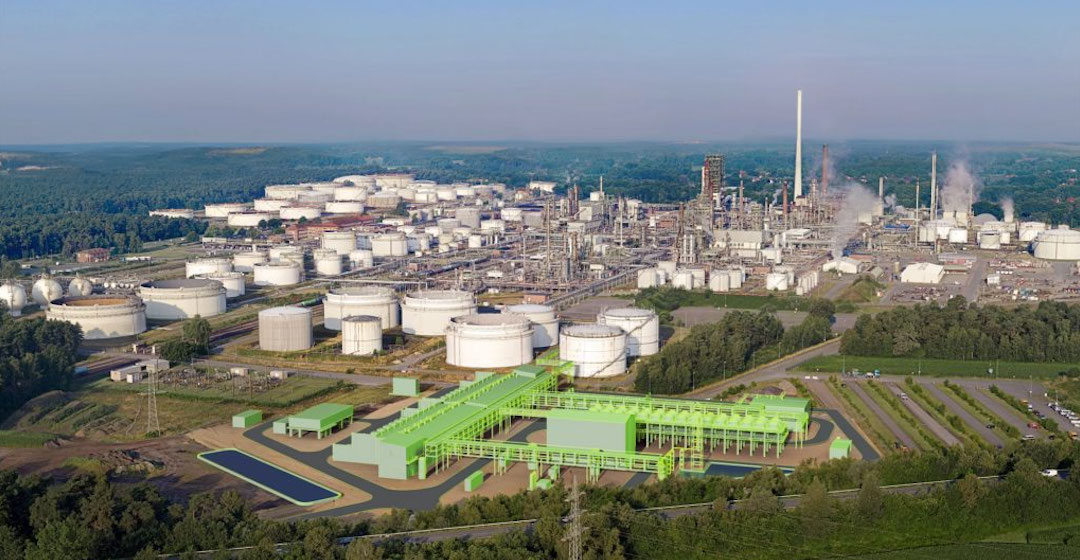
The BP refinery in Lingen is to be supplemented by a hydrogen production facility with an output of 100 megawatts. © BP Europe SE
(Germany) The US company Cummins Inc. will supply a 100-megawatt (MW) proton exchange membrane (PEM) electrolyzer system for BP's Lingen hydrogen project in northern Germany. The yield from the 20 planned "HyLYZER-1000" units is projected to be 11.000 tons of hydrogen annually, powered by offshore wind turbines. The site is slated to be connected to the hydrogen core network at a later date. The contracting partner is Cummins' Accelera business unit. The electrolyzers are manufactured in Guadalajara, Spain, where the company commissioned a 500-megawatt annual PEM plant in April of last year. BP Europe SE made the final investment decision for its 100-megawatt "Lingen Green Hydrogen" (LGH2) project at the end of last year (as previously reported). Commissioning is scheduled for 2027.
+ + + + +
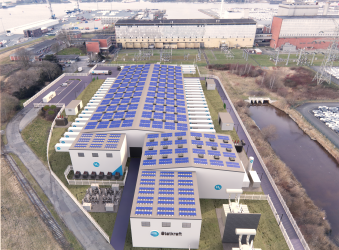
Visualization of the Statkraft site in Emden. The company wants to produce green hydrogen there. © Statkraft
( Germany) The Norwegian state-owned energy company Statkraft has commissioned the Friedrich Vorwerk Group SE to carry out detailed planning for two green hydrogen production plants in Emden. The electrolyzer, initially designed for a capacity of ten megawatts, is to be expanded to 200 megawatts (MW) in the medium term. According to Statkraft, it is currently negotiating a grant of €107 million from the EU Innovation Fund. From 2030, up to 20.000 tons of green hydrogen are to be delivered to German industry via the core network, and customers in Emden will also be able to obtain green district heating via a heat pump system. Statkraft acquired over 1.000 MW of new project rights for solar and wind power plants in 2024, the company reported at this year's "E-World Energy & Water" trade fair. This brings the company's pipeline to over 2.500 MW of secured project rights, of which 1.600 MW are for wind projects.
+ + + + +
Poland promotes hydrogen project and PV and wind power plants if the yield is used for H2 production. © EU Commission
(Poland) The state-owned development bank BGK (Bank Gospodarstwa Krajowego) is providing a total of €640 million for hydrogen projects. "The grants are aimed at companies that want to produce low-emission or emission-free hydrogen," according to a statement from the German economic development agency Germany Trade & Invest (GTAI). Companies can use the funds to finance new electrolyzers with a capacity of 20 megawatts or more, with the requested grant amount being less than €2 million per megawatt. Solar and wind power plants are also eligible for funding, as long as the electricity generated is used for hydrogen production. The funds come from the EU's recovery fund. According to its website, BGK is accepting applications until February 28, 2025. The signing of the funding commitments is expected in June. The marketing agency Germany Trade and Invest – Gesellschaft für Außenwirtschaft und Standortmarketing mbH ( GTAI ) is owned by the German federal government and is affiliated with the Federal Ministry for Economic Affairs and Climate Action.
+ + + + +
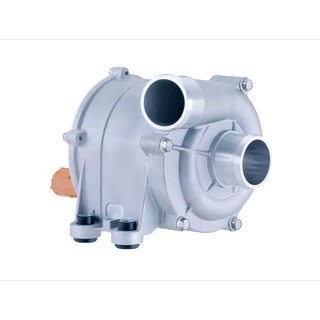
Rheinmetall supplies cooling pumps for fuel cell applications to Asia. © Rheinmetall
(Germany) The defense contractor Rheinmetall has received an order from an unnamed new customer in Asia for the delivery of a "CWA2000 high-voltage coolant pump" for use in an 800-volt fuel cell architecture. Applications include small vans, trucks, and stationary power plants. According to the company, the order volume for a "low six-figure quantity" is more than €26 million. The pump is a wet-rotor design and "virtually wear-free." Production will begin in 2027 at the plant in Hartha (Saxony) and continue until 2031. The 800-volt technology offers "greater everyday usability and twice the charging capacity compared to the 400-volt voltage level" because electrical losses are reduced. The technology allows the use of thinner cables, thus saving space, weight, and precious metals such as copper. The reduced heat loss also allows for a smaller yet more efficient cooling system. The order is "of strategic importance, as it will enable Rheinmetall to deepen its footprint in the important Asian market for components for drive systems in future electric vehicles."
+ + + + +
Photo above
iStock / © Danil Melekhin



