

Austria: Energie AG submits application for repurposing gas pipelines for hydrogen start-up network +++ USA: Nikola opens Hyla filling station in California +++ USA: Lancaster establishes hydrogen supply company +++ Germany: Output of newly installed wind turbines in 2024 slightly above previous year's level +++ UAE: Abu Dhabi to receive two hydrogen buses +++ India: Avaada plans to invest twelve billion dollars in renewables and hydrogen +++ Germany (study): Future role of baseload power plants +++ Japan: Honda builds production facility for a new fuel cell system +++ Norway: Hydrogen Pro receives financial injection from its shareholders
A selection of PtX topics summarized at the end of the week
+ + + + +

Alexander Kirchner, CTO of Energie AG and Chairman of the Supervisory Board of Netz Oberösterreich GmbH. © Energie AG / Robert Maybach
(Austria) Energie AG Oberösterreich intends to apply for the conversion of a section of the existing natural gas pipeline network operated by Netz Oberösterreich GmbH for hydrogen transport. Netz Oberösterreich GmbH, the electricity and gas network operator of Energie AG, has a pipeline network of approximately 6.000 kilometers and could make a portion of it available for hydrogen supply. The plan is to operate the twin-pipeline between Ebelsberg, southeast of Linz, and Sattledt as a dual-use pipeline. This would allow methane to continue to be transported in one section, while the other is used for transporting hydrogen. This second section could transport 50.000 cubic meters of hydrogen per hour – an amount equivalent to approximately 170 megawatts, which covers the output of the district heating plant in Linz. An amendment to the operating permit is required for the planned dual use. “By repurposing the existing pipeline between Linz and Sattledt, we are taking a first major step. This will enable Upper Austria to be one of the first regions in Austria to be supplied with hydrogen,” says Alexander Kirchner, CTO of Energie AG and Chairman of the Supervisory Board of Netz Oberösterreich GmbH.
+ + + + +
(USA) Nikola Corp. is installing another hydrogen refueling station under its own brand, Hyla. The location is Sacramento, California. The station is equipped for Class 8 vehicles (15 tons and above) and will be able to refuel 20 hydrogen trucks daily in the initial phase. It is scheduled to go into operation in January. The company aims to build a comprehensive hydrogen infrastructure in North America. There are already several Hyla refueling stations in the USA. Two additional stations were added in Canada in 2024.
+ + + + +
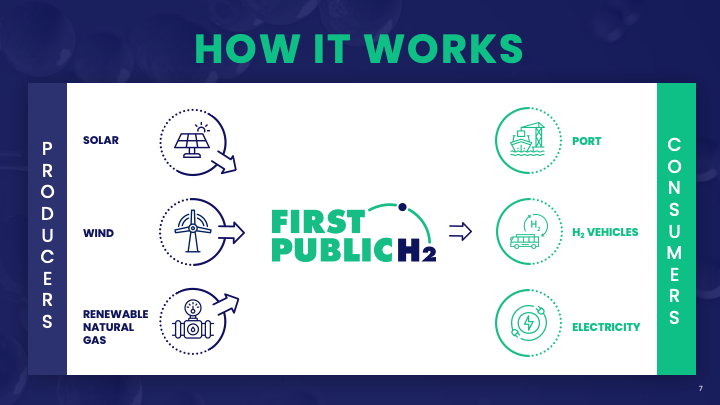
The newly founded company First Public Hydrogen is intended to bring producers of renewable hydrogen together with buyers. © City of Lancaster
(USA) The Californian city of Lancaster and the Los Angeles suburb of City of Industry, with its population of just a few hundred, are establishing a public hydrogen utility. “First Public Hydrogen” (FPH2) is intended to “promote a successful and sustainable hydrogen economy,” said R. Rex Parris, Mayor of Lancaster and Chairman of the Board. He noted a “significant” supply gap: “Large renewable hydrogen consumers are seeking seamless purchasing without project vetting, while producers face substantial upfront investments.” FPH2 will bridge this gap, foster collaboration, and accelerate the growth of the hydrogen market. The public utility will connect renewable hydrogen producers with consumers who want to harness its decarbonization potential in industries such as shipping and ports, transportation, and energy. “By creating a transparent and scalable hydrogen utility, FPH2 is positioning our region and California at the forefront of the clean energy revolution,” said Cory Moss, Mayor of City of Industry.
+ + + + +
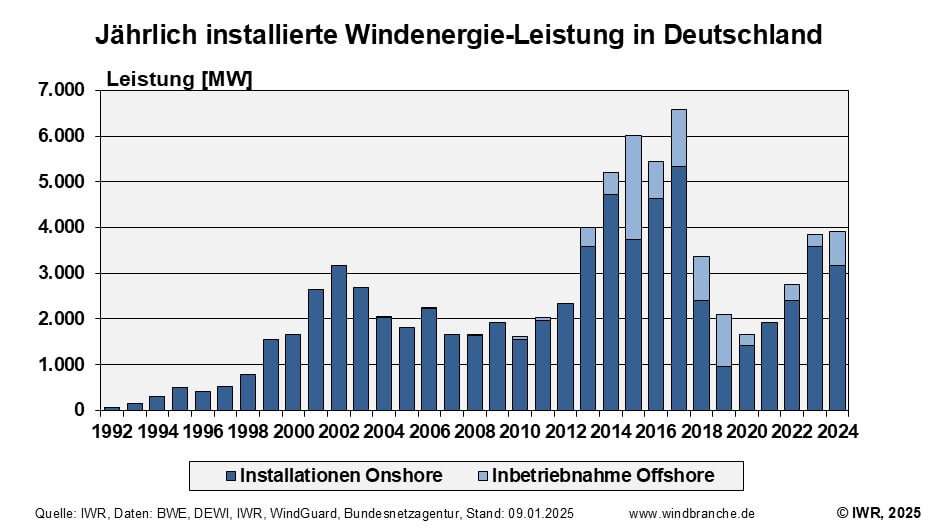
Electricity generation from wind energy in Germany reached a cumulative total of around 2024 billion kilowatt hours in 137 (2023: 142 billion kWh). © IWR
(Germany) In 2024, a total of 701 wind turbines with a capacity of 3.920 megawatts (MW) were newly commissioned (2023: 782 turbines; 3.843 MW). Onshore, 628 turbines with a capacity of 3.178 MW were installed (2023: 755 turbines; 3.585 MW) . In the offshore market segment, 73 wind turbines with a capacity of 742 MW were installed (2023: 27 turbines; 257 MW). North Rhine-Westphalia leads the way with 152 new wind turbines and a capacity of 733 MW, followed by Lower Saxony (126 turbines, 652 MW) and Schleswig-Holstein (115 turbines, 579 MW). At the bottom of the federal state ranking are Thuringia (six turbines, 30,7 MW), Saxony (five turbines, 23,9 MW), and Saarland (two turbines, 9,8 MW). This is according to an initial analysis of data from the Federal Network Agency's market master data register by the International Economic Forum for Renewable Energies (IWR) in Münster. IWR Director Norbert Allnoch sees good prospects, based on the increasing number of tenders issued by the Federal Network Agency, "for the wind market in Germany to gain significant momentum in 2025 and especially in 2026." Cumulatively, around 32.500 wind turbines with a total capacity of 74.900 MW were commissioned in Germany by the end of 2024. Because more and more older turbines are being decommissioned after the end of their operational life and replaced by new, more powerful ones, approximately 30.620 turbines with a capacity of 72.700 MW are currently in operation. According to the data, electricity generation from wind power in Germany fell from 142 billion to 137 billion kilowatt hours (kWh) in 2024, of which 111,6 billion kWh was onshore (2023: 118 billion kWh) and 25,6 billion kWh offshore (2023: approx. 24 billion kWh). Wind power was the most important source of electricity nationwide in 2024 , accounting for just over 33 percent.
+ + + + +
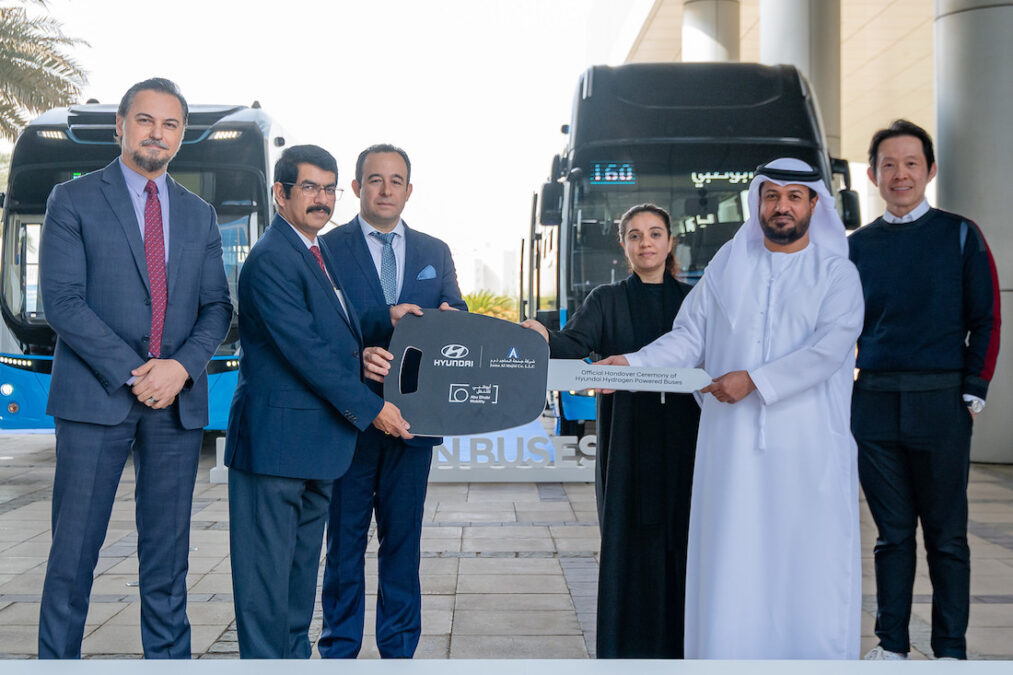
Hyundai has handed over two hydrogen buses to Abu Dhabi Mobility. © Hyundai Motor Corp.
(UAE) Abu Dhabi Mobility, the public transport company in the capital of the United Arab Emirates, has taken delivery of two Hyundai fuel cell buses for use in the city's public transport system. The delivery was handled through Hyundai dealer Juma Al Majid Co. LLC. The buses are the "Elec City FC" and the "Universe FC" models. Technical details regarding the specific configuration were not disclosed. According to Hyundai, the Elec City FC typically has a capacity of 25 seats and 36 standing places. The vehicle can travel 500 kilometers on a single tank of fuel using its 180-kilowatt fuel cell system. The Universe FC has a range of 635 kilometers. The buses were acquired as part of the Integrated Transport Centre's (Abu Dhabi Mobility) "Green Bus" program for city and regional buses, which runs until the end of 2025.
+ + + + +

Avaada plans to invest twelve billion dollars in renewables in the state of Rajasthan. © Avaada Group
(India) The Indian Avaada Group plans to transform the state of Rajasthan into a "global renewable energy hub" with investments totaling around twelve billion dollars. "Rajasthan's enormous solar and wind resources offer a unique opportunity to redefine the global renewable energy landscape," said board member Vineet Mittal at the "Rising Rajasthan 2024" event, which was attended by Indian Prime Minister Narendra Modi and Rajasthan's Chief Minister Bhajanlal Sharma. Rajasthan has a solar potential of over 142 gigawatts and more than 325 days of sunshine per year. Key investments announced at the summit include a 1,2-gigawatt pumped storage project (700 million dollars) to improve energy storage and grid stability, green hydrogen and ammonia projects, and utility-scale solar and wind power projects in Jhalawar, Kota, Barmer, and Bikaner. Avaada did not provide a timeline for when the first projects are expected to be implemented.
+ + + + +
Study: A secure energy supply is possible even without base load power plants. © ESYS
According to current political guidelines, photovoltaic systems and wind turbines are slated to be the primary sources of electricity generation in the future. This will lead to a fundamental shift in the electricity sector: from continuous, readily available production in large power plants to weather- and time-of-day-dependent production in numerous distributed, smaller facilities. A study conducted as part of the Academy project "Energy Systems of the Future" (ESYS) examines the role of baseload power plants in this transformed energy system. "This question is all the more relevant because electricity demand is expected to rise with the increasing use of heat pumps and electric vehicles." ESYS experts have analyzed whether and to what extent the use of baseload power plants in a restructured energy system is advantageous for German and European energy supply. The study also considers this type of power plant in general, examining the technologies used and their necessity. One conclusion: a secure energy supply is possible even without baseload power plants. If they were to be used, low-CO2 options would include nuclear power, geothermal energy, natural gas, and potentially nuclear fusion. Their benefits would primarily arise if they were more economical than other energy sources (mainly photovoltaics and wind power). However, "they are unlikely to reduce the overall costs of energy supply in the foreseeable future." The ESYS position paper is supported by the Leopoldina, the German Academy of Science and Engineering (acatech), and the Union of German Academies of Sciences and Humanities. The Fraunhofer Institute for Systems and Innovation Research (ISI) conducted scenario analyses.
The discussion paper “Nuclear fission, natural gas, geothermal energy, nuclear fusion: What role will baseload power plants play in the future?” is available free of charge as a PDF (55 pages).
+ + + + +
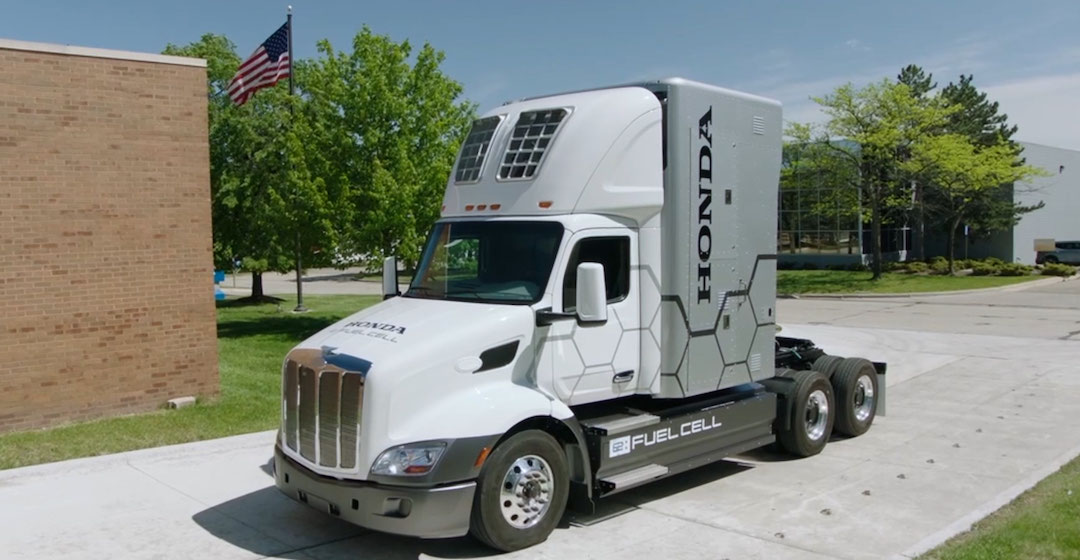
In May 2024, Honda introduced a new fuel cell truck for the North American market. © Honda Motor Co., Inc.
(Japan) Honda Motor Co., Ltd. plans to build a new plant in Japan to produce what Honda calls its "next generation fuel cell system." The plant will be located on part of the grounds and buildings of the Powertrain Unit Factory in Moka City, Tochigi Prefecture, which ceased production of automotive powertrain components in October 2024. The plant will have a capacity of 30.000 units. The investment amounts to 14,7 billion yen (90 million euros). It is scheduled to begin operations on March 31, 2028, the end of the Japanese fiscal year. Honda expects to receive a government subsidy for the construction and production of the plant from the Japanese Ministry of Economy, Trade and Industry (METI). Honda aims to achieve a five percent market share in fuel cell-powered trucks by 2030 and around 30 percent by 2040.
+ + + + +
(Norway) The Chinese company Longi Hydrogen Energy Technology Co., Ltd., a subsidiary of the solar energy group Longi Green Energy, is investing approximately 140 million Norwegian kroner (11,8 million euros) in the technology company Hydrogen Pro ASA, together with Andritz AG and Mitsubishi Heavy Industries, Ltd. Longi also announced an agreement to jointly expand the production, development, and service of electrolyzers for the European green hydrogen market. Through this collaboration, the companies aim to leverage their complementary strengths "to offer our customers compelling added value," said Zhang Haimeng, Vice President & Chief Sustainability Officer of Longi Green Energy and a member of the board of Longi Hydrogen. Synergies are expected in the areas of technology, supply chain, and customer service, and the companies are "confident that this collaboration will drive the industrialization of green hydrogen technologies."
+ + + + +
Photos
iStock / © Danil Melekhin



