
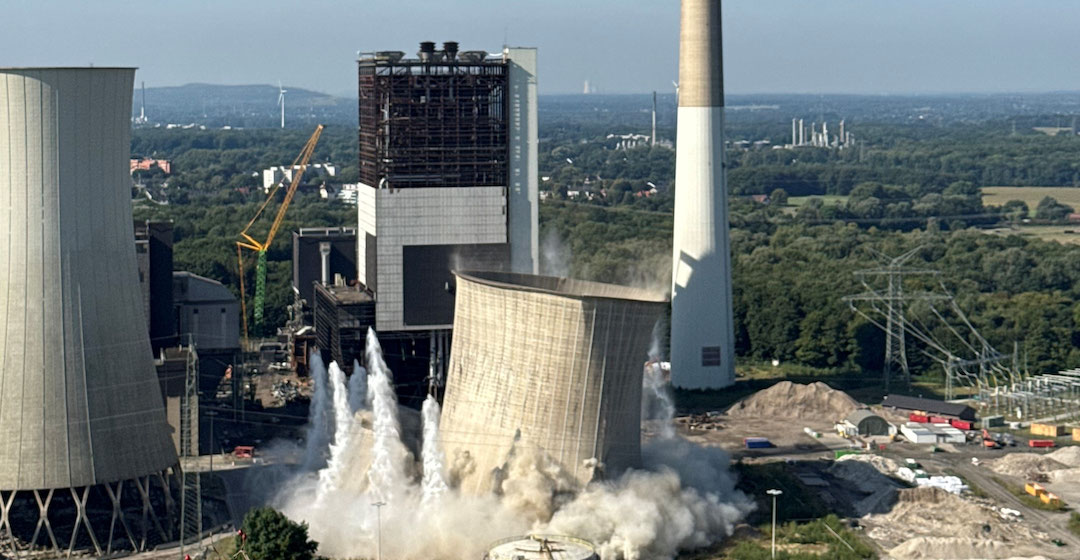
(Gelsenkirchen, Germany) – Uniper SE is continuing to clear space for a gas-fired power plant. The energy company says this plant could also be operated with hydrogen in the future (H2-ready). To this end, the 116-meter-high cooling tower of Unit F at the Gelsenkirchen-Scholven power plant was demolished using 60 kilograms of explosives. Preparatory work had been underway since April 2024.
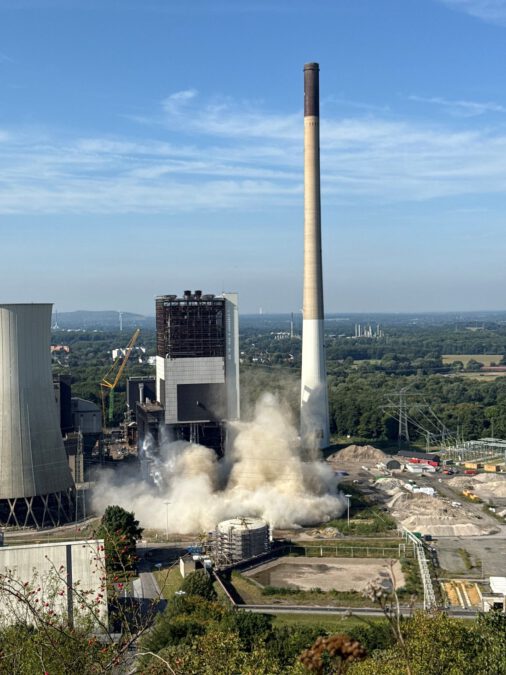
Planned demolition: Uniper plans to process the approximately 11.000 tons of concrete rubble on site and use it to backfill the excavation pits. © Uniper SE
Cooling towers G and H were demolished back in 2008. "This year, we will demolish boiler house F and the flue gas desulfurization plant. Further demolitions are planned for the site in 2026," says Martin Hein, Head of Decommissioning at Uniper. Other demolition activities at the Scholven power plant site are also "progressing well." With the space now created, "the transformation of the site continues," says Uniper's power plant manager, Lars Wiese.

Scholven hard coal-fired power plant in 2021: In 2023, the Federal Network Agency extended the systemic relevance of units B and C until March 31, 2031. © Uniper SE
In January 2020, the company presented a decommissioning plan for its coal-fired power plants in Germany, aiming to achieve savings of approximately 18 million tons of CO2 per year. The removal of the Scholven C coal-fired power plant from commercial operation was the result of the third auction held by the Federal Network Agency (BNetzA) under the 2021 law on reducing and ending coal-fired power generation. Uniper also won bids in previous auctions: With the decommissioning notices for the Heyden 4 (875 MW), Wilhelmshaven 1 (757 MW), and Scholven C (345 MW) power plants, the energy supplier is taking a total of 1.977 megawatts of coal-fired capacity off the market (as previously reported).
According to the annual report, Uniper's direct CO2 emissions in 2024 totaled 14,2 million tons (previous year: 19,4 million tons). The decrease of around 27 percent is primarily due to the discontinuation of commercial operations at the Staudinger 5 and Scholven B power plants in Germany, as well as the shutdown of the Heyden 4 and Ratcliffe power plants (two gigawatts) in the UK. For 2025, Uniper expects direct CO2 emissions to be "significantly below the previous year's level," as coal-fired power generation is expected to be lower than in 2024.
System relevance until 2031
However, in 2023, the Federal Network Agency extended the systemic relevance of the two coal-fired power plants Scholven B and C until March 31, 2031. In May 2024, the Federal Network Agency also classified the Staudinger 4 (gas) and 5 (coal) power plants, as well as the oil-fired power plant units Ingolstadt 3 and 4, as systemic relevance until March 31, 2031. The power plants will continue to serve as reserve power plants until then.
In the past fiscal year, around €200 million was invested in, among other things, hydrogen projects, battery projects, and the revitalization of the Happurg pumped-storage power plant. However, "due to the early federal election in February 2025, the framework conditions for the construction of new hydrogen-capable gas-fired power plants remain unclear," the annual report states. "In addition to the use of hydrogen in power generation, the transition to hydrogen in industry is also proving more difficult than expected."
Currently, there are still few large customers demanding green or blue hydrogen and willing to conclude corresponding supply contracts, the paper states. "The ramp-up of the hydrogen economy is progressing only slowly." This development can be observed not only in Germany, but also in Uniper's other core markets.
Photo above
The site of the former Gelsenkirchen-Scholven coal-fired power plant is being cleared to make way for a new hydrogen-capable gas-fired power plant. © Uniper SE




Trackbacks / Pingbacks