
(Bochum, Germany) – Liquid hydrogen derivatives such as methanol can be transported to Germany more cheaply via pipeline than gaseous hydrogen. A study by the Fraunhofer Institute for Energy Infrastructures and Geotechnologies IEG shows how investors can evaluate import routes to economically model the pipeline transport of liquid energy carriers and reduce planning risks.

Transport chain from green hydrogen via derivatives to the end product of high-value chemicals (HVC). © Fraunhofer IEG
The case study examines the route from Trieste, Italy, to Karlsruhe, Germany. According to the study, transporting hydrogen gas in a repurposed pipeline with a length of nearly 700 kilometers costs €3,90 per megawatt-hour, while in a newly constructed pipeline, the cost is €11,40. Liquid derivatives could be transported for €0,40 and €1,90 per megawatt-hour, respectively. The model developed for this study, "HyTROM+," simulates the transport of liquid hydrogen derivatives such as methanol, Fischer-Tropsch crude oil, or kerosene via pipeline and compares this to the pipeline transport of gaseous hydrogen and CO2. HyTROM+ also demonstrates that reusing existing oil and gas pipelines for liquid energy carriers significantly reduces investment costs, the study concludes.
Economic import routes
“Our model can provide a reliable basis for decision-making for policymakers and pipeline operators,” says lead author Natalia Pieton of Fraunhofer IEG. It is now “easier to determine which energy carriers and import routes are technically feasible and economically robust.” Liquid hydrogen derivatives are a real option for importing energy molecules, “because they are easy to transport and store.”
Transporting hydrogen gas only makes sense where it is needed directly as a raw material. In sectors such as refining, chemicals, and heavy transport, derivatives could be a more cost-effective starting point for value creation. However, this could also mean that potential value creation is outsourced to countries with cheap renewable electricity for hydrogen production and further processing into derivatives.
Transport across difficult terrain over the Alps
The Alpine corridor under investigation serves as a stress test: if liquid derivatives can be transported cost-effectively even in difficult terrain, this applies all the more to flatter regions. The results can be applied to other import routes. Further investigations into delivery costs, including transport and production costs, are the necessary next step.
Fraunhofer IEG developed the HyTROM+ model based on the HyTROM (Hydrogen Transport Route Optimization) model of Fraunhofer ISI, together with the Karlsruhe Institute of Technology (KIT), ETH Zurich, the Technical University of Denmark (DTU) and Fraunhofer CINES.
The results of the study “Transporting the future: A methodology and case study for pipeline imports of hydrogen derivatives to Germany” have been published in the journal “Energy Strategy Reviews” and are available as a PDF (26 pages).
Photo above
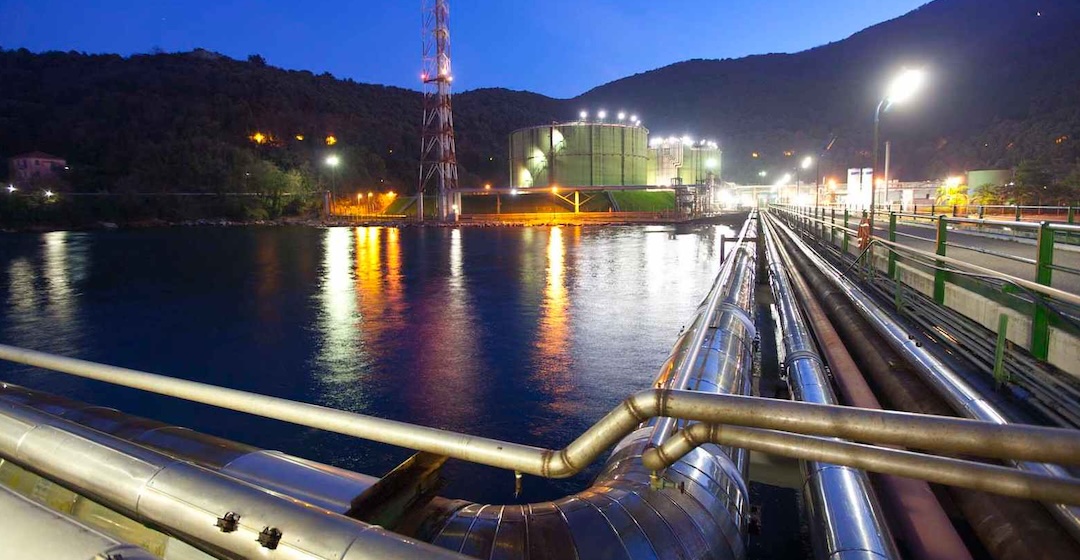
Transporting liquid hydrogen derivatives by pipeline from Trieste across the Alps to Karlsruhe is ten times cheaper than transporting gas. © Snam SA



