
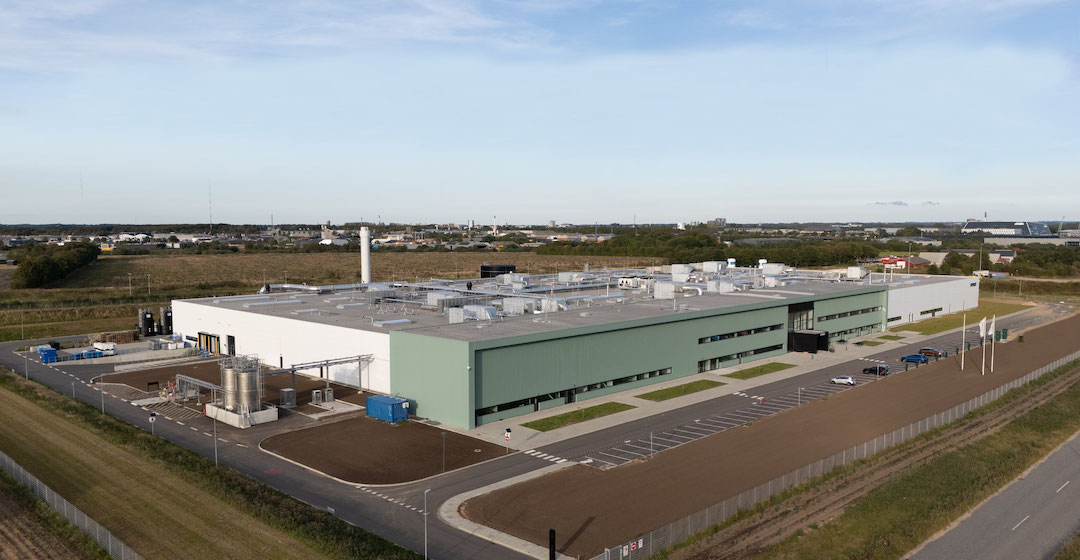
(Herning, Denmark) – The Danish technology and chemical company Topsøe A/S has inaugurated its production facility for solid oxide fuel cells (SOEC; Solid Oxide Electrolysis) in Herning. The annual capacity, covering an area of 23.000 square meters, is 500 megawatts and is scalable if required.
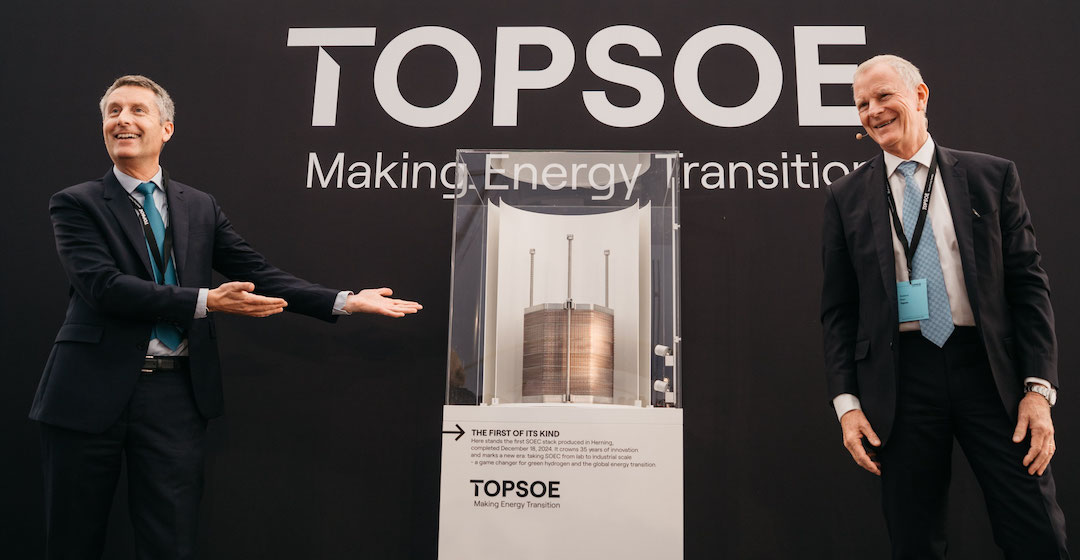
Board member Jakob Topsøe and CEO Roeland Baan. © Topsøe A/S
The factory is the company's "largest single investment to date" and is being supported with €94 million from the EU Innovation Fund. Ministers, customers, business partners, and representatives from various organizations attended the inauguration. Initial plans for the construction were announced back in 2022. At that time, Topsøe announced that it had already pre-sold 500 megawatts of capacity.
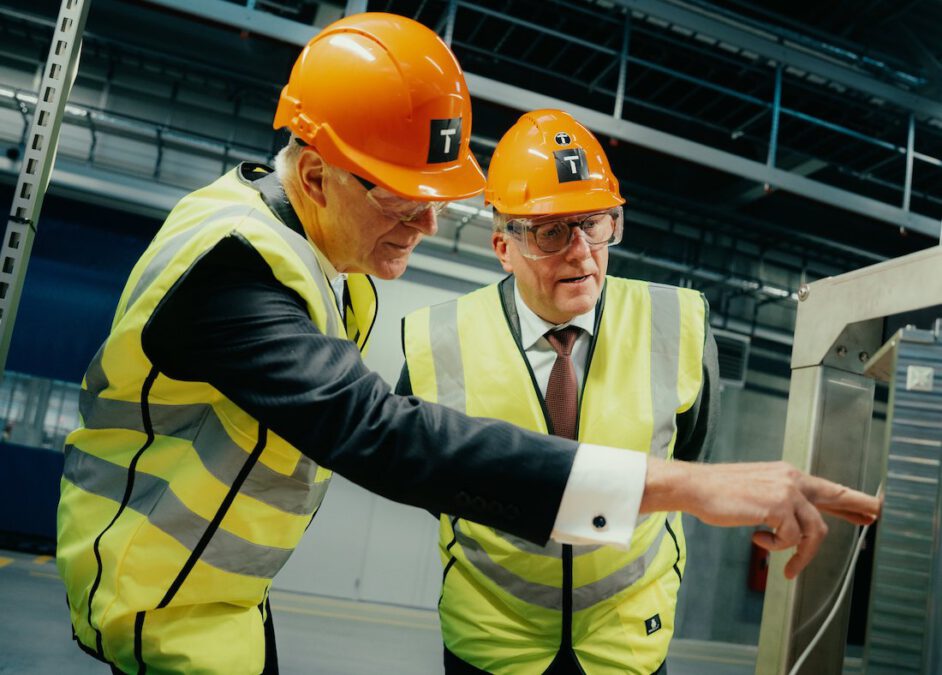
The inauguration was attended by ministers, customers, business partners, and organizations (from left): Topsøe CEO Roeland Baan with Danish Minister of Industry and Trade Morten Bødskov. © Topsøe A/S
The SOEC stacks are used to produce green hydrogen, which can be converted into ammonia and methanol. According to Topsøe, their high-temperature electrolyzers produce more hydrogen per unit than alkaline or PEM technologies and achieve an efficiency that is approximately 20 percent higher, which can be increased to 30 percent through steam integration. While temperatures of 600 to 1.000 degrees Celsius are required, the input of thermal energy can reduce the electricity demand.

Forestal's CFO Alberto López Pampín (second from left) and Topsøe's CCO Power-to-X, Sundus Cordelia Ramli (second from right), have signed an agreement for the supply of SOEC electrolyzer technology for an eMethanol project in Galicia. © Topsøe A/S
Just days before the factory's inauguration, Topsøe announced an agreement with Forestal del Atlántico SA, under which the company will supply SOEC technology from Herning for the "Triskelion" e-methanol project in Mugardos, Galicia, Spain. The project is designed for a capacity of 156 tons of e-methanol per day (57.000 tons per year). The production process will capture 78.000 tons of CO2 annually from a combined heat and power plant. According to previous statements, the electricity for electrolysis will come from a wind farm in the immediate vicinity of the project, secured by power purchase agreements (PPAs). The agreement also includes a ten-year service contract. In 2023, the plant received a grant of €49 million from the European Union's Emissions Trading System's Innovation Fund.
The produced eMethanol is intended for applications in the shipping and chemical industries, such as formaldehyde and adhesives. Forestal also plans to use the energy carrier itself, for example, in the adhesive production for its wood fiberboards, in order to replace gray methanol with green methanol from 2028 onwards. The final investment decision for Triskelion is targeted for the second quarter of 2026, with commissioning planned for 2028.
Photo above
Topsøe has opened Europe's largest factory for solid oxide fuel cells in Herning, Denmark. © Topsøe A/S



