

(Dortmund, Germany) – Dortmund-based long-distance pipeline operator Thyssengas GmbH is entering the preliminary planning phase for the construction of pipelines for the planned hydrogen core network. The Federal Network Agency (BNetzA) approved the nationwide network in October, with a total length of 9.040 kilometers. Approximately 60 percent of this will be converted from natural gas to hydrogen, and 40 percent will be newly installed. This is "the starting point for the development of a nationwide hydrogen infrastructure," said agency head Klaus Müller at the presentation.

“There must be no stall now” (from left): Arne Dammer (Head of Strategy and Innovation), Thomas Gößmann (CEO) © Thyssengas GmbH / Kloubert
"The confirmation of the hydrogen core network is a milestone for Thyssengas and all players along the H2 value chain," says Thomas Gößmann, CEO. Thyssengas' share is reportedly 1.100 kilometers. There are around 35 new construction and conversion projects in North Rhine-Westphalia. This will connect both the major industrial centers and medium-sized companies in Münsterland, the Ruhr area and the Rhineland. Thyssengas operates a gas network around 4.400 kilometers long, mostly in North Rhine-Westphalia, but also individual lines in Lower Saxony. This supplies distribution network operators as well as industrial companies and power plants.
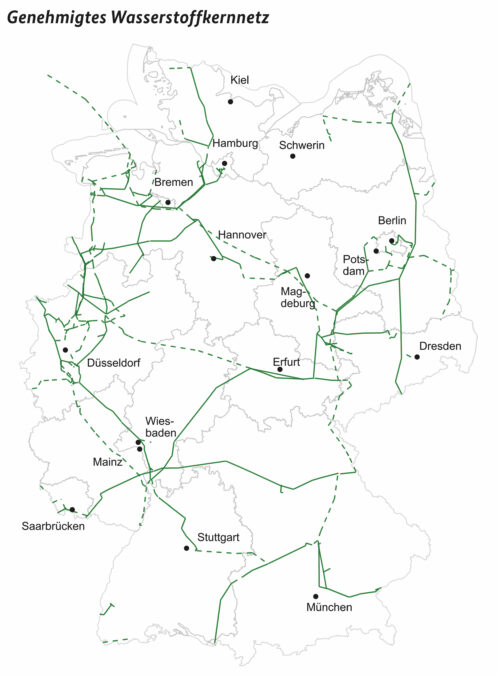
In October, the Federal Network Agency approved the German hydrogen core network with a good 9.000 kilometers of pipelines, mainly by converting existing natural gas pipelines. Dashed lines: new construction. © Federal Network Agency
"Our most time-critical H2 projects are now entering the necessary planning and approval processes," says Gößmann. For projects whose planned commissioning is still further in the future and whose implementation path still needs to be specified, Thyssengas is working closely with potential H2 customers, politicians and authorities. The aim is to "jointly make these projects ready for the market in the further network development process."
"We are currently transforming our energy system and creating a completely new energy market for hydrogen," says Arne Dammer, Head of Strategy and Innovation at Thyssengas. As a result, there are currently "still some uncertainties" with regard to the specific design. "We can therefore only proceed step by step and all players must be prepared to shape this phase proactively." In order to push ahead with the hydrogen ramp-up, three factors in particular are important, according to the group:
- The industry's previously non-binding declarations of intent on future hydrogen demand must soon be translated into binding contracts.
- Future grid connections should already be taken into account during the preparations in order to later connect regional hydrogen customers without major adjustments.
- The further distribution of hydrogen from the core network to the area must be planned in cooperation with the local distribution network operators.
"We, the long-distance network operators, can provide the transport infrastructure, but for the ramp-up, network construction and market development, we still need "political support, courage and pragmatism as well as the cooperation of all players," says Thomas Gößmann. "In the interests of the business location," there must be no stalling," said the CEO, with a view to the upcoming elections for a new federal government.
Photo above
Dortmund-based Thyssengas GmbH begins the planning and approval procedures for its share in the hydrogen core network. © Thyssengas GmbH / Schaper



