
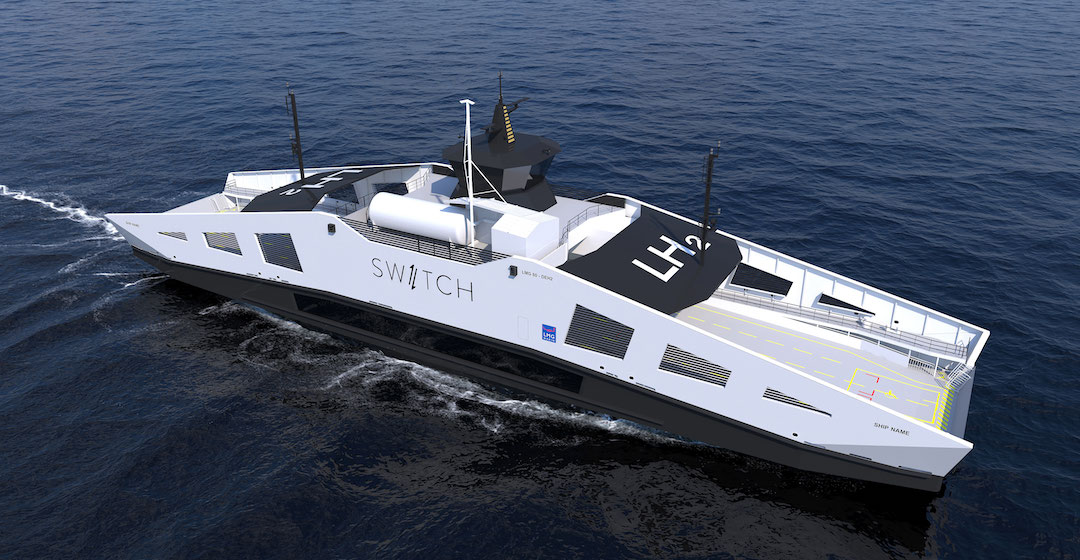
(San Francisco / USA) – US shipping company Switch Maritime LLC plans to develop a liquid hydrogen-powered ferry for 300 passengers and 80 vehicles. The so-called RoPax (Roll on/Roll off) class vessel is designed to quickly transfer passengers, vehicles, or cargo without lengthy port stays ("docking – unloading – departing"). The combined carrier is being developed in cooperation with LH2 Shipping and the Norwegian company LMG Marine AS.

Since July, the passenger ferry "Sea Change", which runs on gaseous hydrogen (GH2), has been commuting in San Francisco Bay. © Switch Maritime LLC
Switch has already proven that marine hydrogen propulsion systems work well. Just a few months ago, Switch's first hydrogen-powered vessel began public passenger service as part of the San Francisco Bay Ferry System. The 21-meter catamaran " MV Sea Change " has been transporting up to 75 passengers three days a week since July between Pier 41 in the harbor and the Downtown ferry terminal, located about 20 minutes away.
The 600 kilowatt (kW) electric motor (from BAE Systems) is powered by 360 kW fuel cells (Cummins Inc.) with 246 kilograms of gaseous hydrogen (GH2). The range is 300 nautical miles (555 kilometers), the speed is 20 knots. The tanks (Hexagon Purus) are filled once a week with a mobile GH2 trailer. It takes about two hours to transfer 150 kilograms. When operations are expanded to seven days a week in the coming months, the Sea Change will need to refuel twice a week.
Another H2 ship for San Francisco in the works
"Our first H2 vessel was the result of years of close collaboration with the U.S. Coast Guard, demonstrating the feasibility and safety of hydrogen refueling," says Pace Ralli, founder and CEO of Switch. They are currently working on a 25-knot, 150-passenger catamaran, also built for the SF Bay Ferry Service, which is scheduled to be unveiled in the first quarter of 2025. The H2 gas storage and fuel cell equipment are identical to the Sea Change technology.

The first direct mobile refueling of the Sea Change by a truck took place in November 2021 for test runs under the supervision of the US Coast Guard (USCG). © Switch Marine
In general, hydrogen can meet requirements for long ranges and performance due to its high energy density, says the company. In addition, it simplifies the emission-free operation of ships: no fixed charging infrastructure on land is required and refueling takes place via truck-to-ship or ship-to-ship processes.
Compressed GH2 is well suited for small to medium-sized ships. However, as the size and energy requirements increase, cryogenic, i.e. ultra-cooled liquid hydrogen (LH2) is the preferred solution. Similar to liquefied natural gas (LNG), cryogenic LH2 enables faster refueling speeds for large quantities.
RoPax ferry with liquid hydrogen
That is why the new RoPax ferry will also be powered by LH2. The design has already been certified by the Norwegian company "Det Norske Veritas German Lloyd" (DNV GL). The LH2 refueling is carried out according to the same international safety code that also applies to the cryogenic LNG refueling of ships in the USA, "so we can rely on it," says Pace Ralli. However, there is "still a lot to do to meet the requirements of the US Coast Guard."
In future, the LH2 from the cryogenic storage tanks will be vaporized on board and used in the PEM fuel cells to generate electricity for the electric motors. As with the GH2 fast ferries, the ship's only emissions are pure water vapor. The ferry will have an operating speed of 14 knots and in normal operation will only be refueled once a week with 3.000 kilograms by trailer without any onshore charging infrastructure.

The car ferry MF Hydra has been running on liquid hydrogen without emissions and disruptions since it began operations in March 2023. © Norled AS
The Norwegian " MF Hydra, " also co-developed by LMG Marine AS, serves as a reference. Owned by the shipping company Norled AS, it commenced commercial operations in March 2023. The ferry can carry 80 cars and ten trucks, and also accommodates approximately 300 passengers and crew members. The Scania engine delivers up to 553 kilowatts (750 hp), enabling a speed of nine knots.
The four-ton LH2 tank (about the size of a 40-foot container) is located on the upper deck of the Hydra and is filled every two weeks by LH2 truck. The green hydrogen is supplied by the industrial gas manufacturer Linde plc. The Norwegian ferry has been refueled about 50 times so far and - apart from planned maintenance work - has never been out of service.
Photo above
Rendering of the future RoPax ferry, which will be powered by liquid hydrogen. The Norwegian LH2 ferry MS Hydra serves as a reference. © Switch Maritime LLC



