

(Jülich / Germany) – Solar and wind power will be the main energy sources in Europe by 2050. Nuclear power will only play a role if investment costs fall significantly. Global hydrogen imports will become more important if the expansion of renewables and grid capacity is slow – or if import prices of less than three euros per kilogram are expected in the short term.
Increase the expansion of wind power and PV
These are the results of a study recently presented by the Jülich Systems Analysis team at the Jülich Research Center. The study shows how European countries can best use their potential to implement the agreed "European Green Deal". According to the concept presented by the EU Commission at the end of 2019, net greenhouse gas emissions in the European Union are to be reduced to zero by 2050.
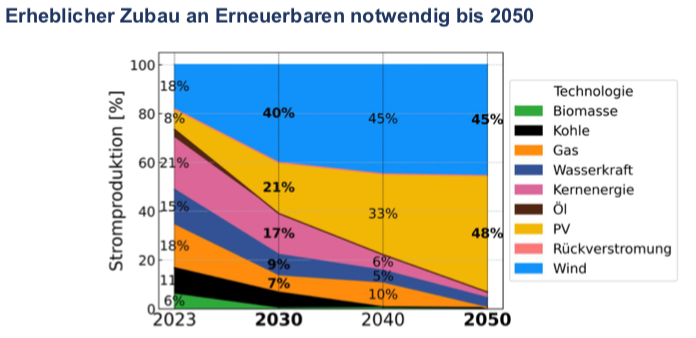
By 2030, wind power and photovoltaics will be the largest electricity producers in Europe, with a share of around 60 percent. The goal is to build a capacity of 2050 GW for solar power and 3.000 GW for wind power by 1.700. Coal and gas will then no longer be needed for electricity supply. 44 percent of electricity generation will be needed for hydrogen production. © Jülich System Analysis
Wind power and photovoltaic systems will be the main sources of European energy supply in the future. In 2030, their share will reach 60 percent, and in 2050, over 90 percent. The expansion of renewable energies is "essential" and must be increased "by four to five times" compared to the current expansion rate: for PV from the current 23 gigawatts (GW) per year to 115 GW per year, and for wind, an increase from 14 GW to 57 GW per year is required. "The potential is sufficient for self-sufficiency," say the authors. "Slow expansion of renewables would significantly increase dependence on global imports."
Nuclear power plants are also being discussed as an option. However, analyses have shown that these are not competitive with photovoltaics and wind power - even taking into account storage and increased transport costs - as long as the real investment costs of nuclear power plants are not less than 6.600 euros per kilowatt of installed capacity. For example, at Hinkley Point C (Great Britain) it is 17.500 euros, at Flamanville-3 (France) around 10.875 euros and at Olkiluoto 3 (Finland) around 6.875 euros per kilowatt.
"Hydrogen will become essential"
By looking at the electricity, gas and hydrogen infrastructure regionally, including the conversion of existing gas networks and storage facilities to hydrogen, the need for network expansion is estimated at 800 gigawatts for electricity and 1.800 gigawatts for hydrogen. Energy transport is increasingly taking place from northern and southern Europe towards Germany. This is "sensible and feasible" for reasons of cost and security of supply. At the same time, northern and southern Europe are creating new markets for themselves, which will reach hydrogen export volumes of 2050 billion euros in 100.
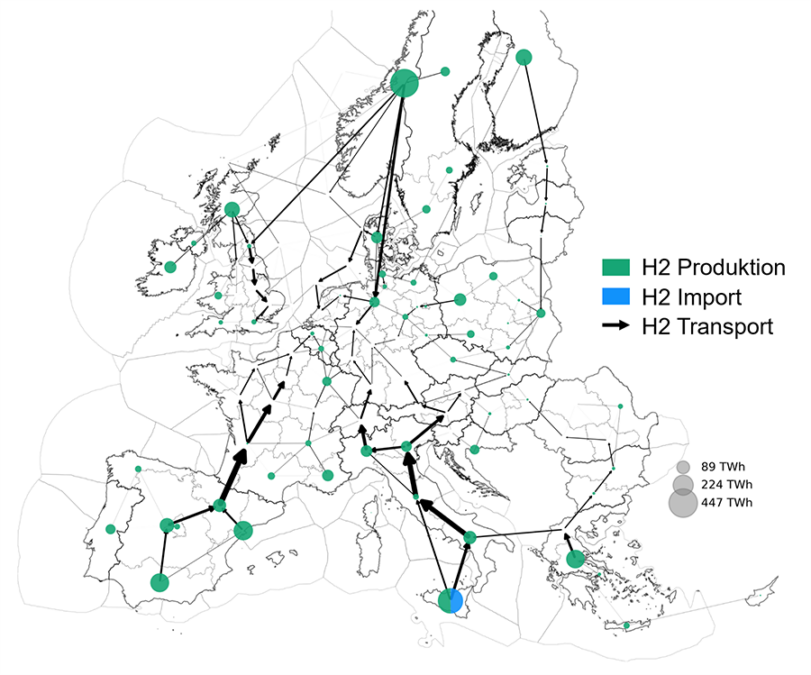
In 2050, European hydrogen production will be competitive. Germany would then be the largest hydrogen importer, Norway, Spain, Italy and Greece would be the largest suppliers. © Jülich System Analysis
The Jülich researchers recognize a "significantly higher hydrogen demand than in previous studies". While the chemical industry's demand is estimated to be around 42 megatons per year in 2050, the air and shipping traffic - among other things for the use of green fuels - will lead to a Europe-wide increase of 30 megatons per year. In Germany, this will increase hydrogen demand by half.
In theory, Europe has the option of ensuring its own cost-efficient supply without having to rely on imports from other countries. "European hydrogen production is competitive up to an import price of 3,20 euros per kilogram in 2030" - as long as the expansion of renewable energies goes according to plan. "Otherwise, the import of green hydrogen or its products will be necessary." In 2050, the world market price must be 2,20 euros per kilogram for European hydrogen to be competitive.
Germany is currently a hydrogen importer
Of all European countries, Germany will have the greatest demand for electricity and hydrogen: eleven percent of total electricity demand and 21 percent of total hydrogen demand. Germany will import 35 percent of its electricity demand and 80 percent of its hydrogen demand, which will require the expansion of additional capacities of 90 gigawatts for electricity and 200 gigawatts for hydrogen. The analysis names Spain, Norway, Italy and Greece as the most important hydrogen exporters.
Average hydrogen production costs within Germany can be estimated at around three euros per kilogram for the year 2050. In order to ensure seasonal storage and thus energy supply, all salt caverns currently used for natural gas storage must be converted to hydrogen storage. In addition, 80 new caverns are to be built in Germany in order to be prepared for dark periods that occur across large areas of Europe.
Reconversion plays only a minor role
In contrast to the results of other studies, however, hydrogen regeneration only plays a "minor role as long as all countries are increasingly expanding renewables". To ensure security of supply in the event of large-scale blackouts or insufficient expansion rates of renewables in Europe, up to 93 gigawatts of regeneration capacity may be necessary in Germany. Across Europe, the construction of more than 50 terawatt hours of additional storage capacity is necessary, which corresponds to the construction of around 200 salt caverns.
The study "European Energy Transition: Germany at the Heart of Europe" will be published at the end of the year. The presentation of the key findings (16 pages) and detailed results (29 pages) are available free of charge as PDFs.
Photo above
Study: European hydrogen production is competitive up to an import price of 3,20 euros per kilogram in 2030 - as long as the expansion of renewable energies goes according to plan. The analysis names Spain, Norway, Italy and Greece as the most important hydrogen exporters. © European Union



