

(Berlin, Germany) – A central hydrogen hub connected to the future core hydrogen network could serve as a "cost-efficient and future-proof solution for hydrogen supply." Such a hub could distribute the energy carrier to filling stations and centrally manage the processes for its purification, thus "significantly increasing economic feasibility and efficiency." This is the conclusion of a study published at the end of last year, jointly conducted by the German National Organisation for Hydrogen and Fuel Cell Technology (NOW GmbH) and the German Energy Agency (Dena). The study compares the technological and regulatory requirements and projected costs of various connection options in 2030.
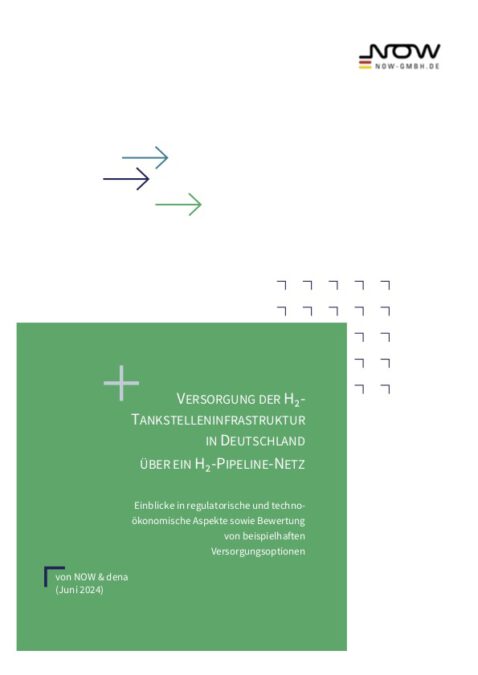
Dena and Now GmbH investigated the possibilities of supplying filling stations with hydrogen via pipeline. © Now GmbH
Four supply options were analyzed for technical feasibility and economic evaluation: the direct connection of a hydrogen filling station to the H2 core network, the use of an H2 hub on the core network, the connection to the H2 distribution network and the use of an H2 hub on the distribution network. "The results of the study confirm the central role that the hydrogen core network can play in supplying future hydrogen filling stations," says Alina Hain, COO of NOW GmbH. According to this, hydrogen hubs on the core network, integrated infrastructure planning and the further technological development of hydrogen processing "could ensure the security of supply to filling stations in the future, even when there is high demand, and at the same time reduce the costs of delivering hydrogen to the filling stations."
coordinate planning
Due to the uncertainties that have so far prevailed in the forecasts and scenarios regarding the actual future hydrogen demand in Germany, the hub model could represent "a cost-effective option to create the conditions for the market ramp-up of heavy-duty hydrogen-powered trucks". For the efficient development of the H2 infrastructure, the study published at the end of last year recommends "the creation of a planning approach coordinated between the H2 network and hydrogen filling stations as well as a platform for the coordinated recording of future hydrogen demand in the transport sector".
Specific recommendations include integrating the planning for hydrogen networks and the refueling station network, establishing a platform for assessing hydrogen demand, identifying potential hydrogen hub locations, and creating operating models. The German core hydrogen network, approved by the Federal Network Agency in 2024 , has a length of over 9.000 kilometers, is intended to repurpose approximately 60 percent of existing natural gas pipelines, and is scheduled to be gradually commissioned starting in 2025.
The study “ Supply of the H2 refueling infrastructure in Germany via an H2 pipeline network ” (data as of June 2024) is available free of charge as a PDF (74 pages).
Photo above
In order to supply filling stations with hydrogen in the future, the plans for the core network should be coordinated with the station operators. © Now GmbH / Carolin Weinkopf



