
(Beijing / China) – The oil company China Petroleum & Chemical Corporation (Sinopec) aims to position itself as China's leading hydrogen company. According to the company, it will collaborate with the state Assets Supervision and Administration Commission (SASAC) as part of its "Hydrogen Highway" initiative.

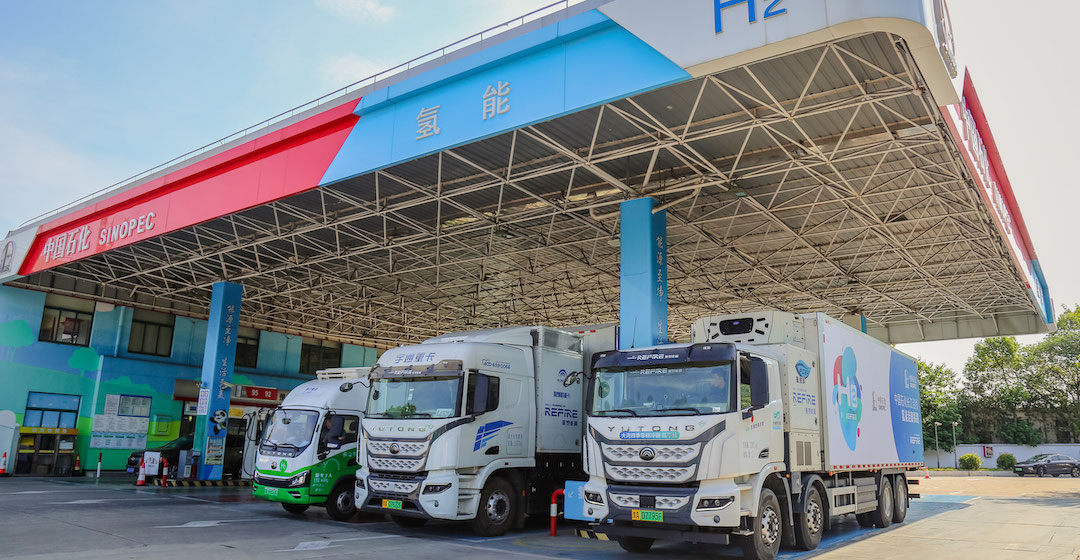
Sinopec operates 146 hydrogen refueling stations and eleven supply centers, with more planned. © Sinopec Group
Sinopec currently operates 146 hydrogen refueling stations and eleven supply centers. Further highway refueling networks are now to be established along existing hydrogen corridors to activate the hydrogen economy. Recently, three hydrogen-powered logistics vehicles completed a 1.500-kilometer journey from Shanghai through five provinces to Yichang in Hubei Province. Refueling stops were made at six Sinopec stations. The company aims to "develop sustainable business models to drive high-quality growth in the industry."
Further hydrogen corridors planned
To date, Sinopec has established five intercity hydrogen corridors: Beijing-Tianjin, Chengdu-Chongqing, Shanghai-Jiaxing-Ningbo, Jinan-Qingdao, and Wuhan-Yichang. After connecting Shanghai with Yichang via the Yangtze River, the company plans to connect its network with the Chengdu-Chongqing corridor to complete the hydrogen axis for vehicles along the Yangtze River.
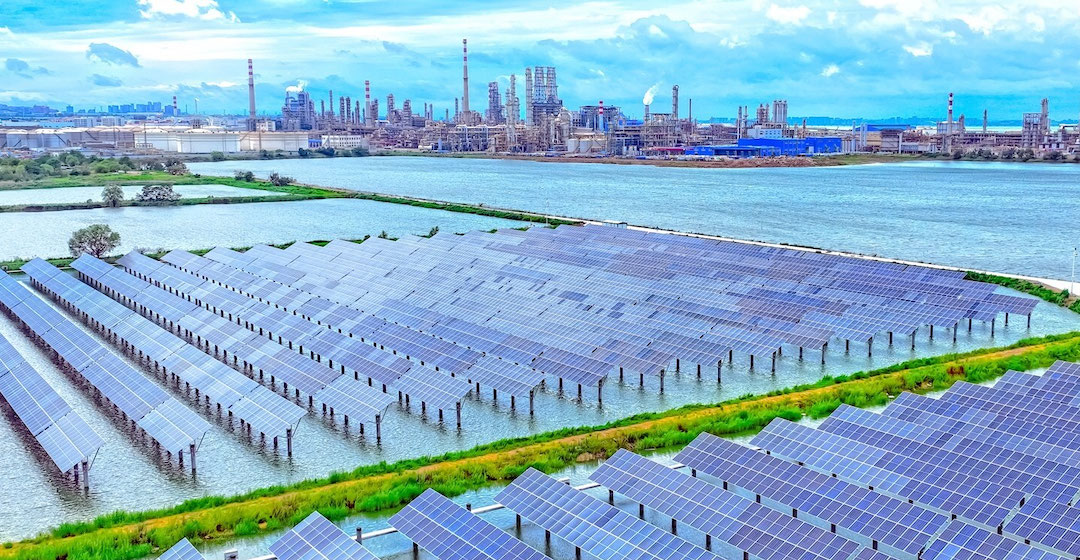
China's project to produce hydrogen from seawater at Sinopec's Qingdao refinery in Shandong Province. © Sinopec Group
Sinopec claims to have an annual hydrogen production capacity of 4,45 million tons. Last year, the company also completed a research project on hydrogen production from seawater at its Qingdao refinery. The plant integrates direct electrolysis with the production of green hydrogen from renewable energy. Its output is 20 cubic meters per hour. This approach not only offers a new solution for coastal regions but also paves the way for the utilization of industrial wastewater with high salinity.
Salt water for electrolysis
The challenge: Seawater contains about three percent salt, and impurities such as chloride ions can corrode electrolytic electrodes, while cation deposits can clog the device channels, reducing efficiency and causing damage. The state-owned refinery operator Sinopec Qingdao Petrochemical Co., Ltd., in collaboration with the Dalian Institute of Petroleum and Petrochemicals, has therefore developed, among other things, chlorine-resistant electrode technology and a seawater circulation system.

The integrated wind-solar hydrogen project in Inner Mongolia has the capacity to produce 30.000 tons of hydrogen per year. © Sinopec Group
An integrated wind-solar hydrogen project in Inner Mongolia with an annual capacity of 30.000 tons opened in February 2023. The green hydrogen is intended to help reduce CO2 emissions from coal processing. Wind turbines with an installed capacity of 450 megawatts and PV power plants with a capacity of 270 megawatts will generate the green electricity. The project also includes a hydrogen storage facility with a capacity of 288.00 cubic meters. The investment cost was estimated at 5,7 billion yuan (682 million euros). Another wind-solar hydrogen project in the Mongolian city of Ulanqab, with a capacity of 100.000 tons per year, will provide China's first large-scale, cross-province, long-distance pure hydrogen pipeline.
Photo above
Recently, three hydrogen-powered logistics vehicles completed a 1.500-kilometer journey from Shanghai to Yichang in Hubei Province. They refueled at six Sinopec stations. © Sinopec Group



