
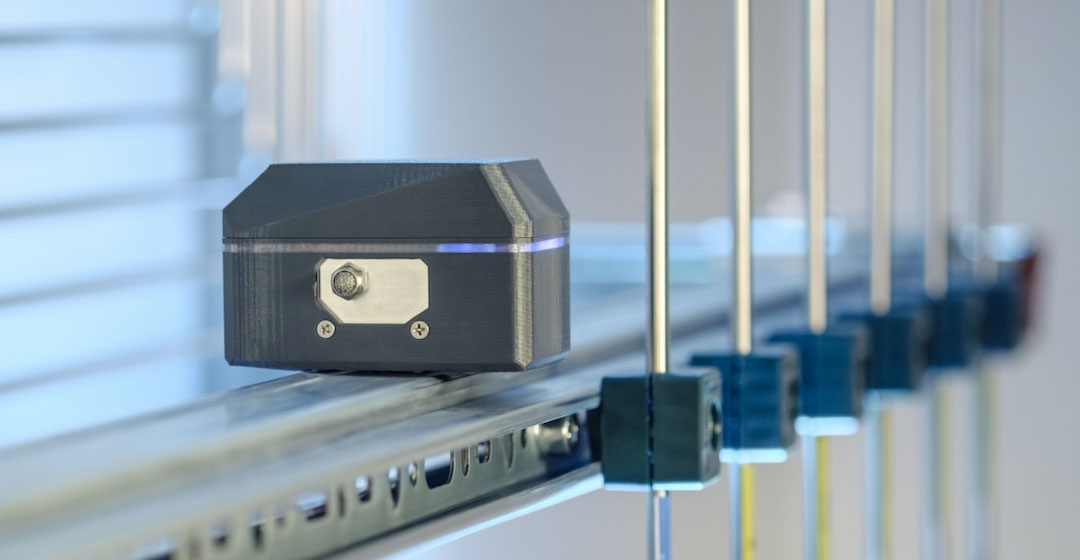
(Freiburg / Germany) – Light can cause gas to vibrate, thereby generating a resonant sound wave, a phenomenon known as the "photoacoustic effect." An ultrasonic sensor detects this. If hydrogen enters its housing through a membrane, a shift in resonance occurs – a change in tone. This altered tone is then registered by microphones.
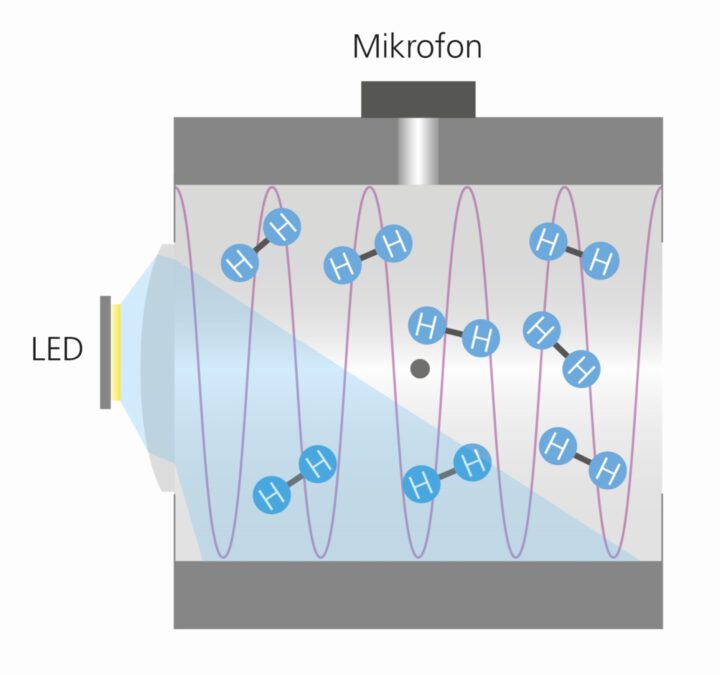
Functional principle: LED light generates an ultrasonic wave in the gas. If hydrogen enters the housing, a resonance shift occurs. A microphone based on a microelectromechanical system (MEMS) registers this resonance shift. © Fraunhofer IPM
According to scientists at the Fraunhofer Institute for Physical Measurement Techniques IPM in Freiburg, the safety of the pipelines, storage facilities and connection points is of crucial importance for the development of the hydrogen infrastructure. This is because the invisible and odorless gas is highly flammable and explosive. The sensor system developed at the institute can reliably detect "even the smallest amounts of hydrogen". This means that leaks of all kinds can be quickly detected. The ultrasonic sensor can be used to check containers, gas-carrying pipelines or connectors.
"It would also be conceivable to distribute several devices in a room, similar to smoke detectors, and link them to form a sensor network," explains Carolin Pannek from Fraunhofer IPM. The ultrasonic sensor works so precisely that it even registers when the hydrogen contains molecules of other substances, i.e. when it is minimally contaminated. Fuel cells that generate electricity in trucks, for example, require highly pure hydrogen. The smallest of contaminants could damage the sensitive membranes. "Here the sensor checks whether the hydrogen is really pure," say the researchers.
laser spectrometer for ammonia
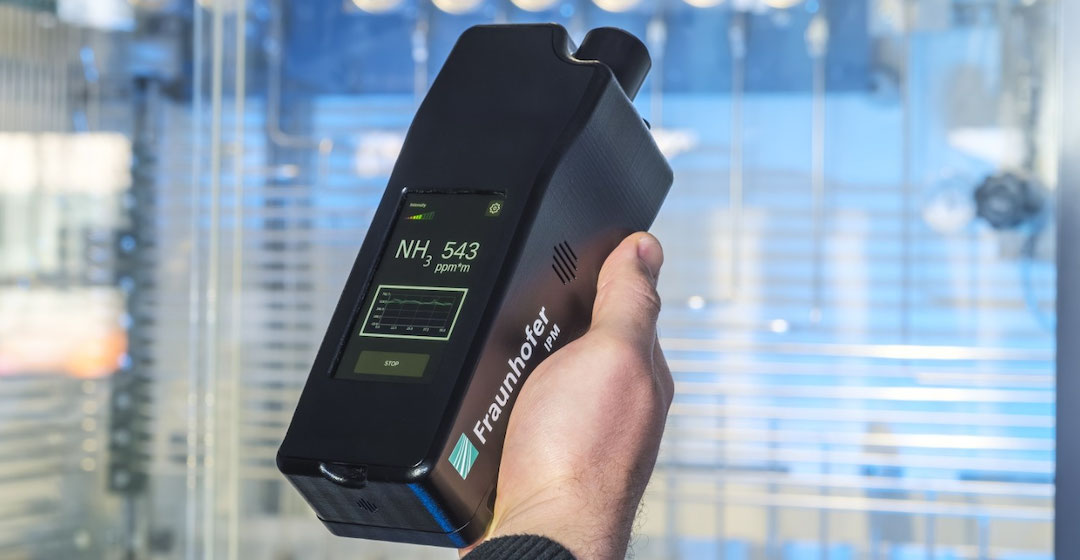
Detection of ammonia: The laser spectrometer at Fraunhofer IPM absorbs the wavelength of ammonia and shows the result on a display. © Fraunhofer IPM
The use of ammonia (NH3) as a hydrogen storage medium is, however, much simpler. "But since ammonia is extremely toxic, leaks must be detected quickly and reliably," says Fraunhofer IPM. A laser spectrometer has been developed for the remote detection of ammonia. It absorbs the wavelength of ammonia, so it reacts immediately and shows the result on a display. "Specialists can hold the compact device in their hands and inspect pipes or tanks from a safe distance of up to 50 meters," says Fraunhofer project manager Pannek. Mounted on drones, it inspects industrial plants or flies over pipelines.
Raman spectroscopy
The third measuring system is a further development of Raman spectroscopy. It works on the physical interaction between light and matter. "The light reflected by the matter has a different wavelength than the incident light. This gives each matter a spectroscopic fingerprint." The Raman sensor developed by Fraunhofer IPM works with inexpensive components and serves "as a flexible test station for quantification." The system is used, for example, in the energy industry for the production of hydrogen.
The research work was part of the hydrogen flagship project TransHyDE of the Federal Ministry of Education and Research together with the project sponsor Jülich.
Photo above
Fraunhofer IPM developed a hydrogen ultrasonic sensor to monitor tanks, pipes or connectors in order to detect leaks at an early stage. © Fraunhofer IPM



