
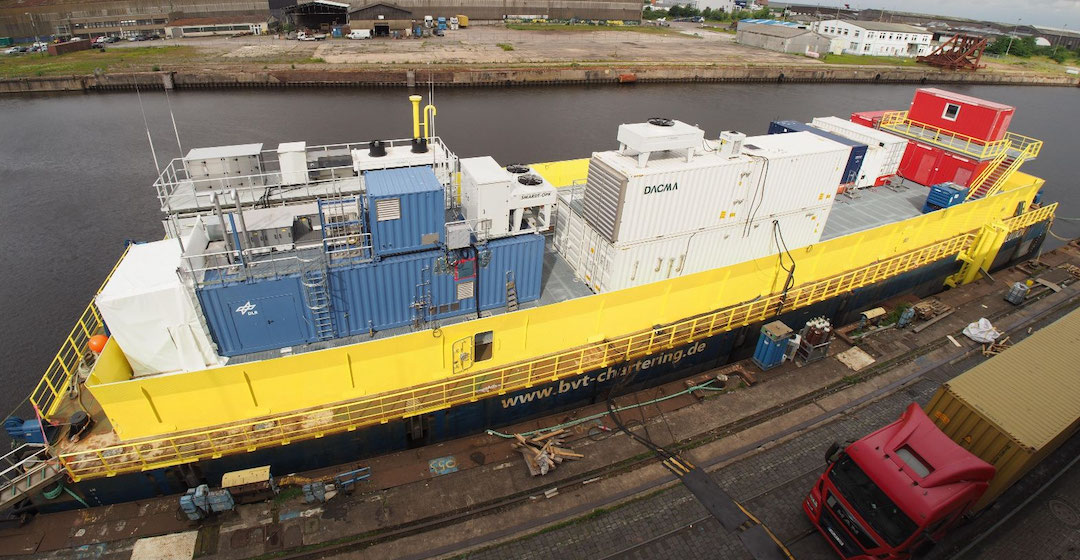
(Bremerhaven / Germany) – Green hydrogen will be produced on a floating test platform under real-world conditions in the North Sea later this year and processed on-site into synthetic fuel. This will demonstrate for the first time that it is possible to establish a complete power-to-X process chain for sustainable fuels on the high seas.
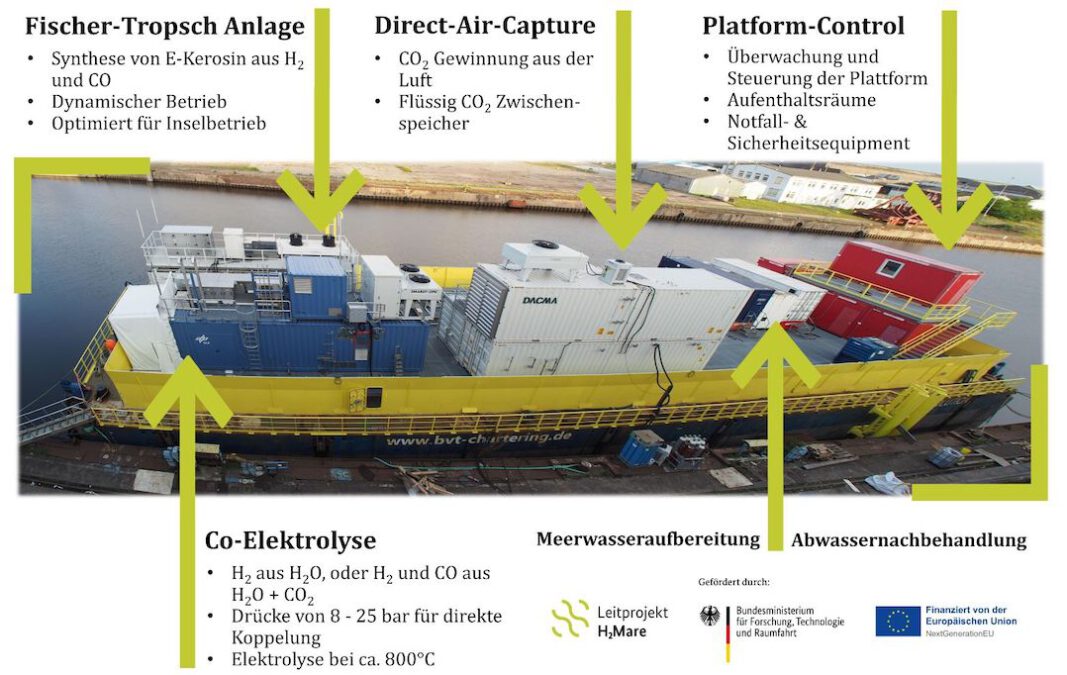
Platform layout diagram. © DLR / Graphics: KIT
A consortium led by the Karlsruhe Institute of Technology (KIT) has now completed this world-first 60 by 15 meter plant in Bremerhaven and put it into operation after a seven-month construction period. To withstand wind and waves, it was designed as a modular container structure. On board, among other things, are a seawater desalination plant and a direct air capture system for extracting carbon dioxide (CO2) from the ambient air. High-temperature electrolysis produces a synthesis gas. This serves as the starting material for Fischer-Tropsch synthesis, in which green hydrogen and CO2 are converted into e-fuels. The design enables dynamic off-grid operation, adapted to the availability of electricity from wind power.
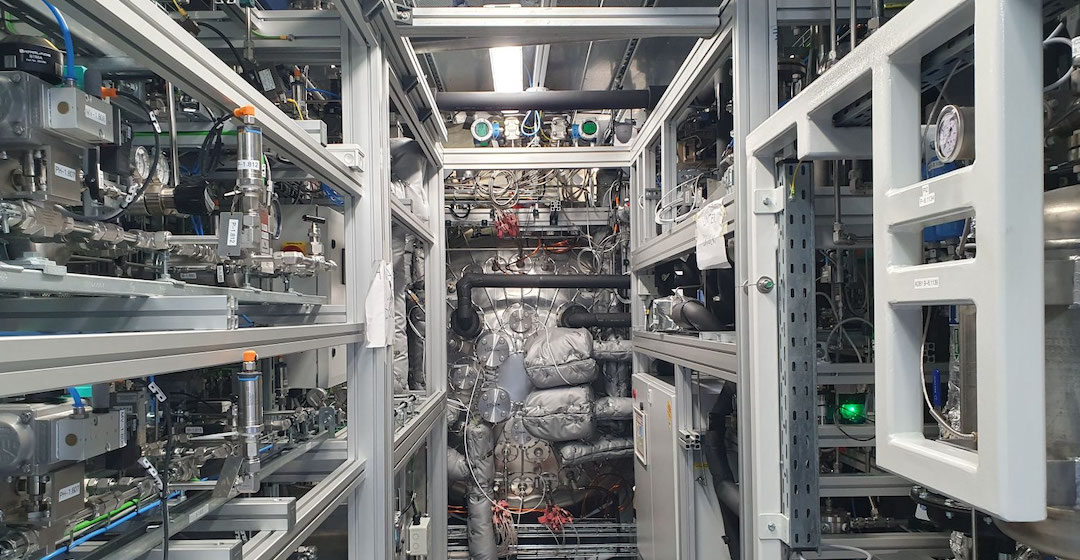
High-temperature electrolysis for the production of synthetic fuels. © H2Mare
After the test run in Bremerhaven, the platform will be towed out to sea and is scheduled to produce fuel under realistic conditions for the first time off Heligoland this year. "We wanted to simulate the entire planning process, from approval through construction to operation of the plant, in reality," says Roland Dittmeyer, Head of the Institute of Micro Process Engineering at KIT and coordinator of the H2Mare PtX-Wind project. The researchers expect the first meaningful test results by the end of 2025.
In addition to the operation of the entire process chain, maritime influences and material properties, as well as regulatory requirements, will also be investigated. The findings will support the development of larger Power-to-X plants without a connection to the power grid, which can be directly coupled with fluctuating renewable energies to produce green hydrogen. Offshore wind turbines generate significantly more electricity and more regularly than their onshore counterparts.
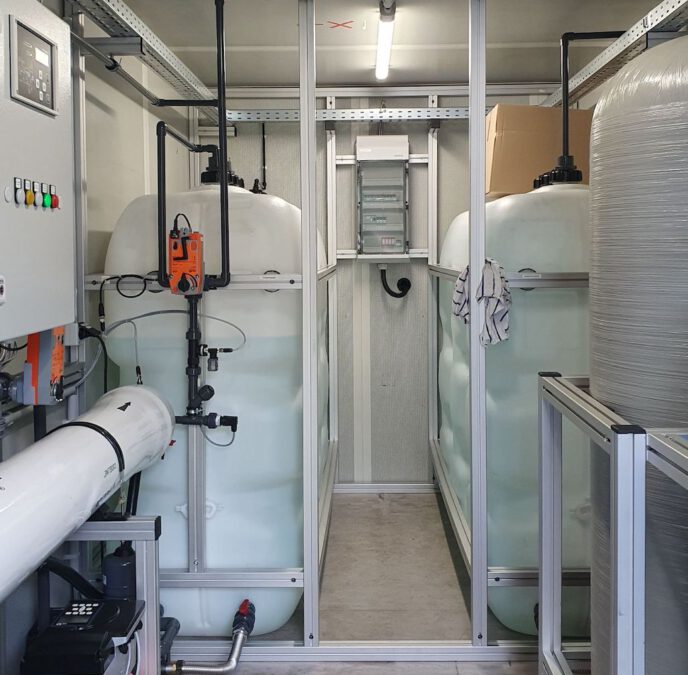
The seawater desalination plant is powered by waste heat. © H2Mare
According to the project description, Power-to-X (PtX) products serve either for temporary energy storage, as fuels, or as chemical raw materials for further processing in industrial processes. They are used particularly in situations with a surplus of renewable energy that could not otherwise be used. If the Power-to-X products are converted into other materials (X) using electricity (Power) from renewable energies, their production is climate-neutral.
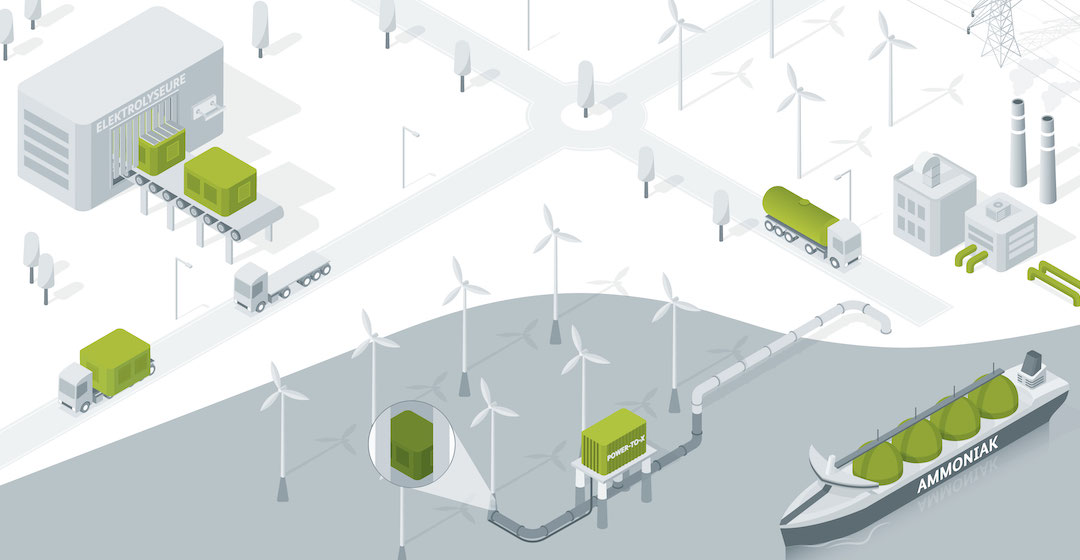
The hydrogen lead projects deal with the production and transport of green hydrogen, on land and at sea. © Projektträger Jülich on behalf of the BMBF
H2Mare is one of three flagship hydrogen projects of the German Federal Ministry for Research, Technology and Space (BMFTR) and a key component of the National Hydrogen Strategy. The "PtX-Wind" project is researching how to further process green hydrogen produced at sea into downstream products such as e-fuels. The direct coupling of wind turbines and electrolyzers is intended to minimize the costs of hydrogen production, according to the Fraunhofer Institute for Wind Energy Systems IWES, which is also involved in the project. Without a connection to the electricity grid, infrastructure costs could be significantly reduced. Furthermore, decoupling electrolysis from the grid would relieve the burden on local grid structures. In addition, "far larger potential areas for wind energy generation are available at sea than on land."
The consortium includes around three dozen partners from science and industry, including the Institute of Engineering Thermodynamics of the German Aerospace Center (DLR), the Federal Institute for Materials Research and Testing (BAM), the Helmholtz Center Hereon GmbH, and several Fraunhofer institutes and universities. Industry partners include RWE, EnBW, Siemens, and Salzgitter Mannesmann.
Photo above
The floating platform with container facilities for the offshore production of synthetic fuels from wind energy, seawater, and ambient air was built in Bremerhaven. © H2Mare



