
(Bern / Switzerland) – The Swiss Federal Council adopted the national hydrogen strategy in December. It outlines the goals and guiding principles for developing a hydrogen economy. However, the government anticipates only low demand in Switzerland until the 2030s.
CO2-neutral production required
The strategy assumes that hydrogen from CO2-neutral production processes will be used. Areas of application include process heat in industry, peak load coverage in combined heat and power plants and thermal networks, reserve power plants, aviation, shipping and heavy traffic on the road.
In addition to domestic production and storage, the connection to the European hydrogen transport network should be ensured and imports should be strengthened through international cooperation and partnerships. The hydrogen infrastructure should be built along the entire value chain, such as production, conversion, transport, storage and refueling, and the "Switzerland as a location for education and innovation" should also be strengthened through the development of the necessary technologies.
level of need still unclear
However, the paper states that there is "no reliable information yet on future demand" from the business community. The hydrogen strategy assumes that the initially rather low demand in Switzerland will be covered "mainly by domestic production" until the mid-2030s.

Hydrogen trucks, such as those from Hyundai, have been driving around in Switzerland for many years, and electrolyzers and filling stations are also being built. But there is apparently still no reliable estimate of the industry's future hydrogen demand. © Hyundai Motor Group
The energy source can be produced at existing power plants or close to consumers. It is transported in converted or newly built gas pipelines as well as by road and rail. From 2035 onwards, the transport and distribution infrastructure in Europe is expected to be expanded to such an extent that imports are possible. Storage requires large gas storage facilities, which do not yet exist in Switzerland, or the hydrogen is converted into liquid synthetic energy sources.
Domestic demand is expected to increase from 2035 onwards. The government believes that imports from the EU and third countries will be more cost-effective than domestic production in the long term, meaning that the share of imports will continue to rise. However, there are uncertainties regarding the trend in demand.
Concrete projects
The Federal Department of the Environment, Transport, Energy and Communications (DETEC) is responsible for monitoring the Energy Strategy 2050 and is developing a concept to provide suitable areas for operators of hydrogen filling stations at heavy traffic centres along national roads.
The cantons are recommended to develop their own hydrogen strategies, to review their plans and approval practices for possible bureaucratic hurdles and to harmonize their legal framework. The topic of energy storage should be discussed together with the cantons and the energy industry.
The “ Hydrogen Strategy for Switzerland ” is available free of charge as a PDF (40 pages).
Comment : While the strategy lists a number of projects with timelines, it reads more like a to-do list. Target values are nowhere to be found: Energy supply is primarily the responsibility of the energy industry. The federal government merely provides the necessary framework, the document states tersely. Surprisingly, Swiss industry seems unaware of "which renewable energy sources it will rely on in the future," and it is also unclear how great the interest in, and thus the share of, fuel cell vehicles will be in the mobility sector. This demonstrates that the Swiss government has either missed the rapid global developments surrounding this energy source in recent years – or is turning a blind eye and refusing to take action. Fuel cell vehicles have been on the road in Switzerland for years, driven by industry initiatives, and production facilities, filling stations, and infrastructure are being built. Without a demand assessment – even one that is currently undergoing significant change worldwide – it is difficult to develop a strategy with concrete goals and target ranges. It is also surprising that industry here appears to be exerting little pressure to demand greater support from Bern for the decarbonization of the Alpine republic and to secure its business future. Politics, industry, and science should act swiftly together so that Switzerland does not soon become a blank spot on the European hydrogen map. alo
Photo above
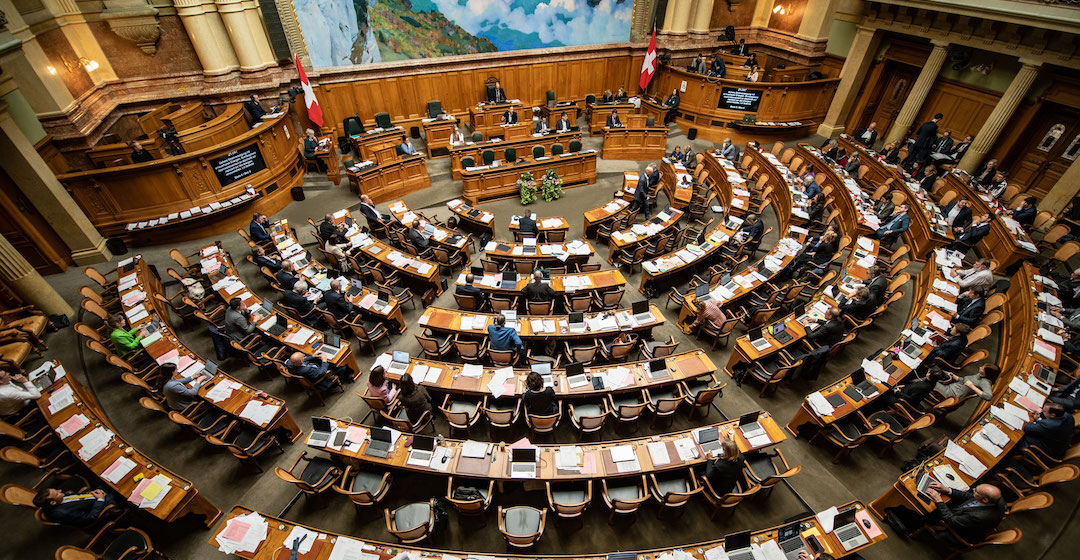
The Swiss Federal Council has adopted the national hydrogen strategy. The government assumes that there will be only a low demand in the Alpine republic until the 2030s. (Photo: National Hall in the Parliament building in Bern) © Parliamentary Services 3003 Bern / Rob Lewis



