

(Trondheim, Norway) – Truck manufacturers Scania CV AB, Hyundai Hydrogen Mobility Germany, and the French hydrogen vehicle provider Hyliko have joined the EU-funded research project "H2Accelerate Trucks." The Volvo Group remains involved, while Iveco and Shell have withdrawn. The consortium is coordinated by the Norwegian Foundation for Industrial and Technical Research (SINTEF).
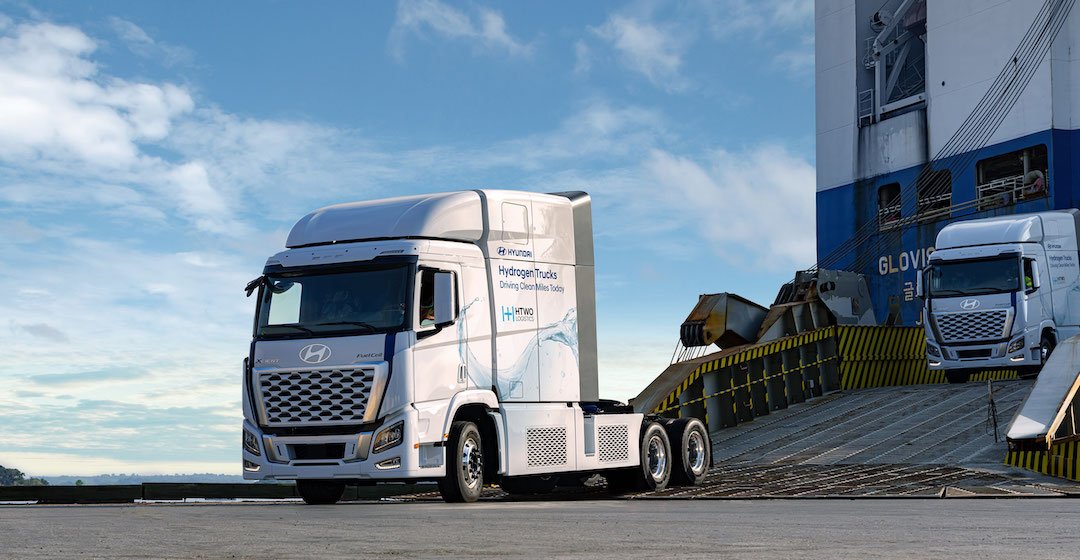
Hyundai has joined the EU-funded research project “H2Accelerate Trucks”. © Hyundai
The goal of Europe's largest project for zero-emission, hydrogen-based heavy-duty transport is to put 125 fuel cell trucks into operation in six European countries by 2028, with the first vehicles expected to be on the road as early as 2026. "This project is one of SINTEF's most important contributions to reducing transport-related greenhouse gas emissions in Europe," says coordinator Steffen Møller-Holst.
Strengthening the infrastructure for petrol stations
The trucks will be refueled at a parallel network of hydrogen stations designed for heavy vehicles. Total Energies and the hydrogen producer Everfuel are contributing the refueling infrastructure. Fuel availability will be ensured by TEAL Mobility, a joint venture between Total Energies and Air Liquide. The company already operates 15 stations across Europe.

TEAL Mobility markets hydrogen under the Total Energies brand through its network of filling stations. © TEAL Mobility
The next-generation hydrogen refueling stations have a capacity of over 1.000 kilograms per day. This is enough to refuel 10 to 20 large trucks daily. The stations will initially be installed in industrial regions before an expansion along the Trans-European Transport Network (TEN-T) is planned. Wherever possible, the hydrogen will be supplied with green hydrogen.
More than 20 European transport companies will participate in the launch to ensure the trucks are tested under diverse, real-world operating conditions and provide insights for future commercial use. Most of the hydrogen trucks will be equipped with 700-bar storage systems, giving them a range of over 600 kilometers. The plan includes both long-haul semi-trailers with a gross vehicle weight of 41 to 44 tons and smaller trucks for regional distribution networks with 350-bar solutions.
New opportunities for Norway
Although the trucks are primarily intended for use in Germany and Switzerland, the project will also provide important insights for establishing sustainable energy solutions in Norway. Therefore, some of the trucks will also be driven on Norwegian roads.

ASKO operates hydrogen-powered trucks on Norwegian roads and is set to receive three more vehicles from Scania. © ASKO Midt-Norge
In Norway, the food wholesaler ASKO Norge AS introduced hydrogen-powered trucks in the Trondheim region back in 2020 and is now receiving three more such vehicles from Scania. As part of the reorganization of H2Accelerate Trucks, the project's original objectives are also being expanded. For example, the consortium aims to establish a hydrogen refueling network specifically designed for the use of zero-emission trucks, which will contribute to increasing the availability and reliability of hydrogen across the European refueling network. Furthermore, this initiative seeks to strengthen confidence in this technology for decarbonizing road freight transport.
“Multiple solutions are needed to achieve zero-emission targets in the transport sector,” says Steffen Møller-Holst. “To be successful, close collaboration between technology providers, fuel suppliers, and research institutions like H2Accelerate Trucks is essential.”
Photo above
One of the hydrogen-powered Volvo trucks during winter testing as part of the H2Accelerate Trucks project. © Volvo Group



