
(Salzgitter, Germany) – Salzgitter AG has laid the foundation stone for one of Europe's largest green hydrogen production plants. The Austrian machinery and plant engineering company Andritz AG is responsible for supplying and installing the 100-megawatt electrolysis plant. The plant will utilize pressure alkaline technology from the Norwegian manufacturer Hydrogen Pro ASA, in which Andritz has held a 13,8 percent stake since April 2024. The plant, ordered in September 2023, is expected to produce approximately 9.000 tons of hydrogen annually starting in 2026.
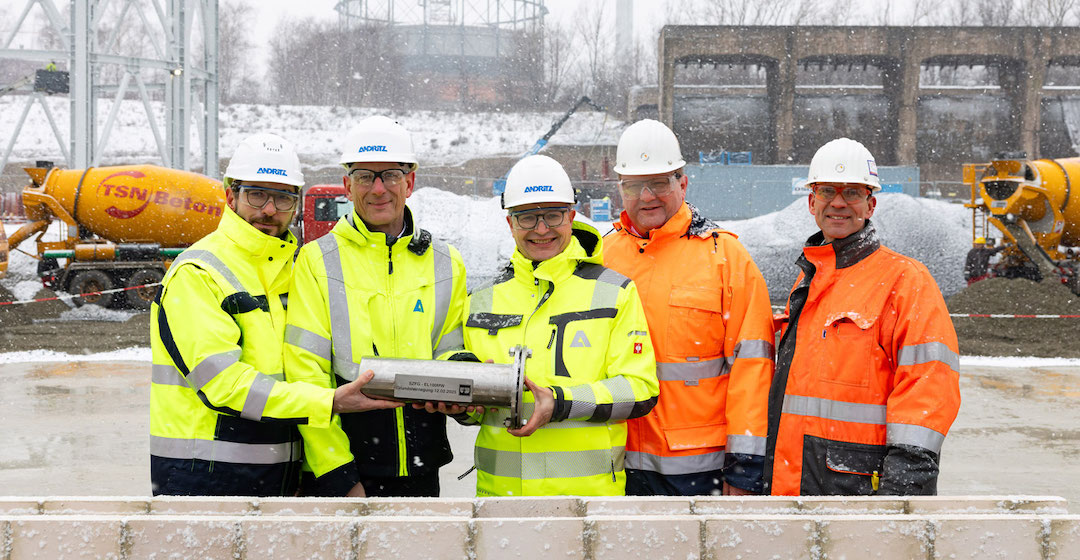
At the foundation stone laying ceremony (from left): Andrea Prevedello (Global Director Project Management Green Hydrogen, Andritz), Walther Hartl (Project Manager Electrolysis, Andritz), Sami Pelkonen (Executive Vice President Green Hydrogen, Andritz), Gerd Baresch (Managing Director Technology SZFG), Thorsten Hinrichs (Head of Media Operations SZFG) © Salzgitter AG
The hydrogen is needed for the "Salcos – Salzgitter Low CO2 Steelmaking" program and will be used in the direct reduction plant currently under construction in Salzgitter (Lower Saxony) to produce virtually CO2-neutral crude steel. At the beginning of 2023, the project received funding of nearly one billion euros as an "Important Project of Common European Interest" (IPCEI). Of this, approximately 700 million euros came from the federal government and 300 million from the state of Lower Saxony. The company is investing a further one billion euros.
The laying of the foundation stone is "another big step within our Salcos program," says Gerd Baresch, Technical Director of Salzgitter Flachstahl GmbH (SZFG). Now "politicians are also called upon to create suitable framework conditions for green production." Baresch is calling in particular for "competitive network costs and a committed development of the hydrogen economy."
Green hydrogen also from Wilhelmshaven
In April 2024, Salzgitter AG and Uniper SE signed a preliminary agreement for the delivery and purchase of 20.000 tons of green hydrogen annually. This hydrogen is to be produced in a planned 200-megawatt electrolysis plant on the site of the former coal-fired power plant in Wilhelmshaven. Depending on the availability of the German core hydrogen network and a pipeline, Uniper could begin delivering certified green hydrogen as early as 2028. The total demand for the first phase of the Salcos expansion project alone is 150.000 tons per year.
Salcos is being built up gradually. An electric arc furnace (also already under construction) will be added to the electrolysis and direct reduction plant. Salzgitter Flachstahl GmbH plans to bring the first products from the new route onto the market in 2026. The conversion to almost CO2033-free steel production is to be completed in 2.
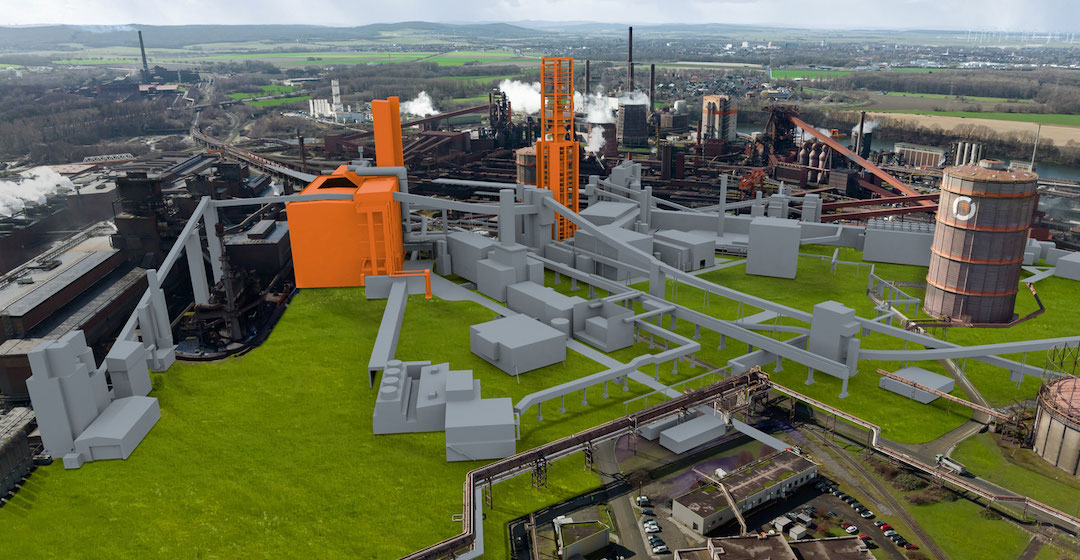
Photo above
Rendering of the Salcos facilities under construction in the Salzgitter steelworks. © Salzgitter AG




The data cited in the article raises some questions.
1.) If the 100 MW electrolysis plant on site is to produce 9.000 t of H2 per year, this means that the electrolysis plant should be at full capacity for 4.500 to 4.700 hours per year (production of around 1,9 to 2 t of H2/h for a 100 MW electrolysis plant). This cannot be achieved with onshore wind turbines (even large ones) (green electricity). So offshore wind turbines + possibly additional purchases of green electricity. Where from?
2.) The 9.000 t H2/a mentioned represent just 6% of the required quantity (150.000 t H2/a) for the first (!) expansion stage. How is the gap to be filled (if the first green steel is to be delivered in 2026, i.e. before Uniper is supplied)?
3.) Even if Uniper delivers 2028 t H20.000/a from around 2 (let's see if that works), this would only be 13,3% of the required quantity. And that's just for the FIRST stage of the expansion.
There are huge gaps in the supply of green H2, not to mention the costs.
Why is something like this being pushed forward when it is foreseeable that the production of green steel will always be considerably more expensive than in regions with cheap solar power/wind power? In the UAE and also in Oman, for example, plants for the production of green steel are currently being built. Do they want to protect themselves with import tariffs? It would not work in the long term and would also be detrimental to the German and European (steel) industry. So where is the "master plan"/business case that justifies/makes this path plausible?
We have forwarded the questions to Salzgitter AG. Editor's note.
Salzgitter AG responds as follows:
To 1.)
"In order to operate the electrolysis and other steel production units in an increasingly climate-friendly manner, we are securing PPAs (Power Purchase Agreements) on a large scale. According to an evaluation by Pexapark, we are currently in sixth place among PPA concluders:
https://www.linkedin.com/posts/ralph-schaper-a1383014a_pexapark-salzgitterag-hierpassierts-activity-7293176774169890818-YWk-?utm_source=share&utm_medium=member_desktop&rcm=ACoAAFETqRUBzOgyjlPnJGDuZnQ8ECjaITPohN4
The PPAs cover various types of renewable energy to ensure the greatest possible availability.”
To 2.)
"Hydrogen will replace carbon as a reducing agent. The coal currently used will be 100% sourced externally. The same will be true for most of the hydrogen required. To achieve this, we are relying on the hydrogen core network that is currently being built and a tender currently underway for up to 150.000 t of hydrogen. Since the core network will not be available in Salzgitter until the end of the 2020s, we have decided to build the electrolysis plant so that we can produce with a mixture of hydrogen and natural gas right from the start. This will already reduce Scope 1+2 emissions from metallurgy by over 60%."
To 3.)
(see answer to question 2)
"Perhaps the following should be added to this fundamental criticism: The EU wants to be climate-neutral by 2050, Germany by 2045. Blast furnace-based steel production is inconceivable in a climate-neutral region. If we want to maintain Salzgitter as a steel location, and we absolutely want to do that, there is no way around a transformation. It is undisputed that there are regions in the world where renewable electricity can be produced more cheaply than in Germany. Whether this directly means that steel production will also be more successful there, particularly for the German and European market with its very high demands on joint developments with regionally based steel customers, is another matter. Salzgitter AG is happy to face fair competition with international manufacturers of green steel; from a climate protection perspective, this is exactly what needs to be achieved: a transformation of the industry that is as broadly supported as possible. It is important, however, that the EU maintains effective carbon leakage protection. This is solved with the so-called Carbon Border Adjustment Mechanism."