
(Berlin, Germany) – There are currently 265 projects and initiatives for the production of sustainable aviation fuels (SAF). A year ago, there were 197. The increase is primarily "due to comprehensive studies of the American and Asian markets, as well as company feedback and announcements in German-speaking countries." This information comes from an updated SAF Monitor, a joint database of the federally owned Now GmbH and the Competence Center for Climate and Noise Protection in Air Transport (CENA Hessen).
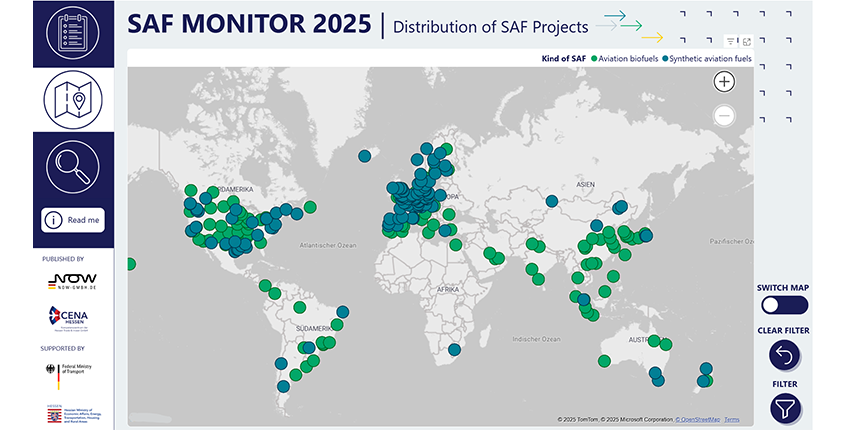
SAF Monitor: The interactive data visualization shows the SAF projects announced or already underway worldwide, based on data from the simultaneously published "CENA SAF Outlook 2025-2030" on volumes, methods, and markets. © Now GmbH
According to the study, most SAF production projects and initiatives are located in the USA (58), followed by Germany (31) and the United Kingdom (17). Compared to the previous year, the forecast production volume for 2030 has increased from 30 million to approximately 35 million tons of SAF – a growth primarily attributable to increases in Asia from three million to approximately 8,3 million tons (plus 38 percent) and South America by two million to approximately 2,3 million tons (plus 130 percent). In North America, 16 million tons are expected (plus six percent).
The CENA SAF Outlook until 2030. © CENA Hessen – Competence Center for Climate and Noise Protection in Aviation / Hessen Trade & Invest GmbH
Globally, announced SAF production in 2024 was approximately 2,6 million tons—almost exclusively from biogenic processes. Biogenic production pathways are also expected to account for the majority of global SAF production in 2030, while synthetic processes are expected to contribute slightly less than a quarter of total production.
The forecasts for Europe are striking, predicting a decline of 2030 million to just under eight million tons (minus 1,5 percent) for 27. According to Now GmbH, this is due, among other things, to "changes in the announcements of major projects in Spain, the United Kingdom, the Netherlands, Austria, and Germany," which cannot be offset by new, smaller projects.
EU regulation requires SAF blends
The EU regulation "ReFuelEU Aviation," adopted in Brussels in 2023, requires aviation fuel suppliers to provide minimum proportions of SAF: a blend of two percent is required from 2025, and six percent from 2030. Approximately one million tons will be needed to meet the SAF quota in 2025. According to the Data Monitor, these quantities are "expected to be achievable with the announced production capacities from projects already under construction or in operation."
EU airports with over 800.000 passenger passengers or over 100.000 tons of cargo per year must enable refueling with SAFs (Single Aircraft Fuel Cells). Exceptions exist for small, remote airports. "Ideally, airports should also provide alternative ground power supply options," such as hydrogen, according to an analysis by Now GmbH on the impact of ReFuelEU.
According to the monitor, 21 percent of the quantities announced for 2030 came from projects already in operation, 16 percent from projects under construction (an increase of four percent). Fifty-five percent of the announced quantities were based on projects in the planning stage, and eight percent on project proposals.
Most advanced-stage projects rely on biogenic processes. However, the EU's sub-quota of 1,2 percent for synthetic fuels is likely a problem. This has not yet been secured by 2030. Targeted political measures are needed to ensure investment in appropriate facilities and the implementation of the planned projects.
CENA Outlook and SAF Monitor
The "CENA SAF Outlook 2025–2030" analyzes current global SAF production and future production volumes up to 2030. It examines production processes for biogenic electricity-based fuels, revealing the breakdown of production volumes. The report also analyzes the development status of projects, allowing for a realistic assessment of expected production volumes.
The "SAF Monitor 2025" is the interactive data visualization of the CENA Outlook. Differences in the announced development of SAF quantities between the SAF Monitor and the SAF Outlook are due to different data cutoffs in June and December 2024, the authors explain. The data is continuously expanded and updated annually. Funding was provided by the Federal Ministry of Transport and the Hessian Ministry of Economic Affairs, Energy, Transport, Housing and Rural Areas.
The SAF Monitor is available on the Now website for renewable fuels. The “CENA SAF Outlook 2025-2030 – Quantities, Methods and Markets for Sustainable Aviation Fuels” is available free of charge as a PDF (32 pages).
Photo above
An EU regulation brings sustainable fuels into aircraft tanks. Pictured: Icelandic project developer IðunnH2 and Haffner Energy are building an eSAF production facility near Keflavik Airport. © Haffner Energy



