
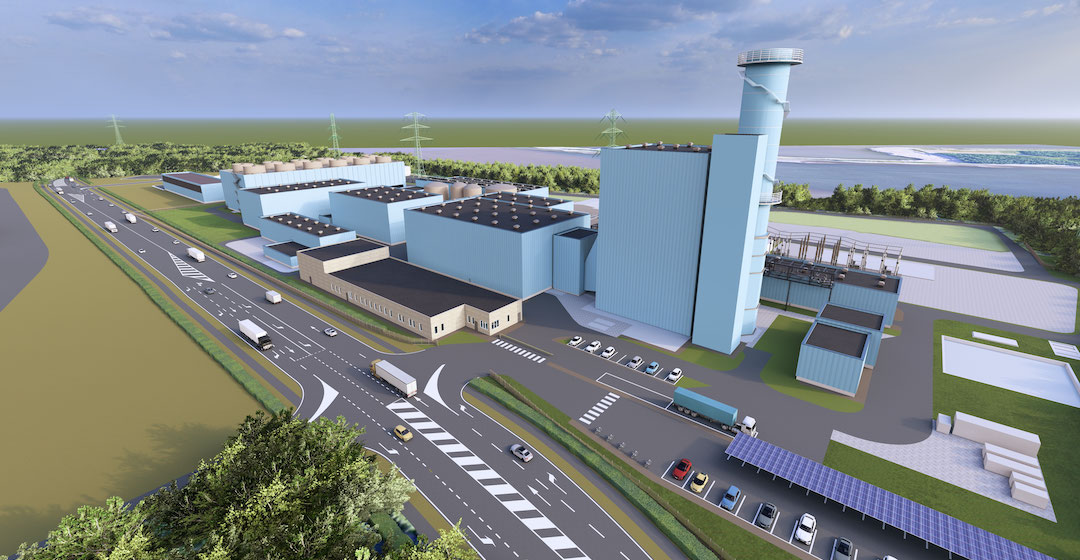
(Essen, Germany) – The Essen-based energy company RWE AG plans to build a hydrogen-capable combined cycle gas turbine (CCGT) power plant in the Lower Rhine region. The plant will have a capacity of 850 megawatts. The planned facility, located on the site of the former coal-fired power plant in Voerde (North Rhine-Westphalia), is "important for ensuring the long-term security of supply in Germany," according to a press release. Furthermore, it will contribute to the successful phase-out of coal. The site, north of Duisburg, is directly adjacent to the future pipeline of the hydrogen core network. The property already has well-developed infrastructure.

In December 2023, the 165-meter-high cooling tower of the coal-fired power plant, which was decommissioned in 2017, was demolished. © RWE
The project isn't entirely new; the site's redevelopment has been planned for several years. The coal-fired power plant was built there in the early 70s and decommissioned in the summer of 2017. Since then, planning for its dismantling has been underway. Demolition began in 2023. At that time, the construction of a gas-fired power plant was already being considered, along with the installation of a 400-megawatt electrolyzer. The 165-meter-high cooling tower was demolished by explosives in December 2023.
RWE commissioned an American-Spanish consortium of GE Vernova and Tecnicas Reunidas to plan and build the hydrogen-capable gas-fired power plant in 2024, and this consortium is currently finalizing the permitting process. According to current plans, the plant in Voerde is scheduled to begin electricity production in 2030. Upon commissioning, it will be able to utilize at least 50 percent hydrogen and can later be converted to operate entirely on this energy carrier. However, there is currently no mention of the electrolyzer.
The Ministry of Economic Affairs is lagging behind
What's missing: the power plant strategy, along with the regulatory framework for tendering hydrogen-capable gas-fired power plants, which the federal government has been promising for months. Up to 20 gigawatts of capacity are to be subsidized by 2030, which translates to roughly 40 newly constructed or modernized power plants in the 500-megawatt class. The previous government had planned for 12,5 gigawatts plus 500 megawatts of long-term storage, as well as two gigawatts for modernizing existing gas-fired power plants for hydrogen use. Power plants with a capacity of 500 megawatts were intended to run on 100 percent hydrogen from the outset.
RWE will participate in the federal government's tenders and begin construction of the plant "promptly after being awarded the contract." The city and region would benefit from secure jobs and local economic development – but Federal Economics Minister Katherina Reiche is making no progress with the power plant planning; on the contrary: "The potential expansion of gas-fired power plants in Germany is in danger of failing due to EU competition regulations," reported the "Tagesschau" news program recently . In Brussels, negotiations are now only taking place regarding new capacities of 12 to 12,5 gigawatts instead of the planned 20 gigawatts. Tenders will likely not be issued this year, the report stated.
400-megawatt battery storage in Bavaria

On October 29, construction of a large battery storage facility began on the site of the former nuclear power plant in Gundremmingen with the obligatory groundbreaking ceremony (from left): Nikolaus Valerius (CEO RWE Generation SE), Markus Söder (Bavarian Minister-President), Markus Krebber (CEO RWE AG), Hans Reichhart (District Administrator of Günzburg), Tobias Bühler (Mayor of Gundremmingen). © RWE
However, RWE has other arrows in its quiver. Just a few days ago, the 160-meter-high cooling towers of the former Gundremmingen nuclear power plant in Bavaria were demolished. On Wednesday, in the presence of political dignitaries, construction began on what RWE claims will be "currently Germany's largest battery storage facility" with a symbolic groundbreaking ceremony on the site. The facility will eventually have a capacity of 400 megawatts (MW) and a storage capacity of 700 megawatt-hours. This will allow for the provision of electricity for two hours.

Visualization of the future energy site in Gundremmingen. © RWE
The more than 200 containers with approximately 850.000 lithium iron phosphate battery cells will be installed in the coming months, along with more than 100 inverters. The system will utilize the existing grid connection of the decommissioned nuclear power plant and can help stabilize the electricity grid within milliseconds. RWE is investing around €230 million in the construction. The storage facility is scheduled to begin commercial operation in early 2028.
Furthermore, a solar park is planned on an area of 55 hectares, and, as in Voerde, a gas-fired power plant is also planned; here, too, the same problem is likely to exist: the Ministry of Economic Affairs is too slow.
According to its own statements, RWE operates battery storage systems in the USA, Europe and Australia with a total capacity of around 1,2 gigawatts, with a further 2,7 gigawatts under construction.
Photo above
Graphic representation of the planned gas-fired power plant in Voerde. © RWE Generation SE



