
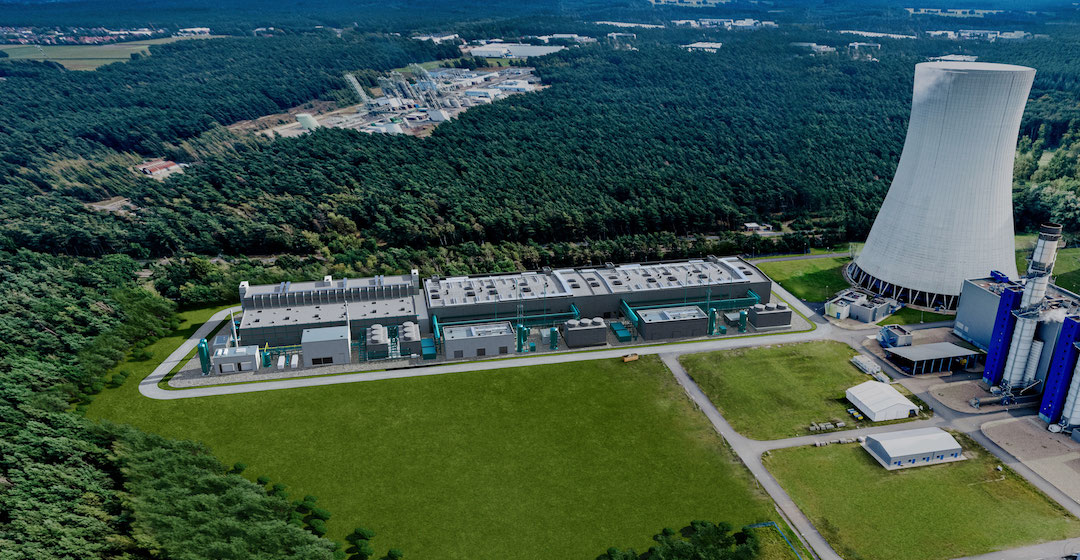
(Essen / Germany) – The energy company RWE AG has commissioned Sunfire GmbH from Dresden and Bilfinger SE from Mannheim to expand the electrolysis capacity of the “GET H2 Nukleus” project in Lingen to 300 megawatts in a third development phase. According to RWE, the contract volume is in the low three-figure million-euro range.

Sunfire had already installed a 10-megawatt alkaline electrolyzer as part of a two-part pilot plant at RWE AG's gas-fired power plant last year. For the second part, Linde supplied a proton exchange membrane electrolyzer (PEM) with an output of four megawatts. © RWE AG
Sunfire is supplying a 100-megawatt electrolyzer, which is said to include ten pressure alkali technology modules, each with an output of ten megawatts. Bilfinger is responsible for its integration, taking on planning tasks and supplying and installing the ancillary process systems, such as water and hydrogen treatment, compression and control technology.
RWE had already ordered two electrolyzers, each with an output of 100 megawatts (MW), from Linde Engineering and ITM Power in 2022. After completion of the entire plant - full production capacity is to be reached in 2027 - up to two tons of green hydrogen per hour will be produced. The energy source is intended primarily for industrial customers in Lower Saxony and North Rhine-Westphalia.
This is what the “GET H2” consortium is planning
“GET H2 Nukleus” is part of the “ GET H2 ” project, which is being funded by the federal and state governments as an “Important Project of Cross-Cutting European Interest” (IPCEI) within the framework of a third wave of approvals. A consortium consisting of RWE AG, BP plc, Evonik, and the network operators Nowega GmbH and Open Grid Europe GmbH (OGE) plans to build a hydrogen infrastructure by 2025 and expand it with further industrial partners by 2030.
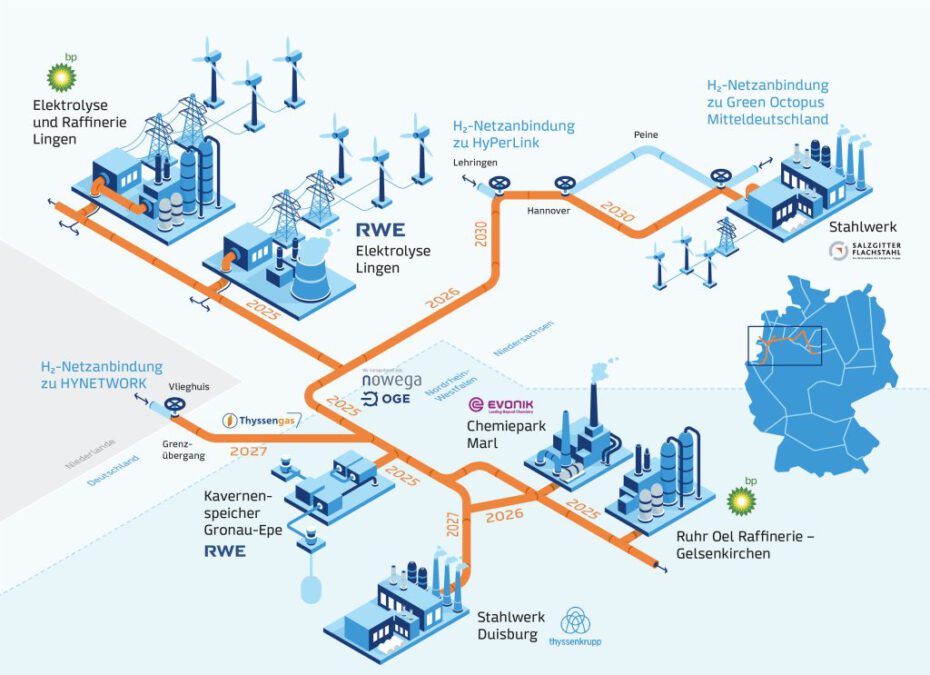
Project outline of GET H2: The first stage is the connection of hydrogen production in Lingen to Gelsenkirchen. © Nowega GmbH
In the first step, the green hydrogen will be transported primarily via converted existing gas pipelines from Nowega and OGE over a 130-kilometer-long network from Lingen to the Ruhr area. There, Evonik is building a partial new structure between the Marl Chemical Park and BP's Ruhr Oel refinery in Gelsenkirchen. Nowega and OGE are building a new hydrogen pipeline between Heek and Gronau-Epe (North Rhine-Westphalia).
Hydrogen storage in Gronau-Epe
From 2027, hydrogen from Lingen will be fed into a cavern storage facility being built by RWE Gas Storage West GmbH (RGSW) in Gronau-Epe. As part of the project called "GET H2 Storage", the company is upgrading and operating two caverns there with an originally calculated cumulative volume of 28 million cubic meters.
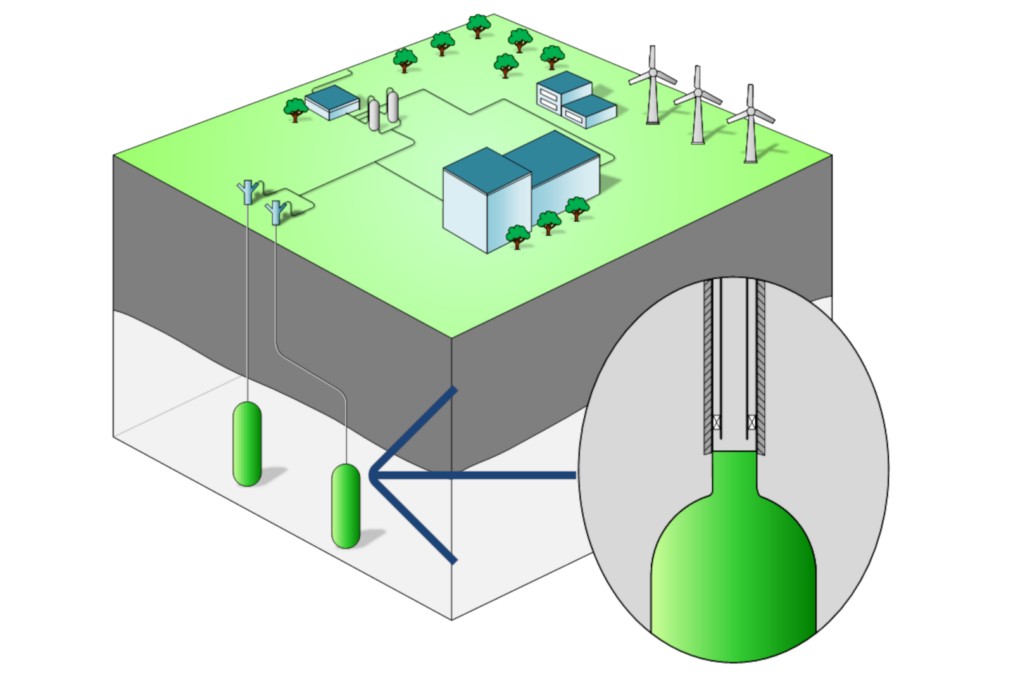
RWE is planning to store hydrogen in caverns in Gronau-Epe that were previously used for natural gas. A few weeks ago, the company announced that it was expanding its plans to include additional underground and above-ground facilities for storing hydrogen at the Kottiger Hook site. The first hydrogen is to be fed into the grid in 2026. © RWE
However, RGSW is already planning to expand to around 70 million cubic meters, of which 38 million cubic meters will be available for customers. To this end, the existing above-ground facility is planned to be expanded to include additional hydrogen storage and withdrawal lines and the necessary ancillary facilities, a cavern that is currently under brine will be converted and filled for hydrogen storage, and a cavern that has previously been used to store natural gas will also be expanded for hydrogen. "The Gronau-Epe site is also suitable as a hydrogen storage facility due to its proximity to the planned hydrogen pipeline between Lingen and the Ruhr area, in conjunction with the optimal geological conditions for gas storage," says an RWE statement.
Connection of the steelworks
By building additional pipelines, Nowega, OGE and Thyssengas GmbH are expanding the infrastructure by 2027/2028 with an additional connection to the direct reduction plant at Thyssenkrupp Steel Europe's steelworks. A pipeline will later also run to the Salzgitter AG steelworks. In Lower Saxony, the steel group is also working on the "Salcos" project to decarbonize steel production using direct reduction. Salzgitter is to be connected to Nowega's gas pipelines by 2030.
In addition, the GET H2 Nukleus and Salcos projects will then be linked to the planned pipeline network called “Green Octopus” in Brandenburg and Saxony.
IPCEI projects by “Hy2Infra”
As the third wave of the “IPCEI Hydrogen” (Important Projects of Common European Interest), the EU Commission has also approved 23 projects by German industry for the development of a hydrogen infrastructure ( as previously reported ). With 30 percent co-financing from the participating federal states, the total funding volume amounts to €4,6 billion. The companies themselves are investing an additional €3,3 billion, bringing the total investment volume to approximately €7,9 billion. A list of all funded projects is available as a PDF . We will be reporting on the “Hy2Infra” projects in a series of articles. Previously published:
"Hamburg starts building a hydrogen infrastructure"
(IPCEI “Hamburg Green Hydrogen Hub” and “Hamburg Hydrogen Industry Network”)
Photo above
Visualization of the “GET H2 Nukleus” project in Lingen: The left part of the functional building will house Sunfire’s electrolysis plant and Bilfinger’s ancillary facilities. © RWE AG



