
(Melbourne / Australia) – According to an executive order from President Trump, the US aims to secure America's economic growth with "beautiful, clean coal." US Energy Secretary Christopher Wright is now implementing this top-level directive to utilize "beautiful, clean coal" and pledged $625 million in subsidies to the coal industry at the beginning of October.
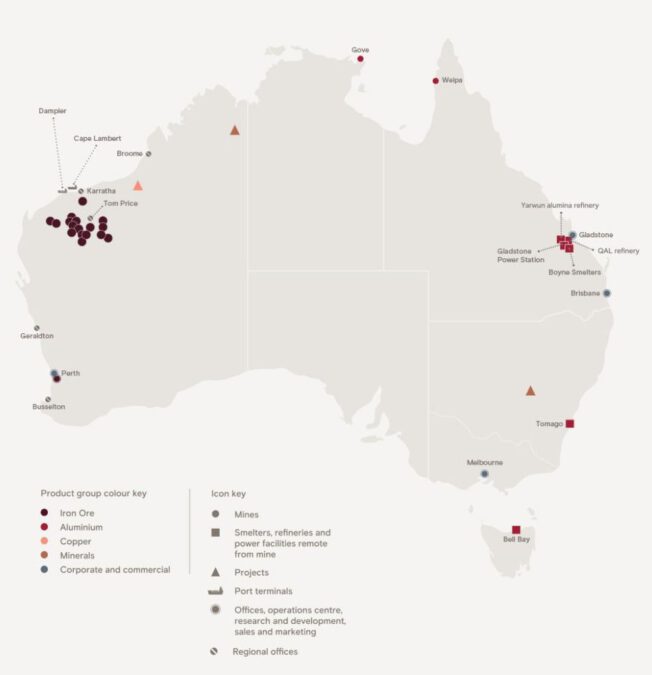
Rio Tinto's empire in Australia: The coal-fired power plants in Gladstone on the east coast are to be shut down soon. © Rio Tinto Group
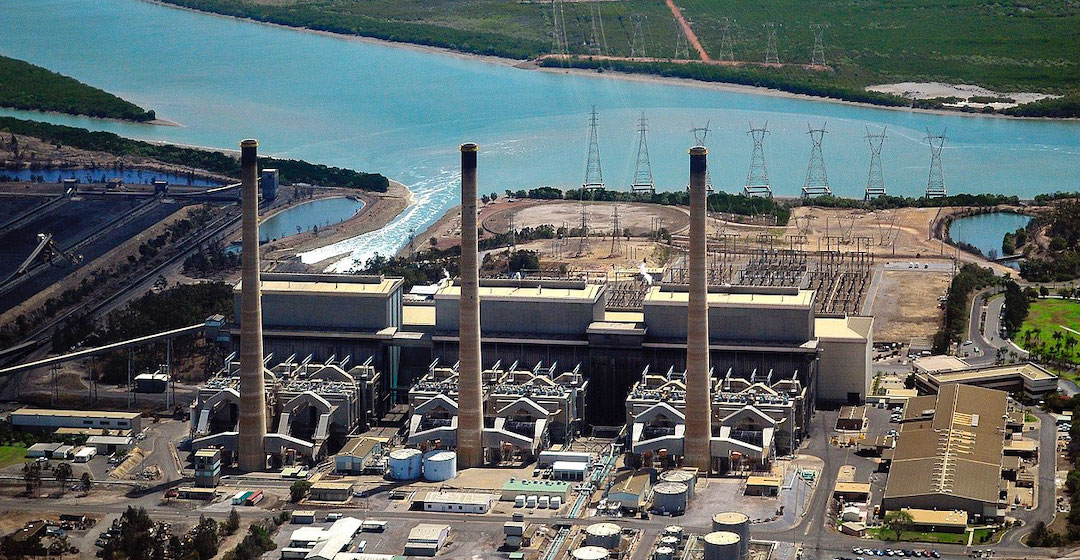
Meanwhile, a good 20 hours' flight further southwest, the industry is forging entirely different plans. Mining giant Rio Tinto has announced a "potential early closure" of its Gladstone Power Station (GPS) coal-fired power plant – at 1,68 gigawatts, the largest in the Australian state of Queensland. Originally scheduled to operate until 2035, the six plants could now be shut down as early as 2029. The reason: It's simply no longer profitable. Rio Tinto CEO Kellie Parker was quoted as saying in the media.
Queensland's oldest power plant is fed by the Rolleston Coal Mine, producing approximately four million tons of coal annually. It is operated by NRG Gladstone Operating Services, a joint venture with Rio Tinto Ltd. as the largest shareholder (42,12 percent), followed by Sunshine State Power, a subsidiary of the US utility NRG Energy, Inc. (37,5 percent).
Rio Tinto is its own best customer
The main consumers of the coal-fired power are regional group-owned companies: Australia's second-largest aluminum smelter, Boyne Smelters Ltd. (BSL), the Yarwun aluminum refinery, and the Queensland alumina refinery. The power purchase agreements (PPAs) with the coal-fired power plant expire in 2029.
While the announcement does not constitute a final decision to decommission the power plant, which has been in operation since 1976, six years early, the British-Australian multinational is merely complying with regulations requiring energy producers to formally notify the electricity and gas market operator AEMO (Australian Energy Market Operator) of any planned closures three and a half years in advance. However, this door has now been opened – and Rio Tinto has long been working on alternatives to coal-fired power.
Trump in Australian
However, the timing of the announcement is remarkable beyond its content: In just a few days, on October 10, the Liberal National Party (LNP), which governs Queensland, plans to present its five-year "Energy Road Map." The content: The state's targets for reducing CO2 emissions through renewable energy, set by the Labor Party in the previous government and approved by Parliament last year, are to be extended; wind and solar farms will be blocked, and operating times for coal-fired power plants will be extended – or so experts familiar with the matter have speculated in the Australian media in recent weeks.
Queensland's Energy and Finance Minister, David Janetzki, appeared unsurprised by the company's announcement, according to the local news portal ABC News. "Rio Tinto has been working on a plan to close the country's oldest coal-fired power plant for some time," he was quoted as saying. However, coal-fired power will be needed for the state's prosperity for decades to come, he told the portal Newswire. However, Queensland Premier and LNP leader David Frank Crisafull was surprised. When asked about the announcement by journalists the morning after, he claimed to be clueless.
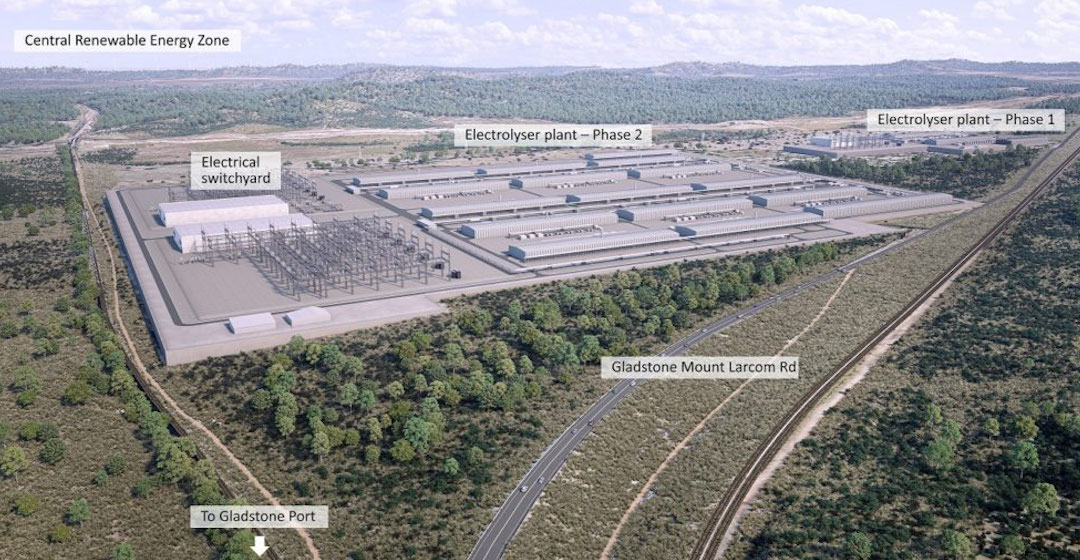
Rendering of Stanwell's planned "CQ-H2" project west of Gladstone in the Australian state of Queensland. The plan was to install electrolyzers with a capacity of 640 to 720 megawatts and produce 200 tons of hydrogen daily using solar power. The energy source was to be used partly in Queensland itself, but primarily supplied to Japan and Singapore. Operation was planned to begin in 2028, with an electrolyzer capacity of approximately 2.240 to 2.800 megawatts. After the NLP government withdrew its support and investors withdrew, the project is in jeopardy. © Stanwell Corp.
Should there be a new wave of government subsidies for fossil fuels, green hydrogen projects are also at risk. In June, the "Central Queensland Hydrogen Project" (CQ-H2), originally planned as a flagship project, was effectively abandoned. According to local media, after Energy Minister Janetzki declared in February that the project was inconsistent with the state's priorities of utilizing existing coal-fired power plants, and the government refused to contribute promised $1,4 billion, the state-owned Stanwell Corporation reportedly withdrew from the project in the summer with a two-line statement: "Stanwell has ceased its involvement in the Central Queensland Hydrogen Project and other hydrogen development activities." And: "The CQ-H2 project was a valuable international collaboration that provided important technical and commercial knowledge to support the future large-scale commercialization of renewable hydrogen." A more definitive departure is hard to imagine. Several prominent Asian project partners also announced their withdrawal.
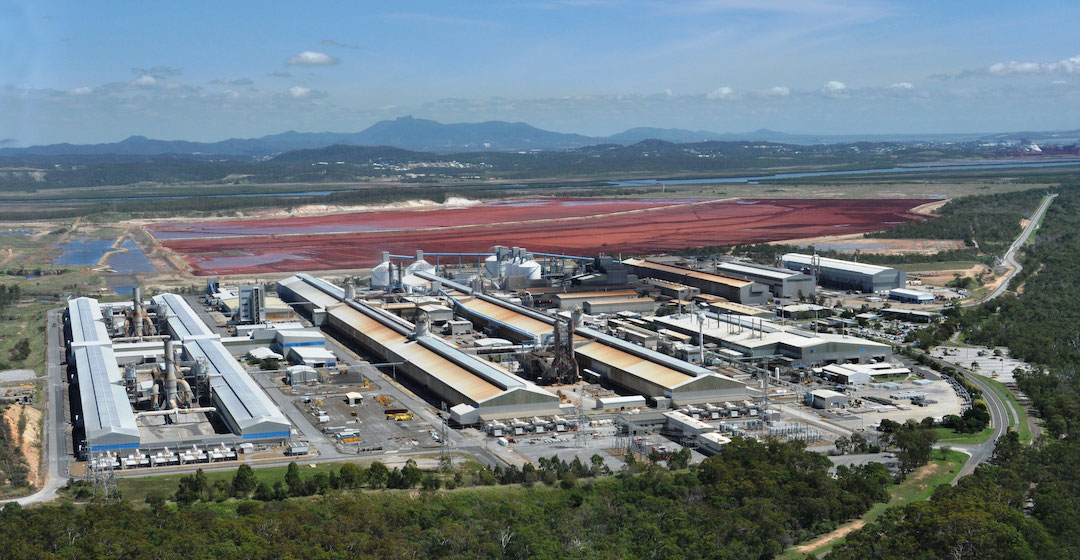
Boyne Smelters is Australia's second-largest aluminum smelter. Majority owner Rio Tinto (73,5 percent) plans to convert the company to renewable energy. © Boyne Smelters Ltd.
However, according to ABC News, the mayor of the Gladstone region, Matt Burnett, wants to ensure that the Rio Tinto power plant remains in operation beyond 2029. His justification is bland: It has driven industry there and supported thousands of local families for almost five decades. To put it simply: "It's always been there" – and no one wants to even consider alternatives. In contrast, the Queensland Conservation Council (QCC), a non-partisan, non-governmental environmental organization comprising hundreds of groups and communities, sees the possible early shutdown as proof that heavy industry and the private sector are making good progress in the transition from fossil fuels to cheaper renewable energies: "Rio Tinto is the largest energy consumer in Queensland, and they have made it clear that they cannot keep their Gladstone operations competitive by relying on expensive coal-fired power," said QCC Director Dave Copeman. Consequently, the company does not see GPS as part of a future energy mix.
“If Rio Tinto can do it, others can too”
"Rio Tinto made this decision based on the assessment that renewable energy with storage is cheaper and more reliable than an aging coal-fired power plant," says Copeman. "We call on the state government to deliver an energy plan on October 10 that provides certainty to communities and industry by providing for the timely closure" of such plants. "If Rio Tinto can do it, others can too."
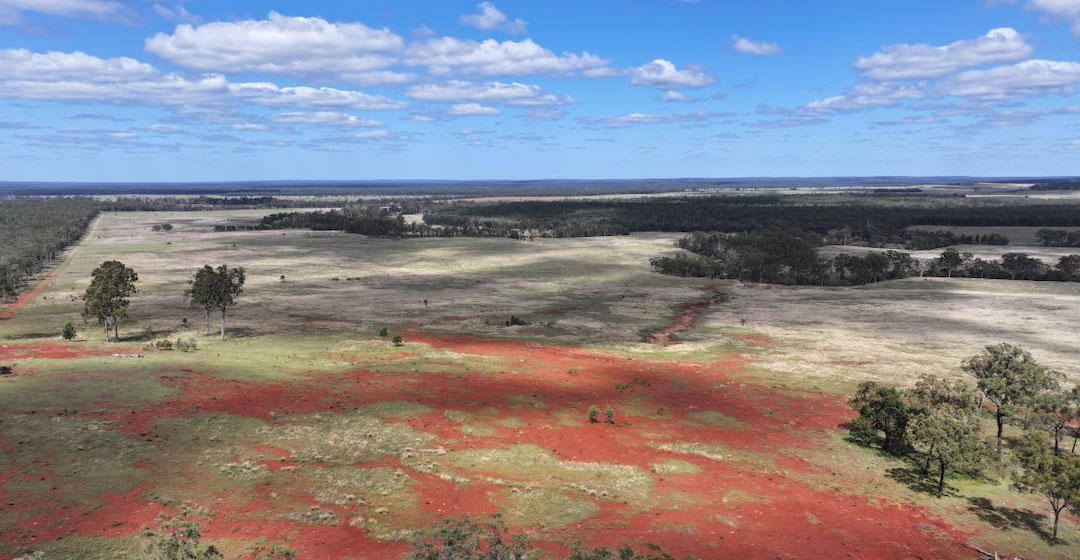
The building permit has already been granted: the Bungaban wind farm is to be built here in Queensland. Rio Tino will purchase 80 percent of the output for its Gladstone factories. © Windlab Pty Ltd.
Preparations for the "in-house energy transition" have been underway for some time. In February 2024, Rio Tinto agreed with project developer Windlab Pty Ltd. to act as anchor customer for a period of 25 years, purchasing 80 percent of the output from the 1,4 gigawatt Bungaban wind farm under development to fund its Gladstone activities.
The agreement followed the announcement of a PPA for European Energy's 1,1 gigawatt "Upper Calliope" solar farm the previous month. Rio Tinto says this makes it "the largest industrial purchaser of renewable energy in Australia." The green power is "another important step" in the refurbishment of the company's production facilities in the Gladstone area. However, the electricity purchases made so far are unlikely to be sufficient to satisfy the energy needs of the three aluminum plants. According to Rio Tinto, these require the output of approximately four gigawatts of installed capacity from wind and solar farms.
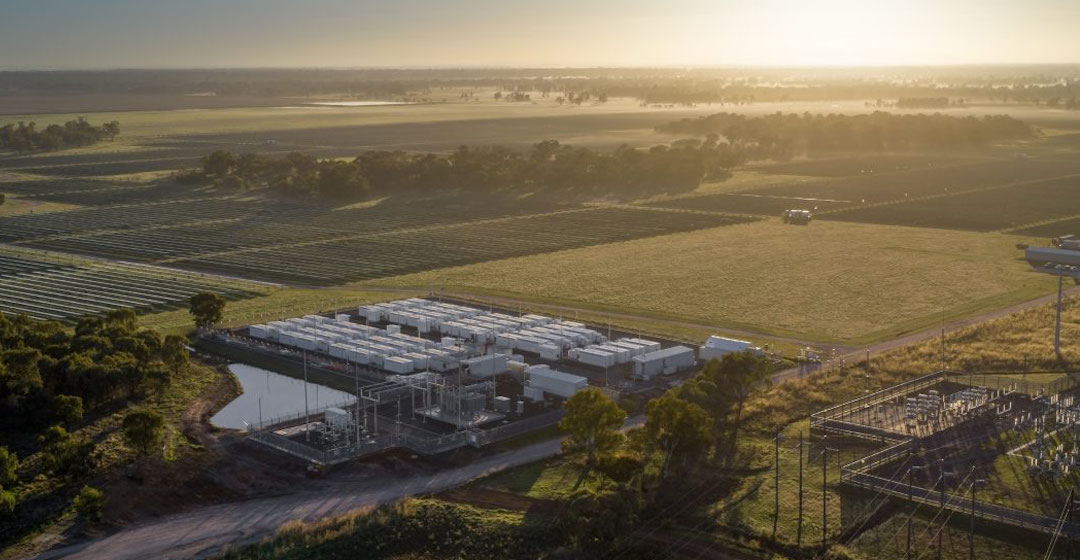
Edify Energy and Rio Tinto are entering into a PPA for two solar power plants and a power storage facility in Queensland. The image shows a similar Edify combination with 150 megawatts of installed solar capacity and 320 megawatt-hours of storage in Darlington Point, New South Wales. © Edify Energy
But the remaining electricity gap is also being gradually closed. In March of this year, Rio Tinto and Edify Energy signed further contracts to ensure a reliable and competitive supply to the Gladstone operations. Rio Tinto will purchase 90 percent of the electricity generation and battery storage capacity from the Smoky Creek & Guthrie's Gap solar power plants, which will be located next to each other, for 20 years. Edify Energy will build, own, and operate the projects, with construction scheduled to begin in late 2025 and be completed in 2028. If GPS were to be shut down in 2029, solar power could begin immediately that same year. The PV systems have a combined installed capacity of 720 megawatts – the yield is forecast at 1,6 million megawatt hours – and they feature an energy storage system with 600 megawatts (2.400 megawatt hours).
Together with the previously announced PPAs, these agreements will contribute to sourcing the output of a total of 2,7 GW of wind and solar farms in Queensland. The financing for Smoky Creek & Guthrie's Gap and its storage facility is secured: Edify was acquired three weeks ago by the Canadian investment group La Caisse for 1,1 billion Australian dollars. According to Edify, this will enable "the next phase of our growth." La Caisse, Executive Vice President Emmanuel Jaclot, asserts that La Caisse is committed to Australia's clean energy future—and thus also to Edify's pipeline of 11 gigawatts of renewable energy and storage on the continent.
Rio Tinto also with hydrogen project
Rio Tinto is also pursuing hydrogen utilization. In the summer of 2023, it signed an agreement with the Japanese conglomerate Sumitomo Corporation to build a 2,5-megawatt electrolyzer and storage facility in Gladstone to test whether hydrogen can replace the natural gas currently used at Yarwun. Converting the entire plant to green hydrogen could ultimately reduce emissions by 500.000 tons per year.
Construction was originally scheduled to begin in 2024, and the plant was to be operational by 2025 with a production capacity of more than 250 tons of hydrogen per year. According to a current project description from the government research institute Commonwealth Scientific and Industrial Research Organisation (CSIRO), the plant is still under construction. The three-year trial phase – also until 2028 – is scheduled to begin this year with an initial capacity of 125 tons, it was announced at the beginning of September.
Energy transition on October 10?
The Energy Road Map presented by the LNP on October 10 is likely to be eagerly awaited in every respect, even beyond Queensland – after all, it will determine whether the "Sunshine State" continues to rely on outdated energy production or makes the leap to renewables. And whether Rio Tinto will back down if government funding is available to extend the operating life of GPS. In any case, all shareholders of the Gladstone coal-fired power plant intend to engage with stakeholders by March 2029 regarding the energy market and options for the future use of the site.
Photo above
Gladstone Power Station (GPS): The largest power station in the state of Queensland has been operated by NRG Gladstone Operating Services since 1994. © Wikimedia / Luis Bartolomé Marcos / CC Attribution-Share Alike 4.0 International license



