
(Dunkirk, France) – A consortium of Technip Energies, Airbus, Safran, and Tereos plans to develop a large-scale plant for the production of sustainable aviation fuel (eSAF) in the port of Dunkirk, France. The joint venture, named "Rebound," will reportedly have an annual capacity of 160.000 tons.
Among the available production methods, "alcohol-to-jet" is developing into a scalable and cost-effective option that converts ethanol produced from agricultural and forestry residues into drop-in aviation fuel that can be mixed with conventional kerosene and used in existing engines and aircraft.
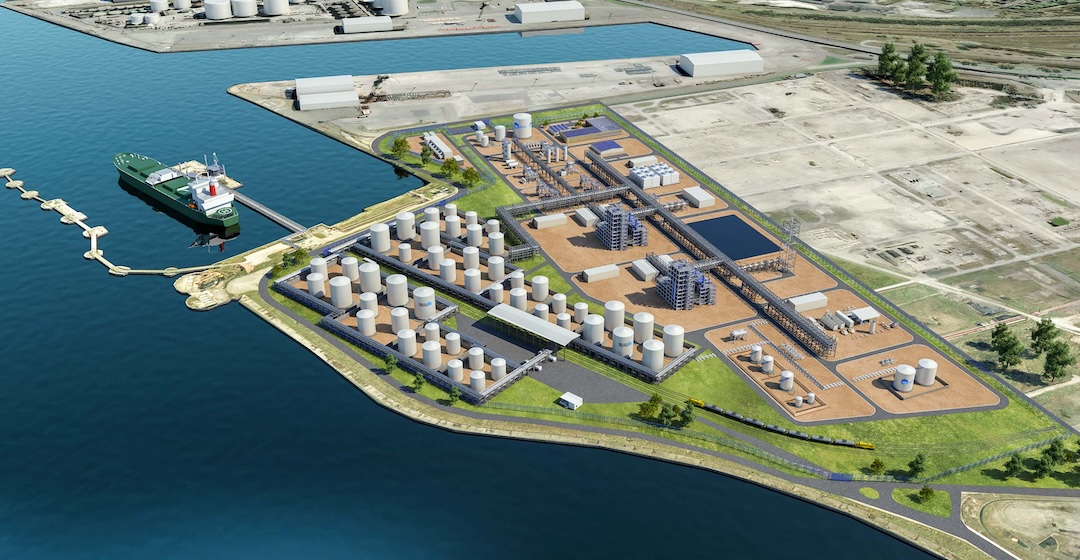
Graphic representation of Rebound's project in the port of Dunkirk. © Technip Energies
According to the agreement, the companies commit to financing the development phase and technical studies required for a Final Investment Decision (FID). During the project development phase, Technip Energies will act as the lead developer and engineering service provider. The company has already secured an industrial site in the port of Dunkirk suitable for raw material transport and production for Rebound. The development process includes selecting the technology licensee, obtaining permits, initiating pre-FEED (Front-End Engineering Design) and FEED activities, securing raw material supply and SAF emission agreements, and securing financing for construction.
Start in the second half of the year
Airbus and Safran are joining as industrial partners and customers. Tereos, a French agricultural cooperative, will procure and supply the ethanol. The four partners cover the entire value chain, from raw material supply to end use in aviation. The establishment of the joint venture is expected to be finalized in the second half of the year.
E-SAF is widely considered the most important lever for decarbonizing aviation. According to an EU regulation, its share of aviation fuel must increase to 70 percent by 2050. Currently, the quota is two percent, rising to six percent by 2030. However, according to calculations by CENA, the aviation competence center for climate and noise protection at Hessen Trade & Invest GmbH, less than 0,5 million tons of SAF have been secured through offtake agreements in the EU for 2030 – significantly insufficient to meet the 3,1 million ton SAF quota mandated for 2030, according to the economic development agency of the Hessian Ministry of Economic Affairs.
The CENA SAF Outlook to 2030. © CENA / Hessen Trade & Invest GmbH
The majority of agreed-upon SAF purchase volumes relate to bio-SAF, while binding contracts for eSAF are still rare. This is also due to the high production costs: producing one ton costs around €7.695 – almost ten times the price of one ton of fossil kerosene, according to the European Aviation Safety Agency (EASA). The largest SAF purchasers in Europe include Air France-KLM, the DHL Group, and the International Airlines Group (IAG). In 2023, they each refueled with between 50.000 and 90.000 tons. SAF accounted for 3,27 percent of the airlines' total fuel consumption, 1,12 percent for Air France-KLM, and 0,65 percent for IAG.
The “CENA SAF Outlook 2025-2030 – Quantities, Methods and Markets for Sustainable Aviation Fuels” is available free of charge as a PDF (32 pages).
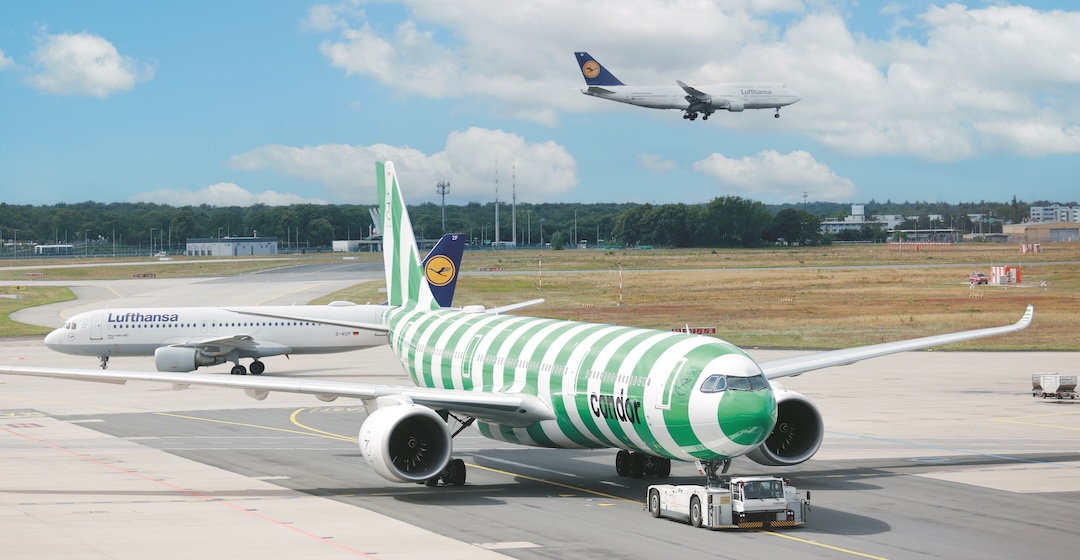
Photo above
E-SAF is considered the most important lever for decarbonizing aviation. According to an EU regulation, its share of aviation fuel must increase to 70 percent by 2050. © Fraport AG Frankfurt Airport Services



