
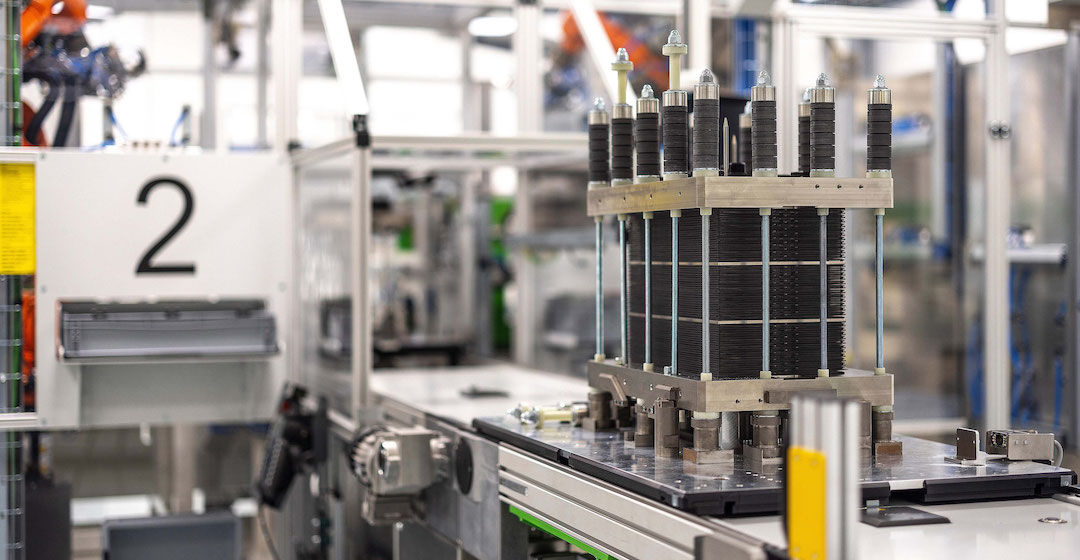
(Hamburg, Germany) – Quest One GmbH is starting series production of electrolysis stacks in Hamburg. Automation – electrolyzers are currently largely manufactured by hand – will reduce production time by approximately 75 percent, thereby significantly increasing efficiency and manufacturing quality. Once fully operational, the plant will be able to produce stacks with an expected annual output of more than five gigawatts.
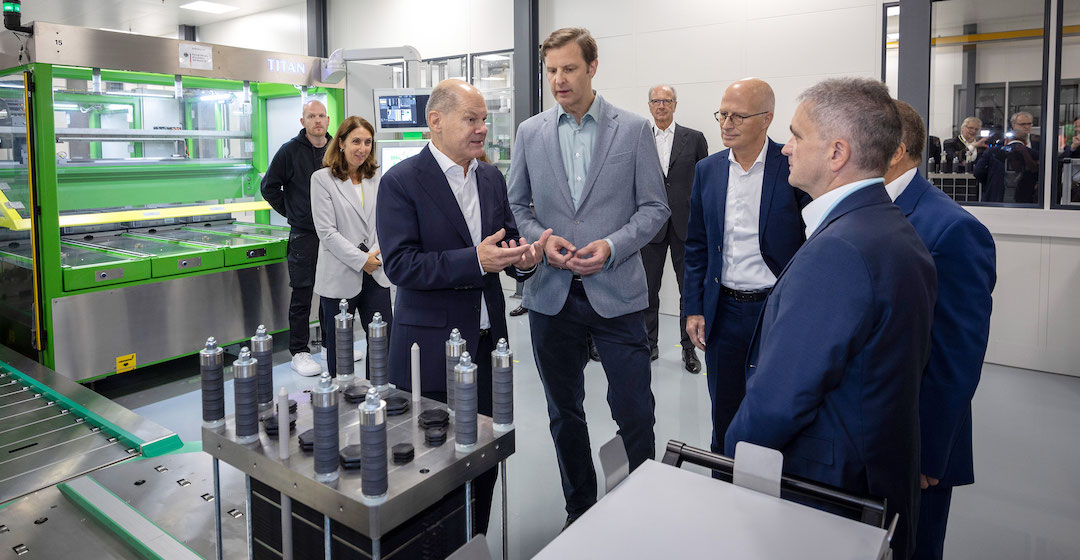
Federal Chancellor Olaf Scholz (front left) visits the electrolysis stack production facility in Hamburg together with Quest One CEO Robin von Plettenberg (front, 2nd from left) and Hamburg's First Mayor Peter Tschentscher (front, 3rd from left) and Uwe Lauber, CEO of MAN Energy Solutions (front, right). According to the information, over 800 guests from politics, industry and science were invited to the opening ceremony. © Quest One GmbH
The stacks manufactured in the new plant are based on PEM technology (Proton Exchange Membrane). PEM electrolyzers are better suited to coupling with power sources whose output fluctuates depending on the weather - such as PV and wind power plants - than alkaline electrolyzers. The highly automated stack production takes place on two production lines: "Titan" with a linear transport system and "Gerd" with swivel arm robots. The namesakes are two moons of the planet Saturn, which itself consists of around 95 percent hydrogen.
The 12.000 square meter gigahub was built after a year and a half of construction on a site of over 26.000 square meters in Hamburg's Victoria Park industrial park. The project was realized in a joint venture between Garbe Industrial Real Estate GmbH and the Jebens Group. The green roofs are equipped with a photovoltaic system. Initially, around 200 employees will work there. The site also serves as a customer and training center.

The three flagship projects of the Federal Ministry of Research "H2Mare" (offshore), "TransDyDE" (transport) and "H2Giga" (serial production) are intended to accelerate the industrialization of the hydrogen market. H2Giga supports the serial production of electrolyzers. © Project Management Jülich on behalf of the BMBF
The stack factory is a result of the research project "PEP.IN," part of the flagship hydrogen project " H2Giga " funded by the German Federal Ministry of Education and Research (BMBF). H2Giga encompasses the scaling up and mass production of components for hydrogen production. The goal is to develop novel processes for the competitive and mass production of PEM stacks and electrolyzers in Germany. The BMBF is funding PEP.IN with a total of €27 million, of which up to €13,6 million is earmarked for Quest One.
The PEP.IN consortium includes the VW subsidiary MAN Energy Solutions SE, the VW/MAN subsidiary Quest One GmbH (formerly H-Tec Systems GmbH), Audi AG, VAF GmbH, the Fraunhofer Institute for Solar Energy Systems ISE, the Fraunhofer UMSICHT, the Center for Fuel Cell Technology GmbH and the Forschungszentrum Jülich GmbH.
Photo above
In Quest One's newly opened Gigahub in Hamburg, electrolysis stacks are manufactured for the production of green hydrogen. © Quest One GmbH



