
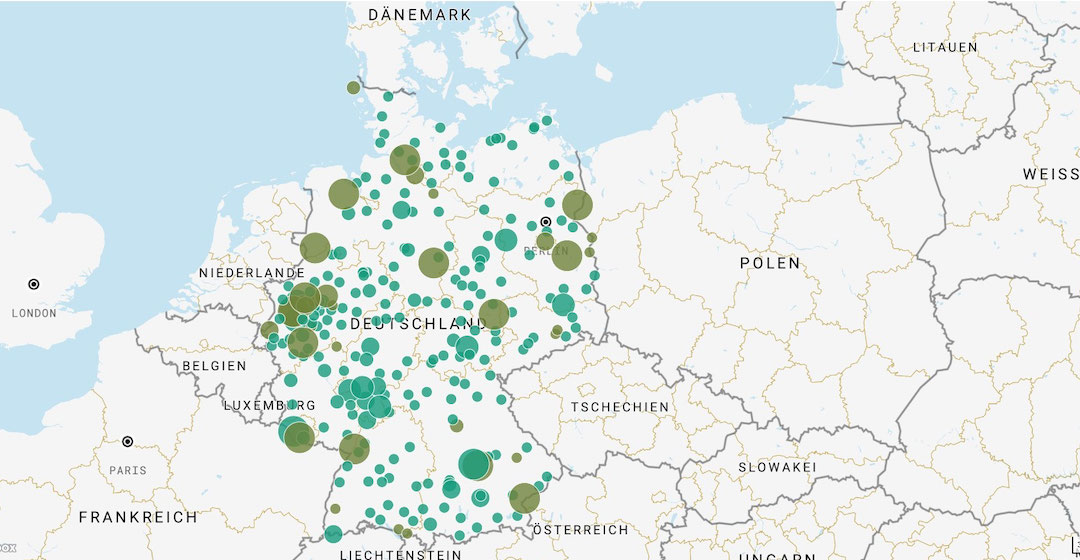
(Freiburg, Germany) – A newly developed atlas identifies and assesses the potential for producing green hydrogen through electrolysis. The project partners identified locations to meet the hydrogen demand of various sectors, including industry (such as chemicals and steel) and transportation hubs for using the energy carrier in buses and trains. The researchers also considered the utilization of oxygen and heat, the byproducts of electrolysis that are generated alongside hydrogen.
Northern Germany has an advantage with wind power
A crucial factor for the cost-effective production of green hydrogen is the availability of renewable energies. Northern Germany has "significant advantages in terms of wind energy supply, while differences in solar radiation are less significant." "Therefore, suitable locations for larger electrolyzers can be found in the electricity grid, especially in the north and particularly near offshore interconnection points," explains Clara Büttner, subproject leader at Flensburg University of Applied Sciences. Electrolysis sites powered by northern German wind power benefit from cost advantages.
The utilization of co-products such as waste heat and oxygen was also able to reduce hydrogen costs in the models examined. These options are often feasible, but do not represent decisive factors in site selection.
Hydrogen core network plays a central role
In contrast, the future German hydrogen core network plays a central role in site evaluation. Electrolyzers are ideal "on sites of former fossil-fuel power plants or industrial parks that have a well-developed infrastructure," says Jochen Behrens, project manager at the Fraunhofer Institute for Solar Energy Systems ISE.
The atlas can be used by project developers, energy suppliers, municipalities, and authorities to identify suitable plant locations. It shows various key figures that are important for investment decisions, including electrolysis capacity, hydrogen production and supply costs, the potential for using renewable energies for electrolysis, and annual energy demand.
A consortium led by the Fraunhofer Institute for Solar Energy Systems ISE is involved in the "PoWerD" project: Flensburg University of Applied Sciences, the Rhineland-Palatinate University of Technology Kaiserslautern-Landau, the German Hydrogen Association, the energy provider Green Planet Energy, the engineering firm Planet, and the ISE spin-off Greenventory. The German Federal Ministry for Economic Affairs and Climate Protection (BMWK) has funded the project with almost 2,5 million euros.
The atlas can be found on the “PoWerD” project page.
The Fraunhofer Institute for Solar Energy Systems (ISE) will present the hydrogen potential atlas in a webinar on June 23, 2025. Participation is free of charge after prior registration.
Photos
The Hydrogen Atlas shows suitable locations for the production and use of hydrogen and its co-products oxygen and heat, shown here for the model year 2030. © Fraunhofer ISE



