
(Aachen / Germany) – A number of hydrogen refueling stations have recently been opened or their construction announced across Europe. For example, H2 Mobility Deutschland GmbH and the chemical company BASF commissioned a new station in Frankenthal (Rhineland-Palatinate) last week. Trucks and buses can refuel there at 350 bar, while cars and light commercial vehicles can refuel at 700 bar.
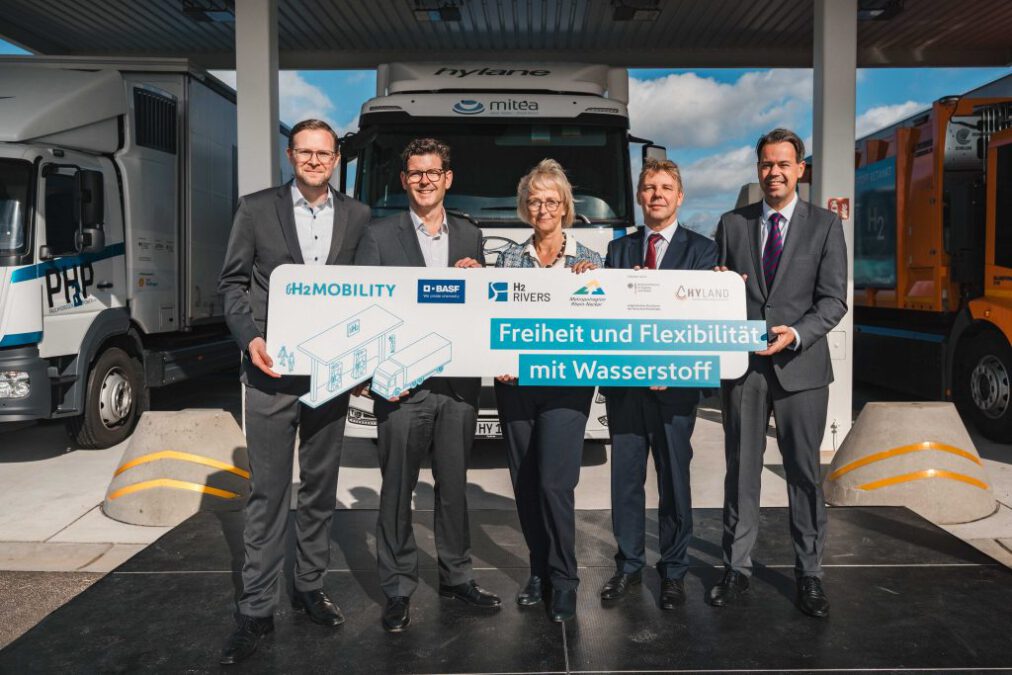
H2-Mobility puts the hydrogen filling station in Frankenthal into operation (from left): Martin Jüngel, Managing Director of H2 Mobility Germany, Tilman Hezel, Senior Vice President Infrastructure (BASF), Doris Wittneben, Head of Future Fields and Innovations (MRN), Sven Halldorn (BMDV), Nicolas Meyer, Mayor of the City of Frankenthal. In the background: "PH2P" truck from Paul Nutzfahrzeuge, Hyundai "Xcient Fuel Cell" from Hylane, garbage collector "Bluepower" from Engenius. © H2 Mobility GmbH
The site is located right next to the BASF factory site. With a daily capacity of around 800 kilograms, the station can supply up to 30 heavy vehicles a day. In a second expansion phase, the capacity will be doubled by 2027. Then three vehicles will be able to refuel at the same time (2x 350 bar, 1x 700 bar). By 2026, further H2 Mobility filling stations "of a similar size and capacity" are to be built in the Rhine-Neckar metropolitan region, including in Mannheim (Baden-Württemberg) and Ludwigshafen (Rhineland-Palatinate).
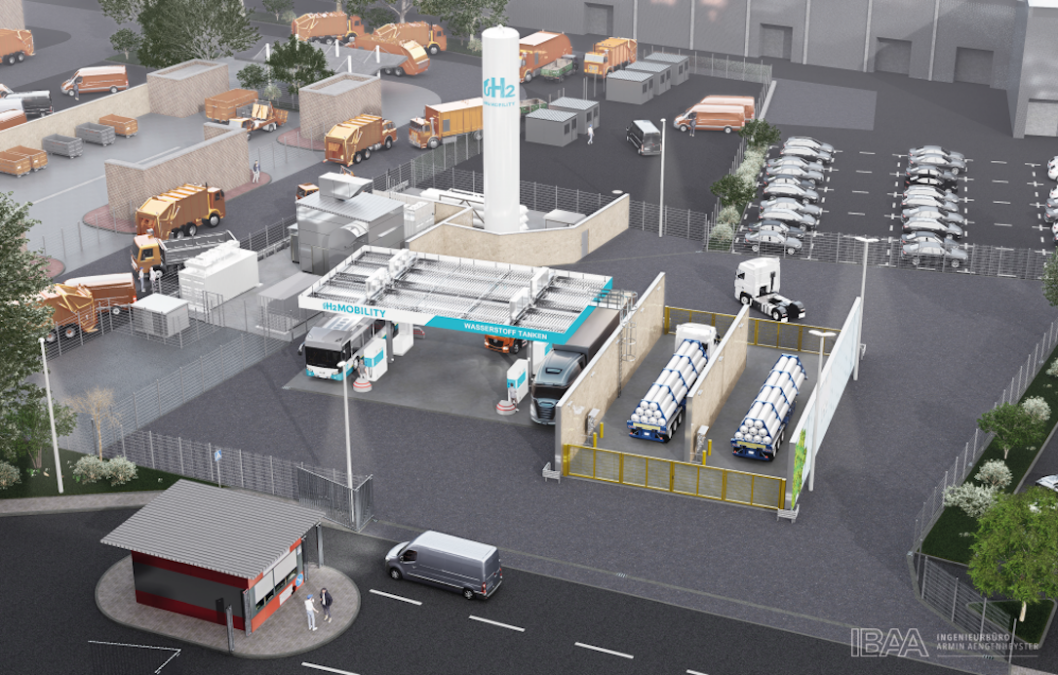
Rendering of the hydrogen filling station currently under construction in Düsseldorf, which is expected to open in early 2025. © IBAA
Recently, H2 Mobility and the French hydrogen producer Lhyfe signed a contract to supply four filling stations with green hydrogen; from 2025, this will include Frankenthal. The plant there was developed as part of the Rhine-Neckar demonstration project "H2Rivers" as part of the "HyLand" program of the Federal Ministry for Digital and Transport (BMDV). The development of the Rhine-Neckar metropolitan region as a hydrogen region is being funded by the federal government with up to 2 million euros as part of the National Innovation Program for Hydrogen and Fuel Cell Technology (NIP20); the hydrogen filling station in Frankenthal with almost 1,3 million euros.
In Düsseldorf, H2 Mobility is currently building a hydrogen filling station with a daily delivery capacity of over five tonnes. There, several vehicle types with 350 and 700 bar (buses, trucks, light commercial vehicles and cars) could be processed simultaneously and one after the other at the same location.
Six gas stations close
However, H2 Mobility had also announced the closure of six 700-bar filling stations in Stuttgart, Kamen, Brunsbüttel, Fellbach, Erfurt and Pforzheim at the end of the year. "We are removing older, small filling stations that were built more than ten years ago and no longer meet today's technical and economic requirements from the network," says Martin Jüngel, Managing Director and CFO of H2 Mobility. The stations are locations "that we built many years ago for cars and where an expansion for heavy commercial vehicles is not possible."
H2APEX filling stations in Rostock
In spring 2, the Luxembourg-based H2023APEX Group was awarded the contract for the planning, construction, operation and maintenance of two hydrogen filling stations in Güstrow and Bad Doberan (investment volume: six million euros). In addition, H2APEX was entrusted with their supply of green hydrogen as well as operation and maintenance.
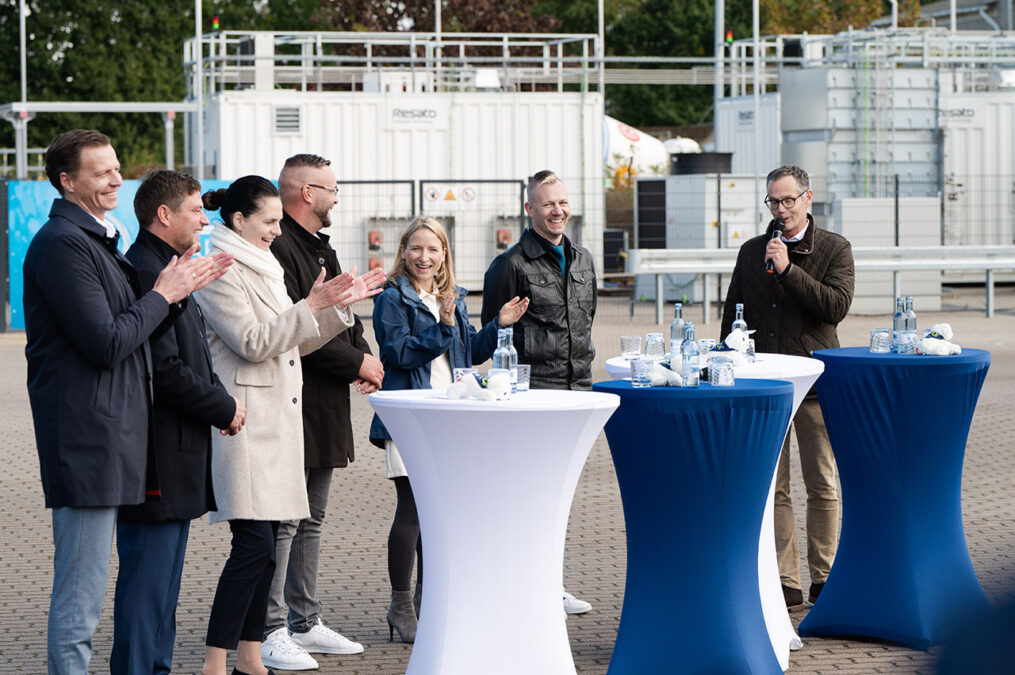
Rebus begins with the introduction of 52 hydrogen buses from Solaris and puts the filling station in Güstrow into operation (from left): Peter Rößner (CEO of H2APEX), District Administrator Sebastian Constien, Ines Jesse (State Secretary in the Ministry of Economic Affairs of the State of Mecklenburg-Western Pomerania), Thomas Nienkerk (CEO Rebus), Daniela Kluckert (Parliamentary State Secretary at the Federal Ministry for Digital and Transport), Marc Weinhauer (Rebus), Christian Goll (CEO Solaris Deutschland GmbH). © H2APEX
The station in Güstrow is now operational - it was developed specifically for bus traffic - and the second in Bad Doberan will be operational by the end of the year. The locations are the depots of Regionalbus Rostock GmbH (Rebus). The two-megawatt electrolysis plant at the company's Rostock-Laage site will provide the green hydrogen required by the end of 2031 with a volume of around 2.200 tons for Rebus. To this end, additional storage capacity for around 400 kilograms of hydrogen will be built for optimized plant operation and the filling and logistics capacity for transporting the hydrogen to the filling stations will be increased.
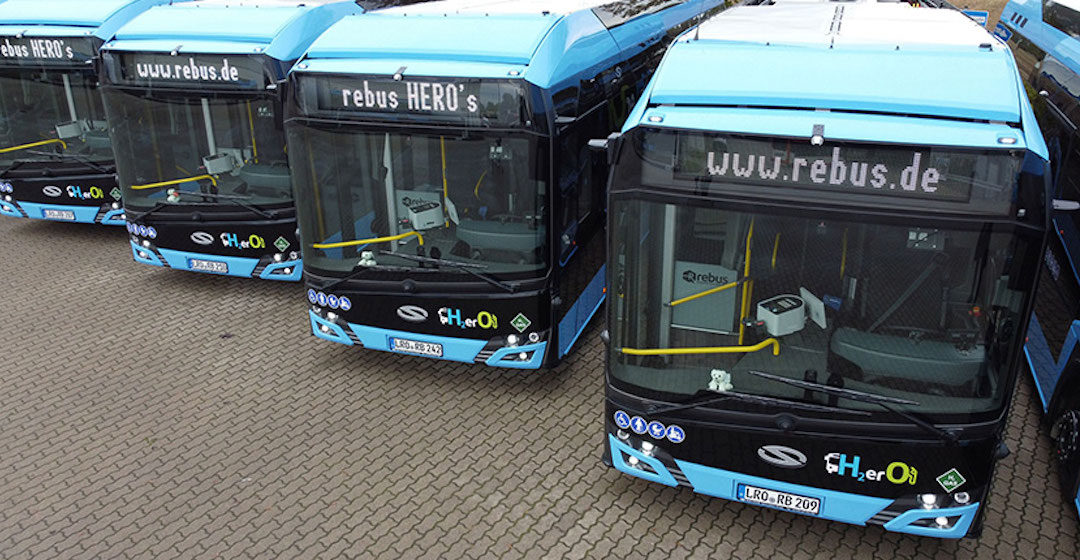
Rebus is adding 52 vehicles from the Portuguese manufacturer Caetano to its hydrogen fleet in Rostock. © Now GmbH
The local transport company in Güstrow has now given the green light to introduce a total of 52 hydrogen buses into its fleet by the end of next year. The Polish manufacturer Solaris Bus & Coach sp. z oo is supplying 47 "Urbino 12 hydrogen" vehicles (twelve meters long) and five "Urbino 18 hydrogen" buses (18 meters). The first 15 are now in operation in Güstrow city traffic and in the southern district. Rebus will thus modernize almost a third of its fleet in a CO2-free manner. According to the information, it will then be the second largest hydrogen bus fleet in Germany and one of the largest in Europe. The total investment amounts to around 40 million euros.
Finland: Vireon builds first H2 station
In Finland, Vireon plans to build the first large-scale green hydrogen filling station in the city of Jyväskylä. There is currently no such station in the country, according to the subsidiary of Norwegian Hydrogen AS, founded in 2023. It is also the first of four strategically located sites made possible by a joint project between the Central Finland Mobility Foundation (Cefmof) and Jyväskylä. Due to its central location, the city is an "ideal starting point for our hydrogen infrastructure," says Per Øyvind Voie, Managing Director of Vireon. This project paves the "way for hydrogen-powered transport throughout Finland."
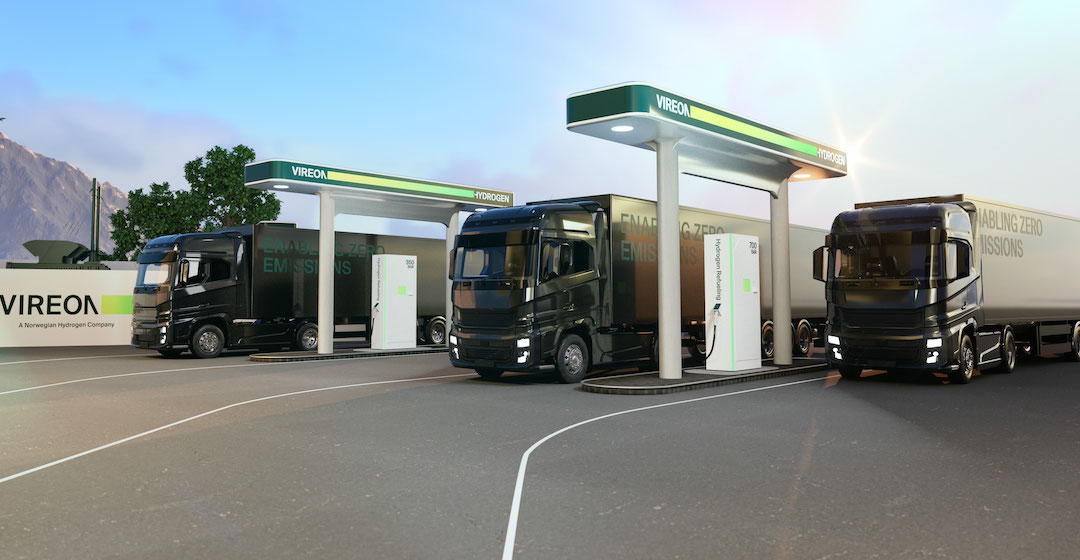
Graphic representation of a Vireon gas station. © Vireon
The filling station is primarily intended for heavy commercial vehicles such as trucks and buses, but will also supply lighter vehicles such as taxis and delivery vans. The first buses in Finland powered by green hydrogen will be tested in Jyväskylä from mid-2025. Five "H2 City Gold" vehicles are to be integrated into the city's public transport system. The manufacturer is the Portuguese Caetanobus Fabricação de Carroçarias, SA, a joint venture between Toyota Caetano Portugal (62 percent) and Mitsui & Co.
Cefmof was founded by the City of Jyväskylä, the Toyota Gazoo Racing World Rally Team and the Toyota Mobility Foundation. The aim is to accelerate "sustainable mobility and urban planning" using green hydrogen.
Sweden: H2 gas station in Örnsköldsvik
Hynion Sverige AB says it has received a grant from the Swedish Energy Agency of 18,21 million Swedish kronor (1,6 million euros) to build a new hydrogen filling station in Örnsköldsvik. The money comes from the Climate Leap program to support regional initiatives and covers 60 percent of the eligible costs.
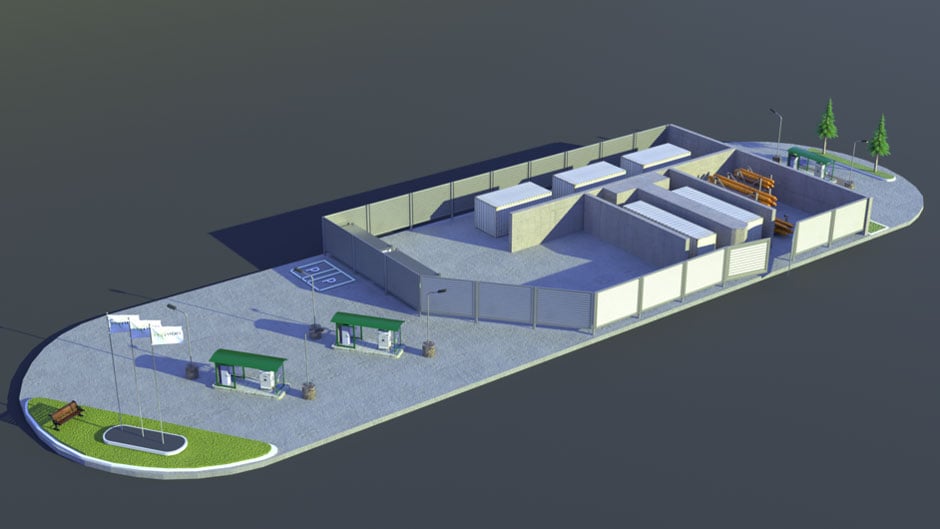
The "new generation" of Hynion's hydrogen filling stations have a capacity of 2.000 kilograms per day. © Hynion Sverige AB
The city was chosen because of its strategic location on the E4, one of Sweden's most important traffic axes. In addition, two national roads intersect here. This makes Örnsköldsvik "an optimal location to support both local and long-distance transport with hydrogen propulsion," the company said. The project is expected to be completed by the end of April 2026.
The "new generation" of Hynion's hydrogen filling stations have a capacity of 2.000 kilograms per day. Similar stations are currently being built in Västerås and Jönköping (we reported). "With the new filling station in Örnsköldsvik, we are strengthening our position as a leading player in hydrogen in Scandinavia," says Slavica Djuric, CEO of Hynion Sverige AB.
France: Station in the TEN-T corridor
In France, the Scandinavian company Cavendish Hydrogen ASA has put a hydrogen filling station into operation as part of the EU-funded project "Cosmhyc Demo". After testing the functionality, the demonstration phase is now beginning. The project was developed together with the "Touraine Vallée de l'Indre" (CCTVI) municipal association and was presented exclusively to regional companies in September. The facility will be presented to the public at an official inauguration ceremony "in the coming weeks", according to the company.
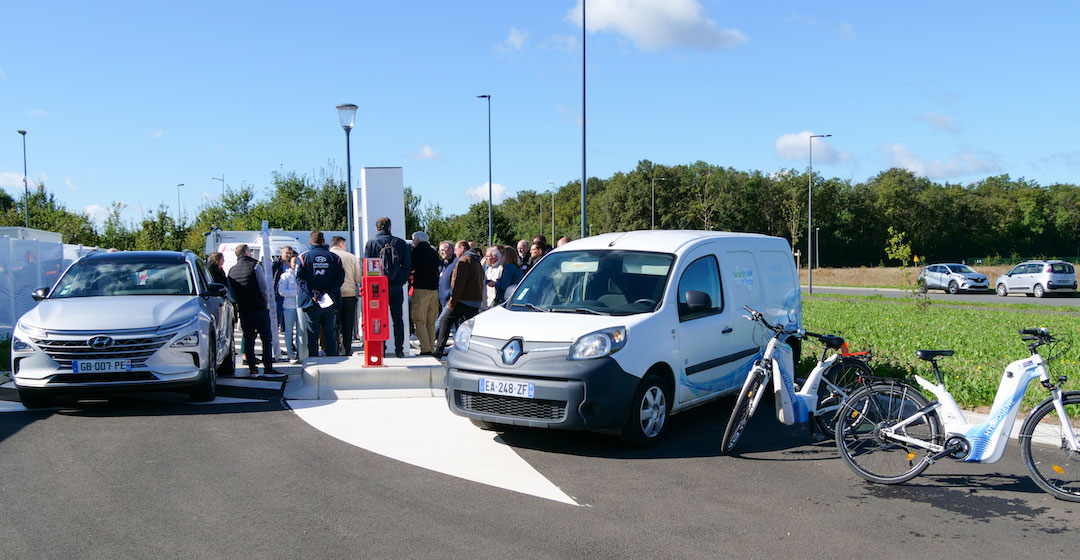
In September, the Touraine Vallée de l'Indre (CCTVI) community association presented the new station to regional companies. Over 60 participants from various sectors accepted the invitation. © CCTVI
It is a station that can refuel light commercial vehicles and cars as well as trucks and garbage trucks at 350 and 700 bar. The site is located directly on the A10 motorway and is therefore in the Trans-European Transport Network (TEN-T) corridor that connects Paris with Bordeaux. The station complements the existing French and European network and closes the gap between Nantes, Paris and Lyon and generally between the Benelux countries, Spain and Portugal.
Cosmhyc Demo is coordinated by the European Institute for Energy Research (EIFER). The consortium includes EIFHYTEC, MAHYTEC, Cavendish, Touraine Vallée de l'Indre and the Steinbeis Europa Zentrum. The consortium received funding of 3,7 million euros from the EU program "Horizon 2020".
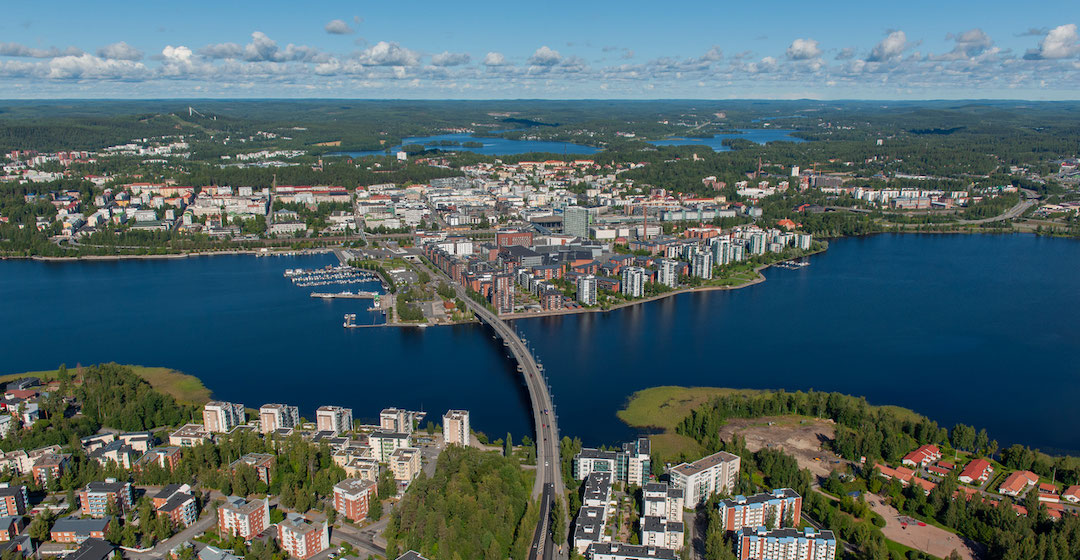
Photo above
The Finnish city of Jyväskylä is getting the country's first hydrogen filling station. © Vireon



