
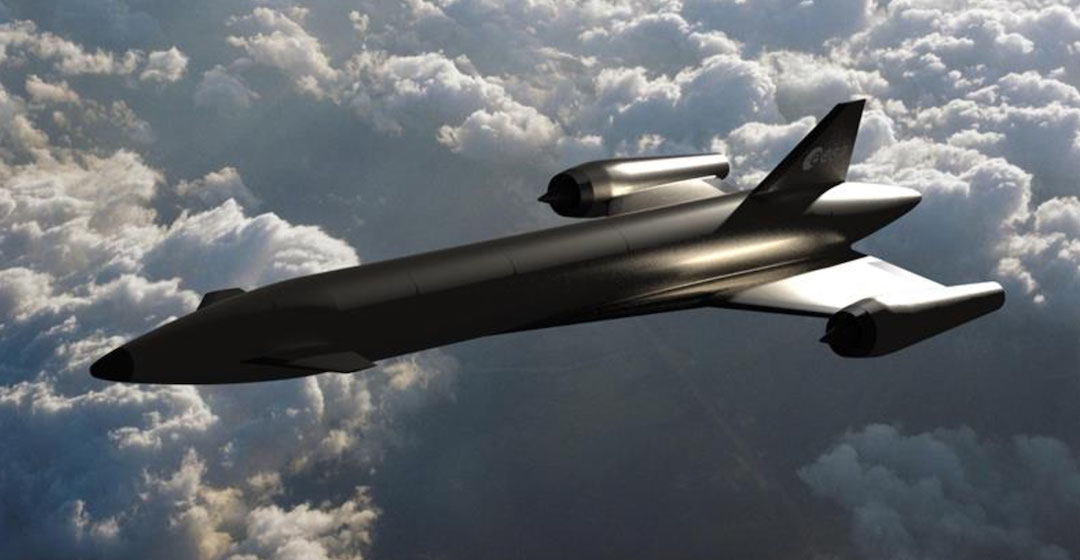
(Paris, France) – The European Space Agency (ESA) and the British company Frazer-Nash Consultancy have launched a joint research program called "Invictus" to develop the concept design for a hypersonic platform. The technology is intended to eventually create a reusable experimental aerospace vehicle capable of horizontal takeoff from a runway and flying at Mach 5 (five times faster than the speed of sound).
Technological Challenges
According to ESA, one of the biggest challenges in operating a hypersonic vehicle is that at high speeds, the exterior surface of the aircraft and the air entering the engines become extremely hot due to shock heating and surface friction. These conditions require special technologies and unique propulsion systems to propel the vehicle at high speeds.
Conventional aircraft engines couldn't be operated in these conditions. While there are some special engines that can fly under these conditions, they only operate within a limited performance window. Furthermore, they aren't capable of taking off from the ground.
Consortium with “SABRE” developers
Working on research and production under Frazer-Nash's leadership are Spirit Aero Systems Holdings Inc., a struggling aircraft fuselage manufacturer (repurchased by Boeing in January), Cranfield University, and several small and medium-sized enterprises. A team of experts from Reaction Engines Ltd (REL) is also involved. Founded in 1989, the British company used ESA funding to research a hypersonic engine called SABRE (Synergetic Air Breathing Rocket Engine). The pre-cooler developed for this purpose cools the air before it reaches the engine, making conventional aircraft engines usable at supersonic speeds. REL's tests have validated the technology under supersonic flight conditions and demonstrated its integration into existing engine architecture.
The pre-cooler is capable of cooling the superheated air in fractions of a second at speeds "well beyond the operating limits of any jet-powered aircraft known to date," according to Frazer-Nash. REL has been in administration since November 2024 after its main investors, Boeing, BAE Systems, and Rolls-Royce, withdrew.
Revolutionizing orbital transport

"Hypersonic flight is the gateway to space." (Tommaso Ghidini, Head of ESA's Mechanical Engineering Department). Pictured: The edge of a star-forming region, NGC 7.600, in the Carina Nebula, approximately 3324 light-years away, as imaged by the near-infrared camera on NASA's James Webb Space Telescope. © NASA, ESA, CSA, STScI
"Hypersonic flight isn't just the next frontier of aerospace—it's the gateway to a new paradigm of mobility, defense, and access to space," says Tommaso Ghidini, Head of the Mechanical Engineering Division at the European Space Agency. With Invictus, Europe is seizing the opportunity to take a leadership role in technologies "that redefine how we move around and beyond the planet."
This lays the foundation for aircraft that launch like airplanes and reach orbit like rockets—"thus revolutionizing both terrestrial and orbital transportation." With decades of experience in propulsion, we now have "all the necessary prerequisites to make this ambitious vision a reality," says Sarah Wilkes, Managing Director at Frazer-Nash.
Convinced by hydrogen propulsion
"The Invictus program will demonstrate the suitability of a hydrogen-powered pre-cooled propulsion system for horizontal takeoff and hypersonic flight," says David Perigo, Chemical Propulsion Engineer at ESA and Technical Lead of the program. It offers "an invaluable opportunity to test the entire engine flow path, from inlet to afterburner, in a full-scale integrated aircraft."
Airworthy until early 2031
The Invictus consortium aims to deliver the preliminary design of the complete flight system, including requirements, analysis, development plan and program definition up to first flight, within the next twelve months.
The goal is to build and fly a Mach 2031 aircraft by early 5 – more than twice as fast as Concorde and over 50 percent faster than the Lockheed SR-71 Blackbird, the world's fastest jet-powered aircraft, which was in service with the US Air Force until 1998.
According to Frazer-Nash, the research is being funded with seven million euros through ESA's General Support Technology Programme (GSTP) and Technology Development Element (TDE).
Class schedule
Visualization of a hypersonic aircraft being researched and developed by a consortium funded by the European Space Agency. © ESA




Engine overheating can be prevented by the side air intake on the vehicle's fuselage. At the same time, turbofan engines can be used without restrictions. VTOL also becomes possible. See patent application "An Improved Deflector Flap for a Vehicle."