

(Washington, USA) – Fuel cell electric vehicles (FCEVs) sold in Europe emit up to 79 percent fewer greenhouse gases over their lifetime than gasoline-powered vehicles – but only if the hydrogen is produced using electricity from renewable sources. Emissions from FCEVs powered by the currently predominant natural gas-based hydrogen amount to 175 grams of CO2 per kilometer (g CO2e/km), which is still 26 percent lower than the life cycle emissions of gasoline vehicles (235 g CO2e/km). However, emissions using green hydrogen are as low as 50 grams. These are the findings of a life cycle analysis by the International Council on Clean Transportation (ICCT).
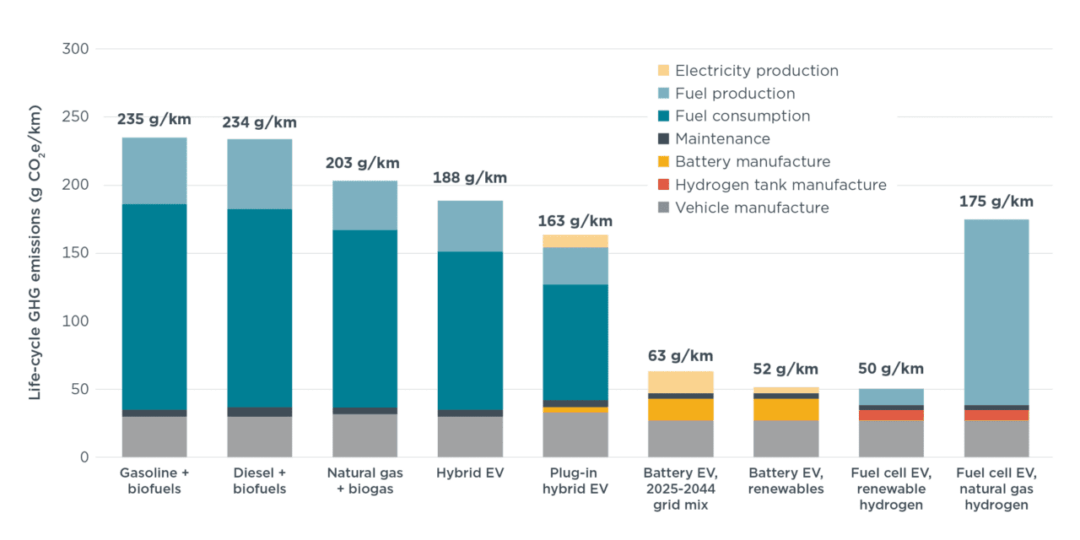
Life cycle analysis: Fuel cell vehicles powered by green hydrogen have the best CO2 footprint of all powertrain types examined. © International Council on Clean Transportation (ICCT)
In contrast, fully electric vehicles (BEVs) sold in Europe today emit 73 percent fewer greenhouse gases over their lifetime than gasoline-powered vehicles (ICEVs, internal combustion engine vehicles). This represents an improvement of 24 percentage points compared to the ICCT's 2021 calculations. The figure for the conventional electricity mix is 63 grams, while the figure for green electricity is 52 grams. "This progress is primarily due to the accelerated expansion of renewable energies and the high efficiency of battery-powered vehicles," says ICCT scientist Marta Negri.
Uncertainty due to misinformation
"Misinformation in the debate" has contributed to the uncertainty surrounding the climate impact of electric cars. According to the ICCT, certain assumptions could significantly distort the results—for example, if one fails to take into account that the electricity mix changes over the lifetime of the vehicles, that the actual fuel consumption figures of cars often deviate significantly from the official figures, or that vehicles are used for an average of more than 20 years.
The higher CO2 footprint of electric cars, presumably due to battery production, is "generally offset within the first to second year of use." Although the production of fully electric vehicles generates around 40 percent more emissions than gasoline vehicles, this initial "emissions deficit" is already offset after about 17.000 kilometers, according to the study.
Hybrid and plug-in better than petrol
Other drive technologies also lagged behind fully electric vehicles in their climate footprint. Diesel vehicles (234 g CO2e/km) had similar lifecycle emissions to gasoline vehicles, while natural gas-powered vehicles (CNG, 203 g CO2e/km) were estimated to have only 13 percent lower emissions. Hybrid vehicles (HEV, 188 g CO2e/km) produced approximately 20 percent fewer emissions than gasoline vehicles, and plug-in hybrids (PHEV, 163 g CO2e/km) around 30 percent lower. Plug-in hybrids are "driven electrically less frequently than originally assumed" in everyday life, according to the analysis.
"Recently, executives in the automotive industry have repeatedly misrepresented the carbon footprint, particularly when comparing electric cars and hybrids," says Georg Bieker, Senior Researcher at the ICCT. However, a life cycle analysis must reflect representative use over the entire vehicle lifespan and be based on real-world data. "With this study, we aim to objectify the public debate and provide policymakers and industry with a reliable basis for decision-making."
A study by the ICCT analyzes greenhouse gas emissions from passenger cars based on their powertrain types. © International Council on Clean Transportation (ICCT)
The authors conclude: The phasing out of new registrations of ICEVs, HEVs, and PHEVs powered by the average fuel and electricity mix by 2035 would align the sector's emissions with the EU's climate targets. BEVs offer significant reductions in greenhouse gas emissions. To achieve a similar or better emission reduction potential than BEVs, FCEVs would have to be limited to the use of green hydrogen. Vehicles powered exclusively by e-fuels would theoretically achieve similar life-cycle emissions to BEVs. However, the availability of e-fuels for road transport is uncertain, while costs are expected to remain high.
The ICCT is a non-profit organization based in Washington, D.C., with offices in San Francisco and Berlin. It is funded by philanthropic foundations, particularly the Hewlett-Packard family. The ICCT and West Virginia University played a key role in uncovering the VW emissions scandal in the United States in 2015 with their own investigations.
The analysis “Life-cycle greenhouse gas emissions from passenger cars in the European Union. A 2025 update and key factors to consider” is available free of charge as a PDF (38 pages).
Photo above
Fuel cell vehicles powered by natural gas-based hydrogen perform only slightly better in terms of emissions than gasoline, diesel, and hybrid vehicles. © H2 Mobility GmbH



