
(Hamburg, Germany) – Daimler Truck AG, Kawasaki Heavy Industries Ltd., and Hamburger Hafen und Logistik AG (HHLA) intend to explore the development of a reliable and economical supply chain for green liquid hydrogen via the Port of Hamburg to the European hinterland. The cooperation aims to facilitate imports from hydrogen-producing countries to Germany, thereby strengthening the Hanseatic city as a central hub.
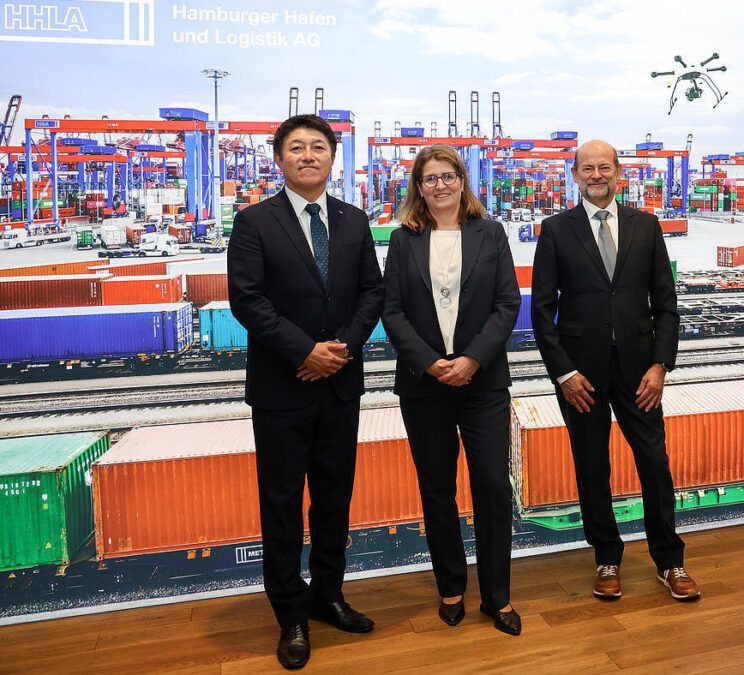
Cooperating on the liquid hydrogen supply chain (from left): Kei Nomura (Kawasaki Heavy Industries), Annette Walter (HHLA), and Andreas Gorbach (Daimler Truck). © HHLA
The initial study will examine the logistical requirements for transshipment and onward transport by road and rail. Furthermore, the company intends to engage other companies and institutions to build a consortium along the entire value chain. Hydrogen is key to a climate-neutral future, and liquid hydrogen plays a central role "because it can be transported independently of pipelines," says Annette Walter, Chief Financial Officer of HHLA. The goal is to "reliably supply industry with hydrogen via our European logistics network."
"Europe will continue to rely on imports for green energy in the future," says Andreas Gorbach, Member of the Board of Management of Daimler Trucks. "We will need more initiatives of this kind to strengthen Europe's leadership in liquid hydrogen." The Mercedes-Benz GenH2 truck, developed in-house, could not only become a consumer of green liquid hydrogen but also enable further transport by road.
Key to a sustainable energy society
Kei Nomura, Executive Central Manager, Hydrogen Strategy Division, Kawasaki Heavy Industries Ltd., also emphasizes the importance of liquefied hydrogen as a "crucial key to a sustainable energy society." Kawasaki has the technologies and extensive experience in production, storage, transportation, and handling. The company is working with authorities and companies worldwide to establish a supply chain early on. A key factor is the development and commissioning of liquefied hydrogen vessels of various sizes—with capacities of up to 160.000 cubic meters, comparable to today's liquefied natural gas carriers.
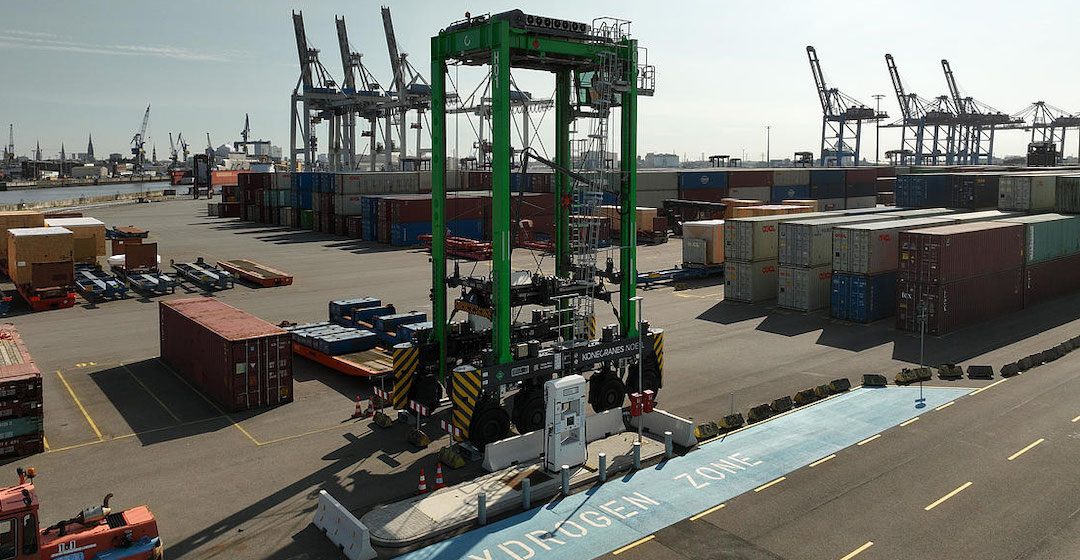
HHLA is currently testing the first fuel cell-powered van carrier at the Tollerort Container Terminal in the Port of Hamburg. © HHLA
Hamburger Hafen und Logistik AG aims to become climate-neutral across the group by 2040. HHLA is also working intensively on the use of fuel cells in handling equipment and heavy-duty transport. In the Clean Port & Logistics cluster, HHLA is working with over 40 partner companies from around the world to develop solutions to bring hydrogen-powered vehicles and terminal equipment to market readiness in a short time and to prepare the necessary measures for their use.
For example, the first hydrogen-powered van carrier for container transport is currently being tested at the Tollerort Terminal in the Port of Hamburg. Special concepts for operation, safety, maintenance, refueling, and supply have been developed for this purpose. The technology achieves the performance level of conventional drives and operates completely emission-free, said Volker Windeck, Head of Hydrogen Projects, at the presentation in September.
Photo above
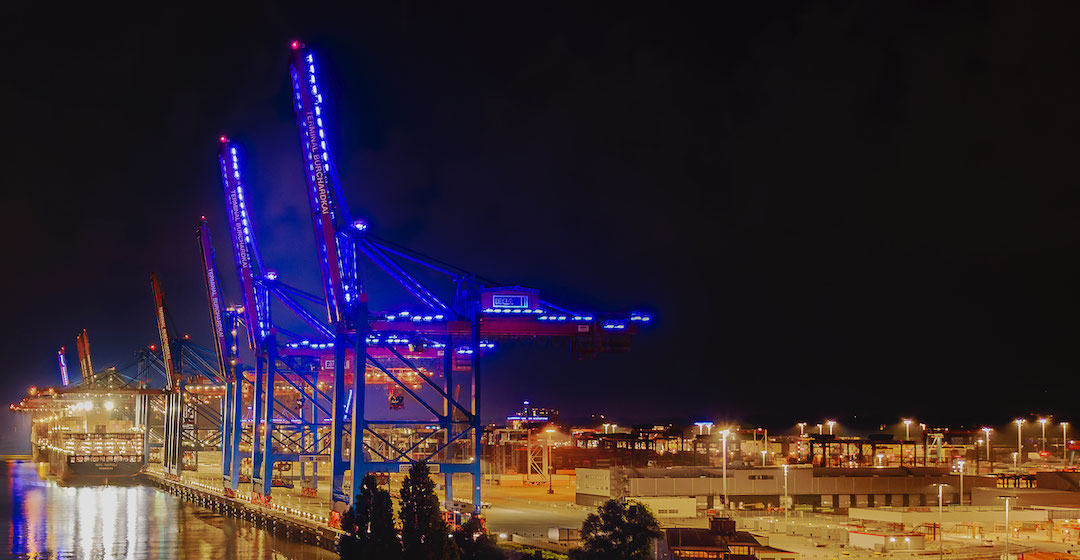
The Port of Hamburg aims to establish itself as a hub for green hydrogen and is working with a consortium to explore ways to supply the hinterland with liquid hydrogen. The photo shows this year's "Blue Port" event in September, during which all HHLA container cranes at the terminals will be illuminated in blue light. © HHLA



