
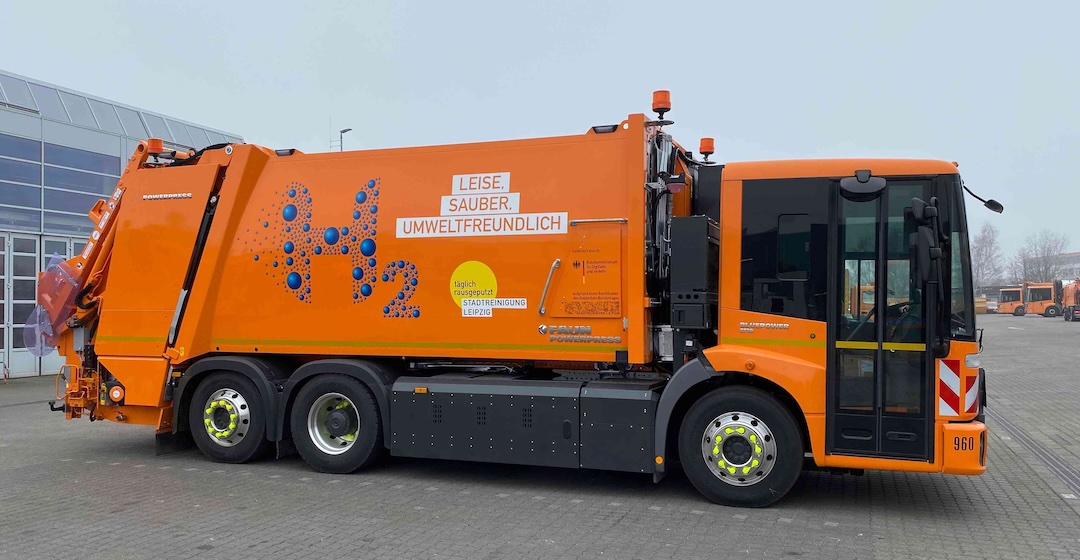
(Leipzig, Germany) – Around six years ago, the city of Leipzig decided to purchase fuel cell-powered garbage trucks. Since 2024, the trucks have been contributing to the testing of alternative drive technologies within the municipal waste management department. However, after two years of operation, practical experience has shown that the vehicles do not yet achieve the necessary availability for regular operation. This information comes from the city council's response to a council inquiry.
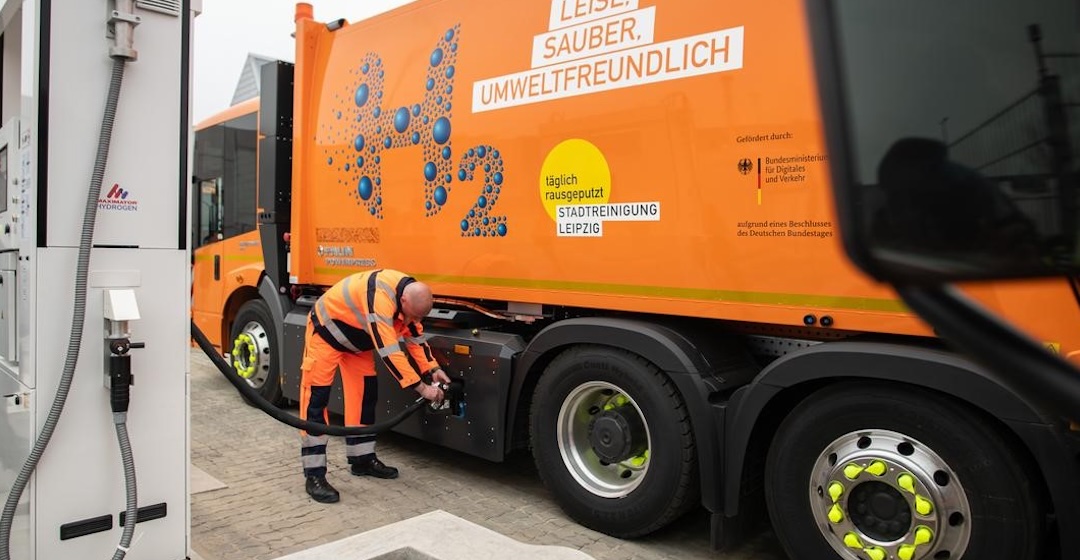
The current focus is on stabilizing vehicle operations and increasing availability. © Stadtreinigung Leipzig GmbH
In particular, this lower availability compared to conventional vehicles impacts operational planning, the need for replacement vehicles, and cost-effectiveness. The current focus for the city of Leipzig's municipal services department is "on stabilizing vehicle operations, increasing operational availability, and further developing its own technical expertise." The acquisition costs for the 16 trucks totaled €17,6 million. Comparable conventional diesel trucks would have cost €5,6 million. The additional costs thus amounted to approximately €12 million – an average of €75.000 per vehicle – which were largely offset by federal subsidies of €10,8 million.
Deployment rate below 50 percent
Conventional waste collection vehicles are assumed to have an operational rate of 80 percent. Hydrogen-powered vehicles achieved an average of 45,6 percent. This was primarily due to technical malfunctions, maintenance and repair needs, and limitations associated with the new drive technology.
"The vehicles' fuel consumption remains significantly below that of conventional vehicles," the council stated in its response. This is "not yet sufficient for regular operation." In the event of unavailability, the manufacturer will provide conventional replacement vehicles. This will ensure the reliability of waste disposal in daily operations.
Central workshop builds up technical expertise
A direct comparison with conventional waste collection vehicles is only possible to a limited extent when it comes to maintenance, as the vehicles, being a new drive technology, have specific technical requirements during operation. The hydrogen trucks require more extensive coordination, diagnostics, and repairs. Maintenance is currently carried out by a local service provider. At the same time, the city's central workshop is developing its own expertise to gradually strengthen the technical support for the vehicles. A final assessment of the maintenance effort will only be possible after a longer comparison period.
No data available for operating cost comparison
A reliable comparison of operating costs per vehicle or operating hour is currently only possible to a limited extent. The necessary data, particularly regarding energy consumption, maintenance, repairs, replacement vehicles, infrastructure, and actual operating hours, are not yet available in a conclusively evaluated form. However, it can be assumed that the calculated costs per day of operation are currently higher than those of conventional vehicles. It should also be noted that hydrogen-powered waste collectors are "still in a phase of technical stabilization and operational optimization."
At the time of the purchase decision in 2020/2021, alternative drive technologies for heavy refuse collection vehicles were in a dynamic development and early market phase. Neither purely battery-electric nor hydrogen and fuel cell technologies offered the same extensive long-term operational experience as conventional diesel vehicles.
“Trucks with purely electric drive are significantly heavier than our new hydrogen vehicles,” said operations manager Thomas Kretzschmar in March 2024. “Had we opted for purely electric vehicles, we would have been able to transport less waste and would have been forced to replan all our routes.”
Photo above
The hydrogen-powered garbage trucks in Leipzig are showing weaknesses, but are still undergoing operational optimization. © Stadtreinigung Leipzig GmbH



