
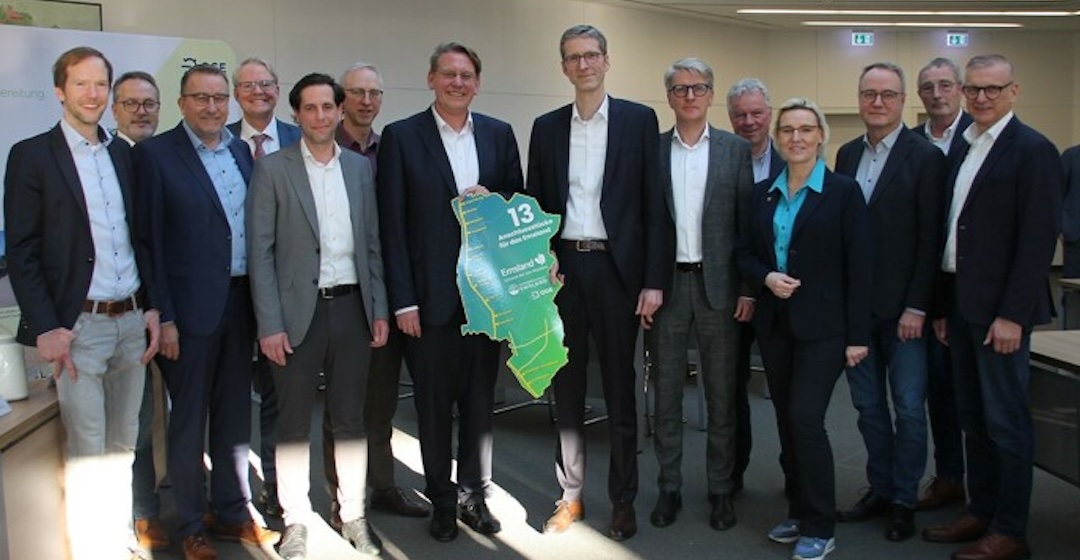
(Emsland / Germany) – The Emsland district and the gas network operator Open Grid Europe GmbH (OGE) have contractually secured the regional connection to the "North Sea-Ruhr-Link III" hydrogen transport pipeline and thus to the future core hydrogen network. "We have now created the strategic and infrastructural prerequisites," says District Administrator Marc-André Burgdorf. Furthermore, the exchange and networking, as well as the final determination of hydrogen potential, will begin through the formation of clusters comprising municipalities and regional businesses.
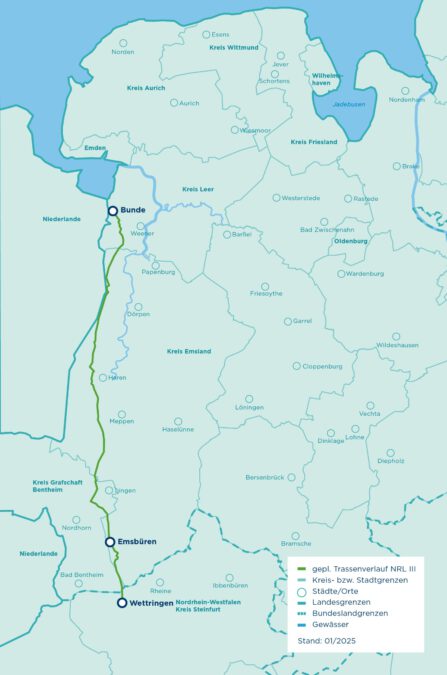
Map of the North Sea-Ruhr Link III hydrogen pipeline. © Open Grid Europe GmbH
The approximately 122-kilometer-long hydrogen pipeline runs from Bunde to Wettringen in North Rhine-Westphalia. Burgdorf says that 13 sections have been planned and coordinated in advance, and the financing for these sections has been prepared in close cooperation with the municipalities. The connections are located in the municipalities of Papenburg, Rhede, Dörpen, Lathen, Haren (Ems), Meppen, Geeste, Twist, Emsbüren, and Salzbergen.
Since October 2024, OGE, together with other gas network operators, has been commissioned by the German Federal Government and the Federal Network Agency to develop the core hydrogen network. The North Sea-Ruhr Link III, along with the Wilhelmshaven coastal line and the North Sea-Ruhr Link I, forms the central connection route for future hydrogen transport from the coastal region to northwestern Germany. Construction is scheduled to begin at the end of the third quarter of this year, with commissioning planned for 2027. However, OGE Managing Director Detlef Brüggemeyer says that continued "clear political support for the hydrogen ramp-up" is essential.
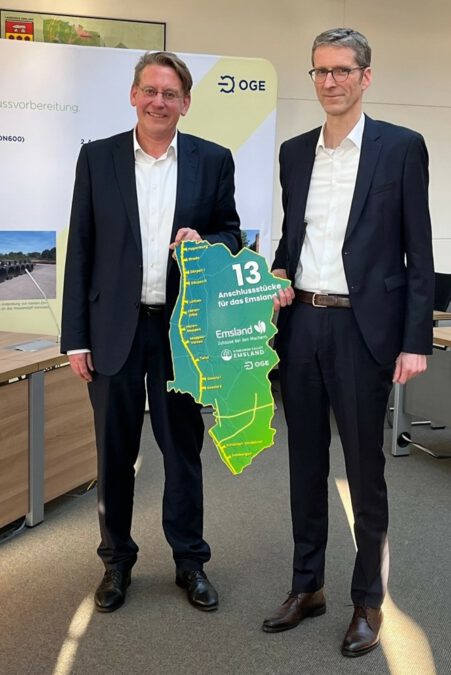
District Administrator Marc-André Burgdorf (left) and Detlef Brüggemeyer, OGE Managing Director, after the contract signing. © Emsland District
“The Emsland region is positioning itself as Germany’s central hydrogen hub and is actively driving the energy transition forward with major industrial and infrastructure projects,” says Lower Saxony’s Minister of Economic Affairs, Grant Hendrik Tonne. With significant investments in electrolyzers, pipelines, and innovative applications, a key region for renewable hydrogen is emerging. This will strengthen Germany’s security of supply and decisively advance the development of a national hydrogen network. Tonne adds: “This is a prerequisite for the decarbonization of German industry.”
Photo above
The contract was signed by District Administrator Marc-André Burgdorf (7th from left) and Detlef Brüggemeyer, OGE Managing Director (8th from left), in the presence of mayors of the participating Emsland municipalities and other invited guests from politics and business. © Emsland District



