

(Chemnitz, Germany) – A consortium of scientists and industry partners plans to develop a hydrogen-powered motorcycle. The bike, dubbed the "Hydrocycle," will be of interest to inner-city delivery services and parcel carriers due to its agility and compact design, according to researchers at the Fraunhofer Institute for Machine Tools and Forming Technology IWU in Chemnitz. They also believe it could "serve as inspiration for the mobility of the future."
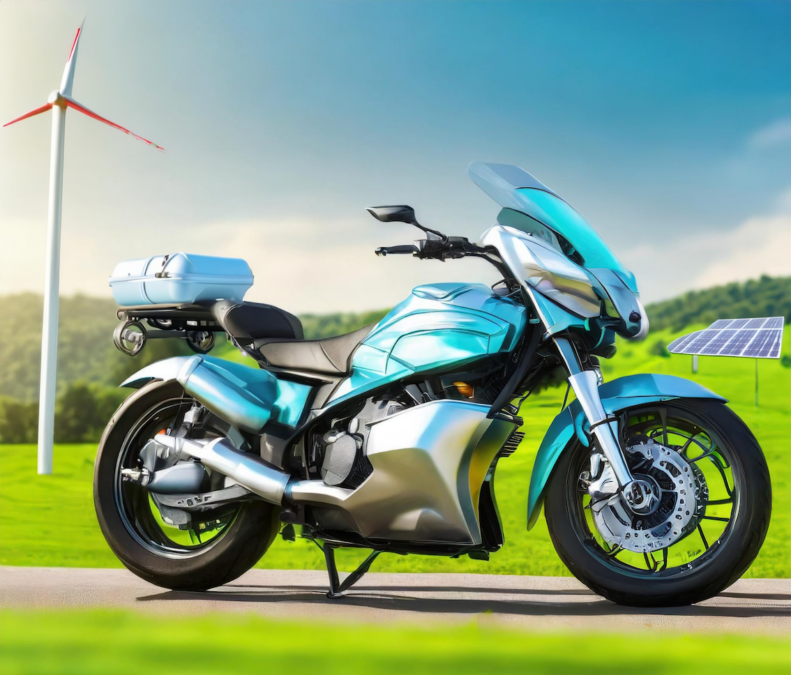
This is what the hydrogen-powered motorcycle called “Hydrocycle” could look like. © IWU (AI-generated image / Adobe Firefly)
“If one kilogram of hydrogen allows a range of around 100 kilometers in a car, an H2 tank for the electric drive can also be accommodated in the limited installation space of a motorcycle,” says the IWU in Chemnitz. However, accommodating a complete fuel cell system in the frame construction, which is required on board to convert the hydrogen into electrical energy, is “significantly more demanding”.

A stack from WätaS is the basis for the development of the fuel cell system in the “Hydrocycle” © WätaSwärmetauscher Sachsen GmbH
The consortium of Fraunhofer IWU, WätaSwärmetauscher Sachsen GmbH (Olbernhau), 1to1design (Prague), Czech Technical University (ČVUT, Prague) and ÚJV Řež (Husinec) have divided the tasks among themselves. The partners from the Czech Republic worked on vehicle development and pushed forward the work packages of vehicle structure, ergonomics and packaging (accommodation of the technology in the available installation space). The German project partners focused on the powertrain. The fuel cell stack from WätaSwärmetauscher Sachsen GmbH serves as the basis for the drive system. The Fraunhofer IWU supports research into new manufacturing approaches and functionalities of the stack. The Chemnitz institute is also responsible for dimensioning the system with regard to the required performance and packaging; also for an interface between vehicle and fuel cell system development.
The prototype of such a “hydrocycle” that meets European approval standards and certification regulations is expected to be created by the end of 2025.
Photos
At ČVUT, scientists are working on the vehicle structure of the planned hydrogen-powered motorcycle “Hydrocycle”. © ČVUT Czech Technical University



