

France: HDF plans further hydrogen power plants in Southeast Asia +++ Germany: H2HUB learning alliance launches further training in the field of hydrogen +++ Namibia: Hyphen receives ten million dollars from the African Development Bank +++ Great Britain: ITM Power develops hydrogen projects in Australia and Canada +++ Namibia: GreeN-H2-Namibia publishes tool to support water management +++ Spain: IFF plans to produce 100 tons of green hydrogen in its fragrance factory +++ France: Lhyfe supplies bus refueling stations in Germany with green hydrogen +++ Norway: Nel receives PEM contract worth 50 million dollars
A selection of PtX topics summarized at the end of the week
+ + + + +
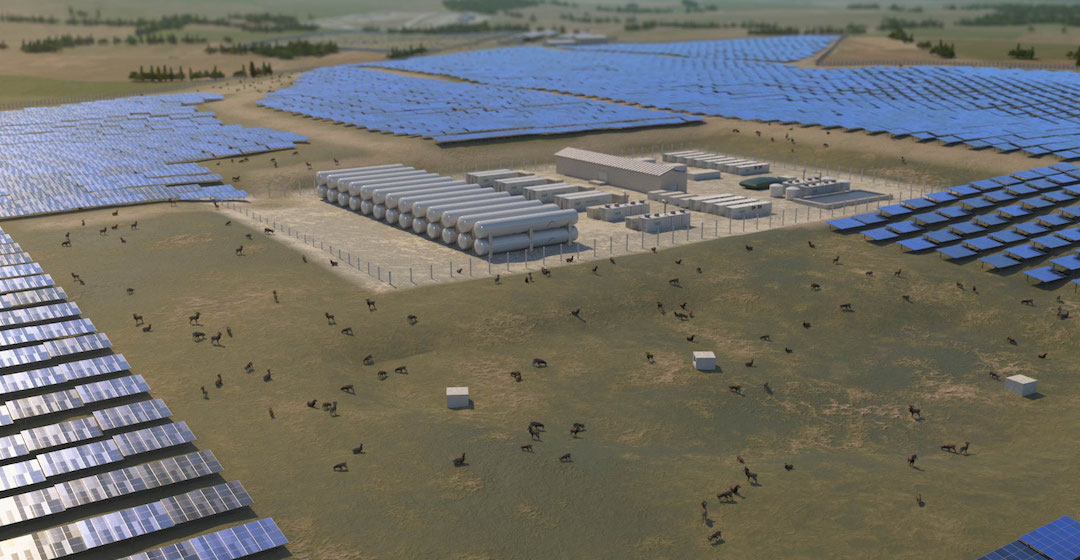
Rendering of a planned "Renewstable" hydrogen power plant with solar power generation, announced by HDF in March 2025, on Barbados. The island nation aims to transition entirely to renewable energy by 2030. The plant is intended to replace the equivalent of 13 megawatts of imported fossil fuels (as previously reported). © HDF Energy
(France) French power producer and fuel cell manufacturer Hydrogène de France Energy Pty Ltd. (HDF Energy) and the Philippine state-owned National Development Company (NDC) have agreed to accelerate the development of green hydrogen power plants. According to the agreement, the local subsidiary HDF Energy Philippines and NDC will jointly evaluate sites for "Renewstable" hybrid power plants. A similar agreement was reached in early December between HDF Energy Indonesia and the provincial government of South Papua. HDF currently reports that it is developing a total of 23 "Renewstable" projects in eastern Indonesia, representing a total investment of more than $2,3 billion. These projects are supported by international development institutions, including the US International Development Finance Corporation (DFC). HDF's "Renewstable" plants are intended to offer an environmentally friendly alternative to conventional diesel power plants. They utilize electricity from intermittent solar and wind farms to produce green hydrogen. This energy is stored locally and, through reconversion to electricity via fuel cells, provides stable base load power to the grid around the clock.
+ + + + +

Members of the H2HUB Plus project team: The next stage of the learning alliance offers further training in the field of hydrogen. © IWES / Michael Palatini
(Germany) A consortium has launched the "H2HUB Plus" project, offering continuing education programs in the field of hydrogen for specialists, managers, students, and pupils in Central Germany. The "learning alliance" builds on the structures developed since 2022 by the preliminary project and expands the program to include additional formats and target groups. These include educational partnerships with companies and public institutions, continuing professional development programs, and public offerings such as citizen dialogues. A summer school is also planned. "H2HUB Plus" is an initiative of Anhalt University of Applied Sciences, Otto von Guericke University Magdeburg, Merseburg University of Applied Sciences, and the Fraunhofer Institute for Microstructure of Materials and Systems IMWS, under the leadership of the Fraunhofer Institute for Wind Energy Systems IWES. The project is funded for four years with approximately €5,3 million by the Federal Ministry for Economic Affairs and Energy.
+ + + + +

Rendering of Hyphen's planned hydrogen project in Namibia. © Hyphen Hydrogen Energy (Pty) Ltd.
(Namibia) The African Development Bank (AfDB) is providing $10 million in funding for a major green hydrogen and ammonia project by the Namibian company Hyphen Hydrogen Energy. The loan supports front-end engineering and design studies. The first phase includes 3,75 gigawatts of renewable energy generation, battery storage, 1,5 gigawatts of electrolysis capacity, and infrastructure projects such as pipelines, transmission lines, and improved port facilities. Upon completion, the project is expected to produce two million tons of green ammonia annually for export and promote local economic development. In addition, a desalination plant will supply three million liters of clean water daily to the water-scarce Lüderitz region in southern Namibia. The project is projected to create 15.000 jobs during the construction phase and 3.000 permanent positions; 90 percent of these will be for Namibian nationals, including 20 percent for young people in a country where youth unemployment exceeds 38 percent. “By supporting these important pre-investment activities, we are creating billions in project financing. This is a strategically impactful development project,” said Daniel Schroth, Director of Renewable Energy and Energy Efficiency at AfDB. The funds are being provided by the Sustainable Energy Fund for Africa (SEFA), a special fund for private investment in renewable energy and energy efficiency. SEFA offers technical assistance and favorable financing instruments to reduce market barriers.
+ + + + +

ITM Power has secured contracts for preliminary studies based on its "Neptune" technology in Canada and Australia. © ITM Power plc
(Great Britain) British company ITM Power plc has been awarded two engineering services contracts for hydrogen projects. The company will develop the design for a project in Australia for an unnamed industrial client. In Canada, ITM Power is preparing a Front-End Engineering Design Study (FEED) for a project that aims to produce hydrogen using hydropower. Both projects, with a combined capacity of 70 megawatts, are based on ITM's containerized green hydrogen production plant, "Neptune V." Just a few days earlier, ITM Power was selected as the technology partner and supplier for two infrastructure projects in Germany with a combined electrolysis capacity of 710 megawatts.
+ + + + +

The report describes the capacities of the water supply infrastructure and its potential bottlenecks. © Dechema
(Namibia) The "GreeN-H2-Namibia" project has published a report on water management in Namibia's Central Hydrogen Valley, located in the Erongo region. The report aims to create a foundation for forward-looking and integrated planning to support decision-makers. Namibia's Central Hydrogen Valley, encompassing Walvis Bay, Swakopmund, Arandis, and Uis, forms the central coastal corridor for green hydrogen, mining, and logistics. With increasing industrial activity, pressure on water supply, infrastructure planning, and governance is growing. Without a clear overview of future water demand and coordinated planning to meet it, the region risks costly duplication of desalination infrastructure development, higher tariffs, and increased strain on sensitive coastal ecosystems. The project is a collaboration between the German Federal Ministry for Research, Technology and Space (BMFTR) and the German Association for Chemical Engineering and Biotechnology (DECHEMA) and the ISOE Institute for Social-Ecological Research. The report “Perspectives for Integrated Water Management in Namibia’s Central Hydrogen Valley” summarizes over 100 information sources and describes the capacities of the water supply infrastructure and potential bottlenecks, explains industrial developments, and provides an overview of desalination projects. This and other reports from GreeN-H2 Namibia are available free of charge on the Dechema website.
+ + + + +

IFF plans to use green hydrogen for flavor production at its factory in Benicarló. © International Flavors & Fragrances IFFSA
(Spain) International Flavors & Fragrances IFFSA, a supplier of flavors, fragrances, and food ingredients, plans to produce green hydrogen and install a storage facility at its Benicarló (Castellón) site. The capacity will be approximately 100 tons per year and will be used by IFF Benicarló for the production of fragrances and flavors. The switch from gray to green hydrogen at the Benicarló site is "a significant change," says Jaime Gomezflores, Senior Vice President for Global Manufacturing Operations at IFF Scent. Previous production methods, such as steam methane conversion, relied on fossil fuels. The energy provider Iberdrola SA will now supply the site with electricity from renewable energy sources.
+ + + + +

Lhyfe supplies bus refueling stations with green hydrogen. © Lhyfe
(France) Manufacturer Lhyfe will supply RFNBO-certified hydrogen to an unnamed filling station operator in Germany. The volume is 90 tons over a period of 15 months. The exclusively privately owned stations will refuel a fleet of several dozen buses. Lhyfe had only recently commissioned a production facility in Schwäbisch Gmünd. The contract confirms "Germany's strong momentum in the development of green hydrogen, particularly in the area of hydrogen mobility," says Lhyfe founder and CEO Matthieu Guesné.
+ + + + +

Nel's PEM factory in Wallingford, Connecticut. © Nel ASA
(Norway) Nel Hydrogen US, a subsidiary of Nel ASA, has received two orders from Kaupanes Hydrogen AS and HyFuel AS in Norway for the delivery of containerized Nel MC 500 PEM systems, each with a capacity of 20 megawatts. The total contract value exceeds $50 million (€43 million), which the company describes as "the second largest order" Nel has ever received. Both projects are being developed by Hydrogen Solutions AS (HYDS). The HyFuel project is owned by HYDS, Sogn og Fjordane Energi AS, and Fjord Base Holding AS. The hydrogen production plant will be installed at the offshore supply base in Florø, Kinn municipality, and is being supported by the Norwegian economic development agency Enova with 180 million kroner (€15 million). The Kaupanes project is owned by HYDS, Dalane Energi AS, and Eigersund Næring og Havn KF. The hydrogen production plant will be installed in the Kaupanes industrial park in the municipality of Eigersund. Enova is funding the project with 206 million crowns (17 million euros). The systems, built at the Wallingford factory in the USA, are scheduled for delivery starting in the second half of 2026, with commissioning planned for early 2028.
+ + + + +
Photos
iStock / © Danil Melekhin



