

Spain: Moeve begins construction of electrolysis plants in Andalusia +++ Germany: Schleswig-Holstein funds electrolyzer for Lübeck waste management company +++ Germany: Consortium says nothing new about announced ramp-up of hydrogen-powered vehicles +++ Germany: Real-time analysis of electrolyzer during operation +++ Germany: Windgas Haurup hydrogen project receives €4,25 million in funding +++ Indonesia: HDF Energy and Pertamina NRE plan to develop hydrogen-based energy projects +++ Germany: First CO2 export terminal scheduled to go into operation in 2031 +++ Germany: Green methanol also from water-scarce regions (study) +++ Switzerland: IET builds modular test platform for new hydrogen technologies +++ Germany: Fraunhofer IAP, UMSICHT and SGC Energy aim to further develop hydrogen and battery technologies +++ Switzerland: PSI inaugurates demonstration plant for sustainable aviation fuel
A selection of PtX topics summarized
+ + + + +
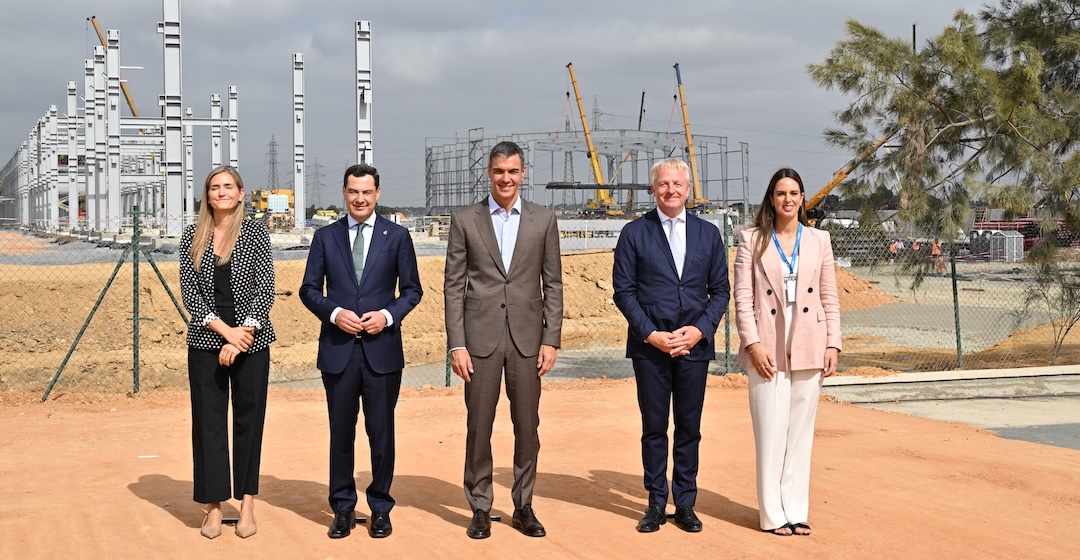
Moeve begins construction of the "Onuba" hydrogen production plant in the presence of Spanish Prime Minister Pedro Sánchez (center). © Moeve SA
(Spain) The Spanish energy and chemical company Moeve SA has begun the first construction phase of its "Onuba" project, which will install electrolyzers with an initial capacity of 300 megawatts in the "Andalusian Green Hydrogen Valley." The company states that a further 105 megawatts are potentially possible. The investment amounts to more than one billion euros, including the associated infrastructure. Approximately one-third of this is subsidized by the Spanish government. During the development, construction, and commissioning phases, over 8.000 direct and indirect jobs will be created across the entire value chain. The site is located in Palos de la Frontera, near Huelva. The projected annual yield is approximately 45.000 tons of green hydrogen, which will be used both to decarbonize the chemical and fertilizer industries and to be processed into fuels for aviation, road, and shipping. Moeve holds a 51 percent stake in the project, with shareholders including the venture capital firm Hy24 and Spain's public-private financial institution Cofides. Other shareholders include Enagás Renovable and Alter Enersun. The "Andalusian Green Hydrogen Valley" is planned to eventually have a combined electrolysis capacity of two gigawatts. In addition to Huelva, Moeve (formerly Cepsa) plans to build a hydrogen production site in San Roque (Cádiz).
+ + + + +
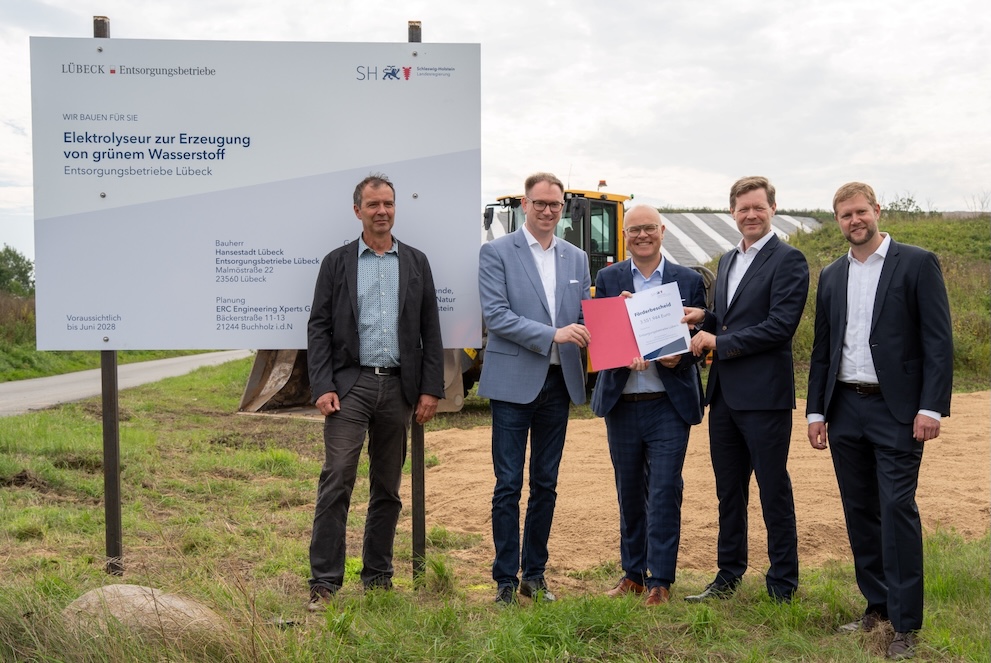
Schleswig-Holstein's Energy Transition Minister Tobias Goldschmidt (3rd from left) presents EBL with the grant notification for the electrolysis project. © Lübeck Waste Management
(Germany) The state of Schleswig-Holstein is funding the Lübeck waste management company (EBL) with approximately €3,5 million for the planning and construction of an electrolyzer to produce climate-neutral hydrogen. The plant will be built on the company's premises as part of the "H2ANSE – Hydrogen from the True North" project and will supply a refueling station for heavy goods vehicles with renewable hydrogen. EBL already operates one hydrogen-powered vehicle and plans to acquire up to ten more waste collection vehicles with fuel cell drives. The PEM (proton exchange membrane) electrolyzer has a capacity of 100.000 kilograms of green hydrogen per year. The 1.100 megawatt-hours of waste heat generated during operation will be used to heat biogas plants. The waste management company intends to use the oxygen released during the electrolysis process to increase efficiency in its adjacent mechanical-biological waste treatment plant (MBT). The electricity for the electrolyzer is supplied by a photovoltaic system already planned on the neighboring Niemark landfill with an installed capacity of seven megawatts.
+ + + + +
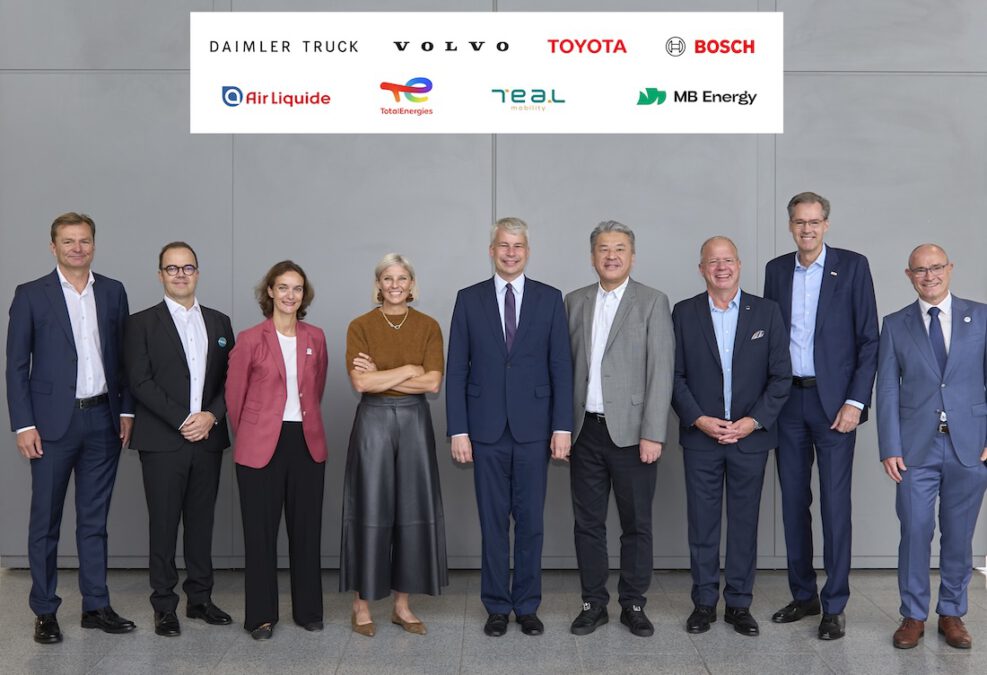
Details announced for the 2026 IAA, detailing how an international consortium intends to accelerate the ramp-up of hydrogen-powered vehicles in Europe beyond already known projects, were not revealed. However, a family photo with Federal Transport Minister Steffen Bilger (center) has now been released. © Daimler Truck AG
(Germany) Leading international corporations want to accelerate the ramp-up of hydrogen-powered vehicles in Europe. A consortium consisting of Bosch, Daimler Truck, Volvo Group, Toyota Motor Corporation, Air Liquide, Total Energies, TEAL Mobility, and MB Energy announced the project at the beginning of September ( more on this here ). Details were to be revealed during the IAA Transportation trade fair in Hanover. For the record, however, there was nothing new. The companies stuck to generalities, reiterated their already known intentions, praised Germany, and continued to call for subsidies to reduce costs and expand hydrogen mobility (we have reported on the companies' plans several times).
+ + + + +
(Germany) Researchers at the Fraunhofer Institute for Manufacturing Technology and Advanced Materials IFAM have developed a new method for investigating the internal condition and aging of electrolyzers or fuel cells during operation. This "dynamic impedance spectroscopy" enables precise condition assessment, targeted fault diagnosis, and predictive maintenance of electrolyzers and fuel cells. Resilience and efficiency can be specifically optimized, the system lifespan extended, and operating costs reduced. To achieve this, a small multi-frequency signal is superimposed on the system in addition to the normal operating current. Simultaneously, the system's response to this signal—specifically, changes in current and voltage—is measured. The relationship between these quantities allows for the calculation of the "complex impedance," a frequency-dependent electrical resistance of the system. "This frequency-dependent characteristic is what makes the impedance so valuable and interesting for us in these applications," says project manager Hermann Pleteit. “Unlike a simple resistance value, it provides a comprehensive picture of the processes inside an electrochemical system. The various physical and chemical processes – such as the reactions at the electrodes, the transport of ions across the membrane, electrical contact resistances, or the supply of the substances involved – each have an effect at different frequencies. This allows us to distinguish these processes from one another, evaluate them individually, and, thanks to the detailed resolution, see in real time the state of the individual components, such as the membrane or electrodes.”
+ + + + +
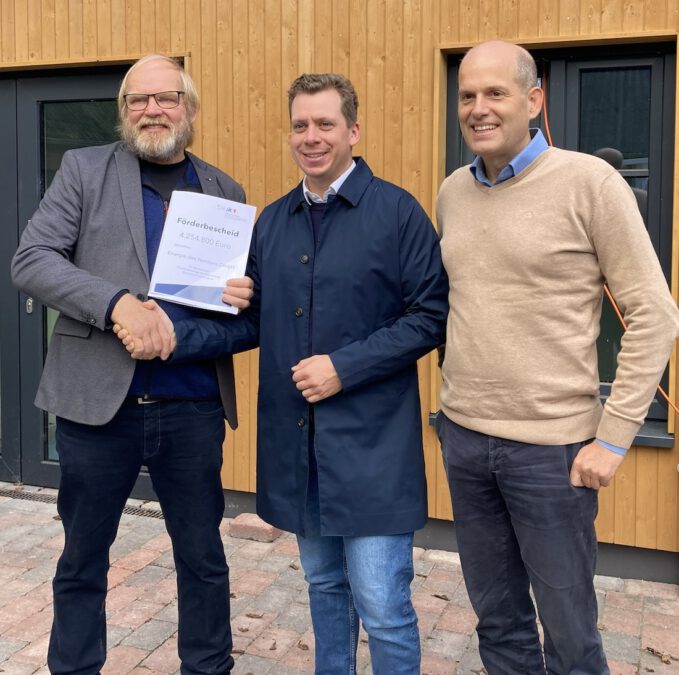
Energy Transition State Secretary Joschka Knuth (center) presented the grant notification from the state of Schleswig-Holstein to Reinhard Christiansen (left) and Sönke Tangermann (right), managing directors of Energie des Nordens. © Green Planet Energy
(Germany) Energie des Nordens GmbH & Co. KG will receive approximately €4,25 million in funding from the European Regional Development Fund (ERDF) and the state of Schleswig-Holstein for the expansion of an electrolyzer powered by wind energy. This funding will enable the gradual expansion of the existing electrolysis capacity at the Haurup site in Handewitt to up to four megawatts. The first phase will see a two-megawatt expansion with a production of around 150 tons of green hydrogen per year. Commissioning is planned for the end of 2027. Initially, the hydrogen will be blended into the existing gas network and marketed nationwide as part of Green Planet Energy's gas product. In the long term, the Haurup II site will be connected to the hydrogen infrastructure to open up new sales opportunities for industry and commerce. "Grid bottlenecks must not lead to an increasing amount of renewable electricity being curtailed instead of being used effectively," says Sönke Tangermann, CEO of Green Planet Energy and Managing Director of Energie des Nordens. “Instead of leaving wind power unused, we need to use it flexibly and store it.” Decentralized electrolyzers like the one in Haurup are “a key component” for this.
+ + + + +
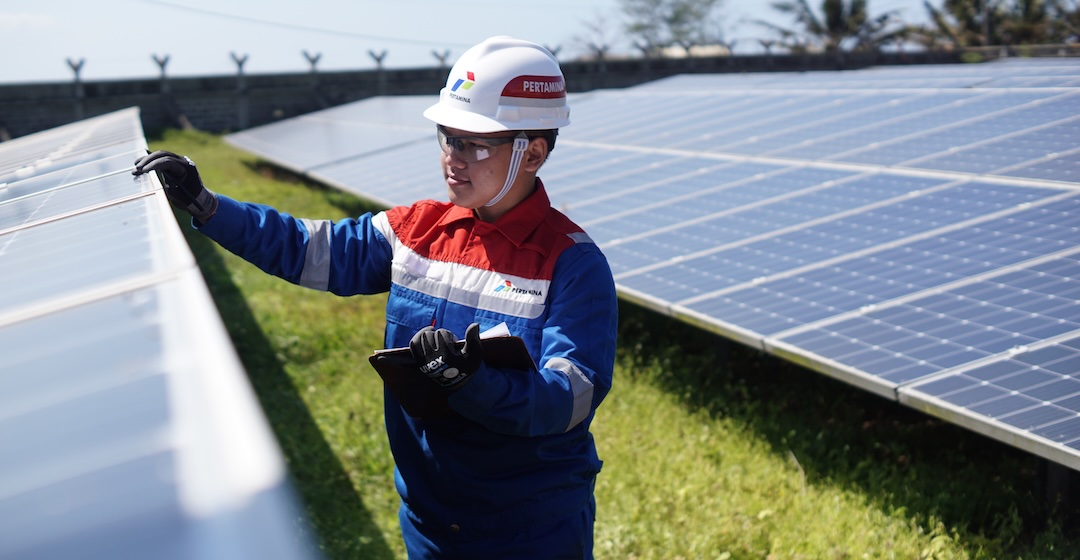
Pertamina NRE and HDF Energy plan to develop renewable energy projects for hydrogen in Indonesia. © Pertamina NRE
(Indonesia) French power producer and fuel cell manufacturer Hydrogène de France Energy Pty Ltd. (HDF Energy), through its subsidiary HDF Energy Indonesia, plans to develop renewable energy projects using green hydrogen and battery storage. HDF Energy's "Renewstable" power plants combine intermittent renewable energy sources with green hydrogen production to generate baseload power around the clock. According to a press release, this solution is particularly well-suited for remote rural and island regions of Indonesia, where electricity generation remains heavily reliant on imported diesel fuel. Furthermore, the company will explore other potential applications of hydrogen, including ways to support industries. Pertamina NRE is part of the state-owned oil company Pertamina and is responsible for the green energy sector.
+ + + + +
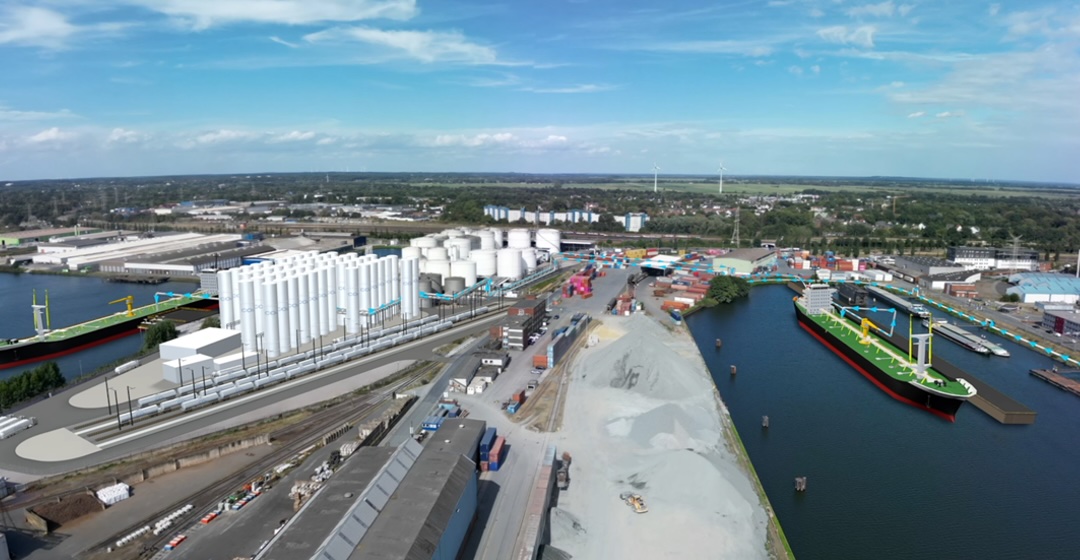
Visualization: CarbonBridge plans to commission Germany's first CO2 export terminal in Bremen starting in 2031. © Messer Group
(Germany) Germany's first CO2 export terminal – called "CarbonBridge" – is scheduled to begin operations in Bremen in 2031. According to company statements, the joint venture between Ambrian Energy GmbH and Messer SE & Co. KGaA received antitrust approval from the European Commission at the end of August. Initially, CarbonBridge is expected to have a handling capacity of around 2,3 million tons per year, with a future target of four million tons. The joint venture will act as a provider of "CO2 logistics solutions," including intermediate storage, transport, and loading to the sink where the CO2 will be permanently stored. Ambrian Energy is contributing a three-hectare site in Bremen to the project. The location offers logistical advantages, such as an existing rail connection and a port berth for ships with a capacity of 30.000 tons. Messer has expertise in CO2 recovery and processing.
+ + + + +
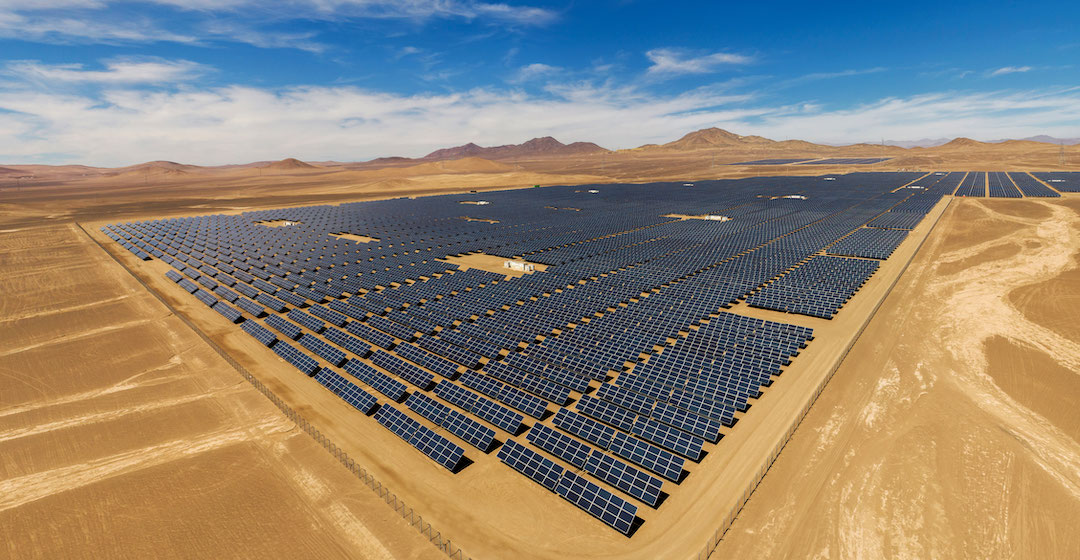
The production of green fuels such as hydrogen and methanol using renewable energy is also possible in water-scarce regions via DAC (Direct Acceleration Combined Heat and Power). The image shows the 40 MW "Chañares" photovoltaic power plant, owned by the Italian energy company Enel, in the Chilean Atacama Desert. © Enel SpA
(Germany) Water scarcity is not a fundamental obstacle to the production of green methanol. In a model calculation, the Jülich Research Centre examined the prospects for the production of green hydrogen and, consequently, methanol in water-scarce regions across the entire process chain. The model is based on direct air capture (DAC). A filter binds CO2 and also absorbs atmospheric moisture. The captured water, along with the CO2, flows into the methanol production process. According to the researchers, the analysis covers more than 20.000 regions in 78 countries that are expected to experience at least moderate water stress by 2050. In approximately 97 percent of these regions, the air contains enough water throughout the year to fully meet the production requirements. Production would even be possible in principle at very dry locations if the plant preferentially operates during more humid hours and stores water temporarily. The DryHy project is also investigating how large-scale water vapor extraction could affect the local climate. “The fact that we are not using local freshwater resources does not automatically mean that extracting air from the atmosphere will be without consequences at any scale,” says Thomas Schöb, head of the Energy System Transformation team. “This question should be investigated on a site-specific basis before building very large plants.” However, the study is not a ready-made blueprint for every location. “But it shows under which conditions the concept is particularly promising – and which technical and environmental questions need to be answered next,” says lead author Henrik Wenzel from Jülich Systems Analysis. The study, “Direct air capture enables sustainable methanol production in water-scarce regions,” is available online at Nature Communications.
+ + + + +
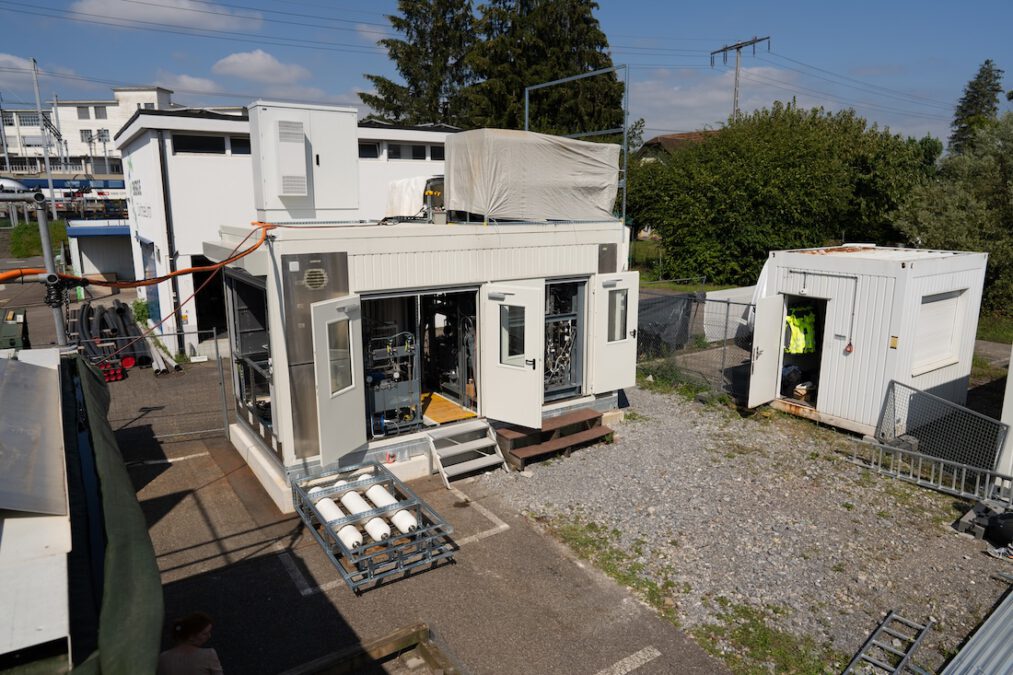
The prototype of a hydrogen refueling station (LCHRS) as the centerpiece of the H2 pilot platform at EIT in St. Gallen. © OST – Eastern Switzerland University of Applied Sciences
(Switzerland) A flexible and modular test platform for new hydrogen technologies is being developed at the IET Institute for Energy Technology at the University of Applied Sciences Eastern Switzerland in Rapperswil-Jona (OST). Companies will be able to use it to "develop, test, and demonstrate components and systems for applications in mobility and industry under realistic conditions." Various hydrogen systems from previous research projects are already available on the IET's Power-to-X research platform. These include electrolyzers, fuel cells, and hydrogen fittings. The prototype of a hydrogen refueling station (LCHRS) with two large compressors is intended to facilitate research and the introduction of hydrogen systems. In the pilot project, these systems will be technically interconnected and combined into an operational H2 platform with a power output in the ten to one hundred kilowatt range. Students are also working on projects such as simulating refueling for hydrogen vehicles. Project partners are Burckhardt Compression AG, Arbor Fluidtec AG, and Endress+Hauser AG. The project is supported by the Canton of St. Gallen, and funding comes from the Swiss Innovation Agency (Innosuisse) of the Federal Department of Energy. ( OST project information ).
+ + + + +
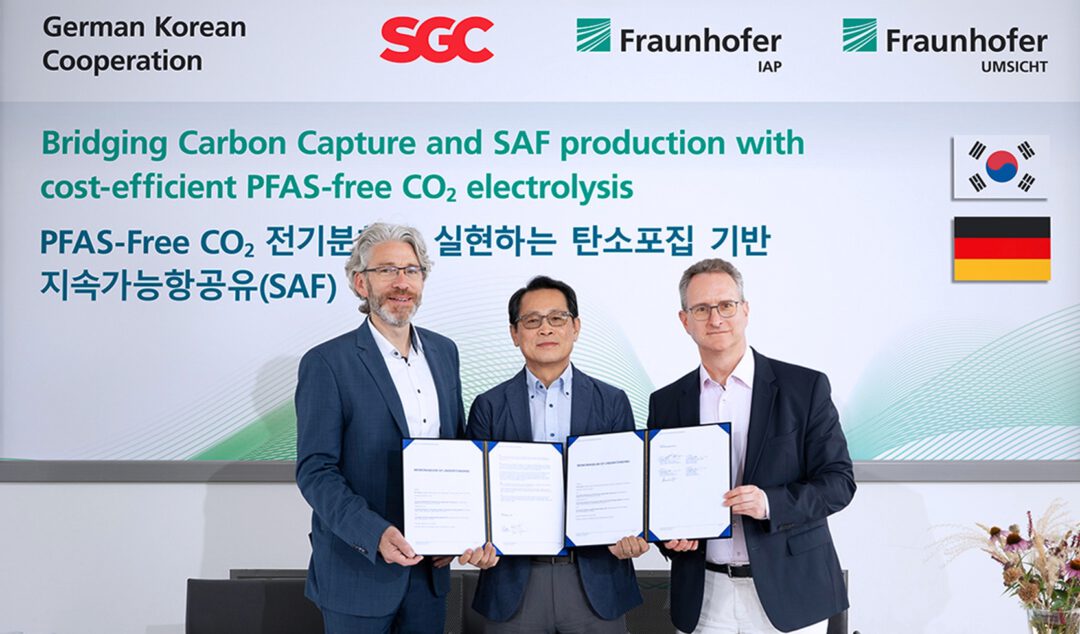
Want to further develop technologies for energy conversion and storage (from left): Christian Doetsch (Head of Fraunhofer UMSICHT), Ken Yoon (Chief Strategy Officer SGC Energy) and Alexander Böker (Head of Fraunhofer IAP). © Fraunhofer UMSICHT
(Germany) The Fraunhofer Institutes for Applied Polymer Research IAP and for Environmental, Safety, and Energy Technology UMSICHT, along with the South Korean company SGC Energy, plan to jointly develop technologies for energy conversion and storage. The collaboration will focus on CO2 electrolysis, hydrogen technologies, fuel cells, and battery technologies. Fraunhofer IAP will contribute its expertise in developing innovative membranes that can increase the energy efficiency of electrochemical processes. Fraunhofer UMSICHT will complement this with its know-how in electrochemistry and plant engineering. SGC Energy will contribute CO2 and electricity resources as well as engineering expertise for the industrial implementation and commercialization of the technologies. A key focus of the collaboration is the electrochemical conversion of CO2 into feedstocks for chemical products or synthetic fuels. Potential applications include sustainable aviation fuels (eSAF). While established solutions are already available for hydrogen electrolysis, there is still a need for development in CO2 electrolysis, where climate-damaging CO2 is directly converted into carbon monoxide (CO) for use in the production of plastics and acetic acid, for example.
+ + + + +
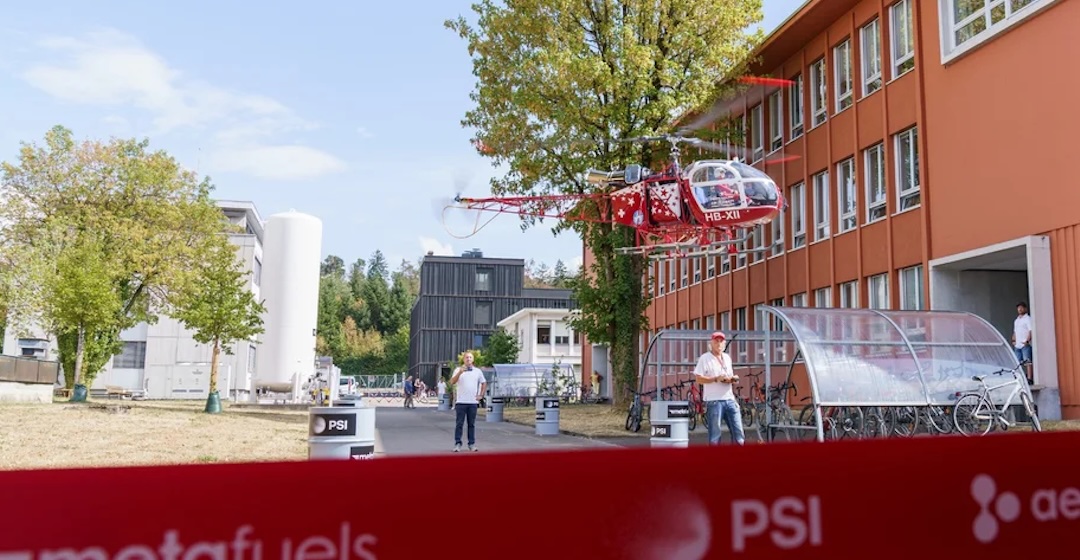
Inauguration of the "Aerobrew" plant in Zurich: A kerosene-powered model helicopter carried a basket containing the scissors for the symbolic ribbon-cutting ceremony. © Paul Scherrer Institute PSI / Markus Fischer
(Switzerland) The Paul Scherrer Institute (PSI) has inaugurated the "Aerobrew" demonstration plant on its premises for testing and commercializing highly efficient synthetic kerosene. It is a joint project of PSI and the Zurich-based company Metafuels. The plant produces a high-quality, climate-neutral synthetic fuel (eSAF) for aviation from water, green hydrogen, and carbon dioxide. According to the institute, this marks the first time the emerging Aerobrew technology has been operated in a practical plant design. The plant is designed to produce fifty liters of SAF per day. It is the first in the world to combine all production steps for synthetic aviation fuel from green methanol under one roof. Metafuels plans to operate the first commercial plant for the production of SAF using the "Aerobrew" technology starting in 2030. With 2.300 employees, the Paul Scherrer Institute PSI is the largest research institute in Switzerland. It is part of the ETH Domain, which also includes ETH Zurich and ETH Lausanne, as well as the research institutes Eawag, Empa and WSL.
+ + + + +
Photo above
iStock / © Danil Melekhin



