

Germany: Associations demand a separate budget line in the federal budget for hydrogen ramp-up +++ Japan: DNV grants Yanmar type approval for Maritime Hydrogen Fuel Cell System +++ Germany: TU Berlin team wins DLR competition with hydrogen aircraft +++ Germany: Methanol qualified as a raw material for sustainable aviation fuel +++ USA: GenH2 finalizes sale of headquarters +++ Austria: Hydrogen Research Center expands research in the field of liquid hydrogen +++ Germany: Bremerhaven University of Applied Sciences researches ammonia as a marine fuel +++ Germany: Gas-fired power plants after StromVKG tenders cause 125 million tons of emissions +++ China: Foton plans to expand in Europe with hydrogen trucks +++ Norway: Nel and Hydrasun cooperate on PEM electrolyzers +++ Germany: Did Economics Minister Reiche use her US trip as a "lobbying platform for fossil and nuclear energy"? +++ A selection of PtX topics summarized
+ + + + +

Budget debate 2027 in the Reichstag on September 9: Associations demand a separate budget line for hydrogen production ramp-up while deliberations are already underway. © German Bundestag / Screenshot
(Germany) The gas and hydrogen lobby is calling for a dedicated budget line for hydrogen promotion in the 2027 federal budget. According to the German Association of Energy and Water Industries (BDEW), "companies along the entire value chain" are preparing investments "whose implementation depends significantly on reliable political framework conditions and long-term planning security." The associations are therefore appealing to members of the German Bundestag to establish a separate budget line for "Contracts for Difference" (CfD) hydrogen. This funding instrument compensates for the difference between the (currently still high) purchase or production costs and the (currently still lower) sales prices. "A clearly designated budget line would be an important commitment to continuing the hydrogen ramp-up and would strengthen the confidence of market participants," the paper states. The appeal is supported by more than a dozen organizations (full text available here ). However, the federal budget is currently being debated in parliament. The prospects of injecting this funding now are likely slim.
+ + + + +

Yanmar receives certification for marine fuel cell technology (from left): Eric Tigelaar (Yanmar Europe), Takehiro Maruyama (Yanmar Power Solutions), Oliver Darley (DNV Maritime), Masaru Hirose (Yanmar Power Solutions), Tomoyuki Murase (DNV Maritime), Olaf Drews (DNV Maritime). © Yanmar Holdings Co. Ltd.
(Japan) Yanmar Power Solutions Co., Ltd. has received type approval from the Norwegian certification company DNV for its Maritime Hydrogen Fuel Cell System. The approval confirms that the GH-FC series complies with DNV's rules and guidelines. This allows shipbuilders, system integrators, and ship operators to adopt the technology for future projects with a reduced certification burden. The certificate is a "significant milestone on our journey to bring hydrogen-powered solutions to the maritime market," says Masaru Hirose, President of Yanmar Power Solutions Co., Ltd. "Building on our operational experience in Japan, we aim to support customers worldwide in their transition to zero-emission businesses and realize sustainable maritime transportation." Yanmar commercialized its maritime fuel cell systems in 2023 and has further expanded their use in Japan through collaborations with ship owners and operators.
+ + + + +

The team from TU Berlin won first place in the DLR Challenge with their "Hydra" concept for a hydrogen-powered aircraft. © DLR
(Germany) The jury of the German Aerospace Center (DLR) has awarded first place in the DLR Design Challenge to the team from TU Berlin for their "Hydra" concept. Hydra is described as "a fundamentally redesigned demonstrator aircraft for future hydrogen aircraft technology," enabling the "experimental validation of hybrid electric propulsion systems under real flight conditions." Thanks to its containerized, modular design, the fuel cell generators can be quickly exchanged within a single workday. The airframe integrates liquid hydrogen as the primary energy source, batteries as supplementary storage, and electric motors with wingtip propellers to improve aerodynamics. The challenge was to develop a completely new small aircraft that could serve as a flying testbed for future aviation technologies. The aircraft was to be designed to be so practical that it could be built and tested within the next few years. The team from TU Braunschweig came in second, and RWTH Aachen took third place. A total of 16 student teams participated in the competition ( the submitted entries with photos can be found here ).
+ + + + +

Project meeting of the SAFari consortium in 2023. © Fraunhofer ISE
(Germany) The international standards organization ASTM has recognized methanol as an acceptable feedstock for the "alcohol-to-jet" production pathway. This would allow at least 50 percent by volume of conventional kerosene to be blended into a "drop-in" fuel. According to the Fraunhofer Institute for Solar Energy Systems ISE, which is involved in the development of sustainable aviation fuels (SAF) within the "SAFari" collaborative project, this fuel is "fully compatible and can be used without modifications to aircraft, engines, or existing infrastructure." The focus is now on further optimizing and scaling up the production process. The goal is to provide larger quantities of fuel "to pave the way for the industrial implementation of methanol-based sustainable aviation fuel," says project manager Franz Mantei. The world's more than 23.000 large aircraft consume around 350 billion liters of fuel annually and emit approximately three percent of human-caused CO2 emissions. Especially for long-haul flights exceeding 4.000 kilometers, there is no alternative to liquid fuels due to the required energy density. For European air traffic alone, the prescribed quotas will result in approximately 40 million tons of liquid fuel by 2050. The SAFari project has been funded by the German Federal Ministry of Transport (BMV) since December 2022 with nearly 15 million euros for a period of six years. In addition to the Fraunhofer Institute for Solar Energy Systems (ISE), the project partners include ASG Analytik-Service AG, BP Europa SE, Clariant AG, and the German Aerospace Center (DLR).
+ + + + +
(USA) GenH2 Corp. has completed a sale-and-leaseback transaction with a private investor. The company is selling its headquarters and production facility in Titusville, Florida, generating mid-single-digit million-dollar proceeds. These funds will be used to support the fulfillment of existing orders and to invest in further research and development. GenH2 Corp., a subsidiary of Path2 Hydrogen AG and a provider of hydrogen infrastructure solutions, acquired and renovated the property in 2022.
+ + + + +

The LHL expands HyCentA's existing research activities in Enns to include opportunities for the development, testing, and validation of liquid hydrogen technologies. © Austrian Provincial Government / Cityfoto.at / Simlinger
(Austria) The Hydrogen Research Center Austria (HyCentA) is expanding its development activities in the field of liquid hydrogen. The new Liquid Hydrogen Lab (LHL) will provide opportunities for material testing at cryogenic temperatures, as well as for component and system testing, including storage tanks, pumps, valves, sensors, transfer and refueling systems, and hydrogen-based propulsion technologies, and for investigating larger systems and components. According to HyCentA, the "heart" of the facility is a liquid hydrogen tank with a capacity of approximately 4.400 kilograms. A conditioning tank for tests at pressures up to 36 bar is also available. This will allow for realistic simulation of operating conditions, particularly for maritime applications, aviation, and road transport. The LHL in Enns, southeast of Linz, is scheduled to be commissioned in the first quarter of 2027. The Austrian Federal Ministry for Innovation, Mobility, Innovation and Technology (BMIMI) is funding the project with five million euros. An additional 1,6 million euros will be provided by Test-Fuchs Aerospace Systems GmbH and HyCentA.
+ + + + +

The RisBa project, investigating ammonia as a marine fuel, is launching at Bremerhaven University of Applied Sciences (from left): Raimond Claussen, Ilka Frerichs, Nadja Köppen, Mattis Zegers, Tarja Lubenow, project manager Uwe Arens, and Sebastian Trudwig. © Bremerhaven University of Applied Sciences / private
(Germany) Researchers at Bremerhaven University of Applied Sciences are developing preventative safety concepts for ammonia bunkering in Bremerhaven and Wilhelmshaven. The project was initiated by the Bremen Senate for Economic Affairs, Ports and Transformation. "To become more climate-friendly, shipping needs new, sustainable fuels. Ammonia is well-suited for this: it is easier to liquefy and transport than hydrogen," says Senator Kristina Vogt. "Through systematic risk analysis and the development of protective measures, the port-side foundation for the safe and environmentally sound use of ammonia as an energy carrier in the maritime sector will be established," says project manager Uwe Arens. This will also contribute to sustainable port development. The project "Risk Assessment for Ammonia Bunkering in Bremerhaven and Wilhelmshaven" (RisBa) is funded by the Northwest Metropolitan Region. The project duration is twelve months.
+ + + + +

New gas-fired power plants built following the Electricity Supply Act (StromVKG) tenders could emit 125 million tons of greenhouse gases. © FÖS / DUH
(Germany) The German Environmental Aid Association (DUH) has assessed the climate risks of the new gas-fired power plants planned under the Electricity Supply Security and Capacity Act (StromVKG) in a study. According to the study, the nine gigawatts of power plant capacity from the first tenders, which began with the bid deadline of September 8, 2026, could alone cause up to 83 million tons of CO2 emissions during operation by 2045. An additional 42 million tons of CO2 equivalents would be emitted from methane emissions during extraction, processing, and transport. In total, this could result in up to 125 million tons of greenhouse gas emissions. The costs of climate damage would amount to between 24 and 127 billion euros. The DUH calls for "fair tender criteria that also consider sustainable energy solutions, instead of unilaterally subsidizing new gas-fired power plants." The study only considers the first tender round of the StromVKG. Further tenders with government subsidies are planned for 2027 and 2029. Should further gas-fired power plants be awarded contracts, emissions and climate damage would increase even further. The Electricity Supply Security Act (StromVKG), however, does not contain any binding requirements for a later conversion of these power plants to green hydrogen. Subsidies for the conversion are only planned for around four gigawatts and are not expected to take effect until 2040 or 2043. What requirements these conversion concepts would have to meet and how the subsidies would be financed remain unclear. The German Environmental Aid (DUH) is calling for binding roadmaps for an early transition to green hydrogen. The study "Supply Security Act under Analysis – Climate Impact Assessment of New Gas-Fired Power Plants: Greenhouse Gas Emissions and Hidden Costs until 2045" by the Forum for Ecological and Social Market Economy (FÖS) is available free of charge as a PDF (24 pages).
+ + + + +

The heavy-duty truck based on the CAVAN platform is designed for various drive concepts and will be offered with both battery-electric and fuel cell technology. © Graphic: Foton
(China) Chinese commercial vehicle manufacturer Foton will present its European expansion plans at the IAA Transportation 2026 trade fair in Hanover. The focus of its trade fair presentation will be on vehicles with battery-electric and hydrogen-based powertrains. In addition to launching new models, the company is establishing local sales and service structures and investing in manufacturing, supply chains, and spare parts supply. One component of the European expansion is the new regional spare parts distribution center in Unna, North Rhine-Westphalia. The center has now commenced operations and is intended to enable faster delivery of spare parts to European customers and service partners. Several of Foton's light trucks and vans already possess the relevant approvals and certifications for the European market. According to the company, vehicles under its new energy brand CAVAN are currently being launched in 15 European countries as well as in other international markets such as Australia and New Zealand. Globally, the company has 32 local production sites, including locations in Southeast Asia, Latin America, and the Middle East. A joint venture was also established with the shipping company COSCO Shipping, providing additional transport capacity for vehicle exports. From January to August 2026, Foton, a brand of Beiqi Foton Motor, exported approximately 149.000 vehicles, according to its own figures.
+ + + + +

Hydrasun will manufacture Nel PEM electrolyzers at its Aberdeen site. © Hydrasun Ltd.
(Norway) Scottish company Hydrasun Ltd. will produce containerized PEM electrolyzers from Nel ASA in Aberdeen. The project is supported by the Scottish government's Just Transition Fund with £1,9 million (€2,2 million) and will enable Hydrasun to invest in and modernize its facilities. This will create twelve new jobs and secure eleven existing ones. Nel's PEM technology platform is currently available in 1,25 and 2,5 megawatt versions. Stack production will continue at Nel's US plant in Wallingford, Connecticut. In March 2025, Hydrasun announced that it was building a hydrogen refueling station in Aberdeen in partnership with BP, with Nel supplying a 2,5-megawatt electrolyzer (as previously reported).
+ + + + +
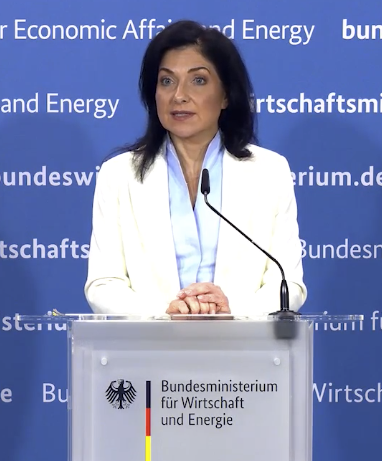
DUH alleges that Economics Minister Reiche "did not merely want to attend CERA Week, but rather use it as a high-profile platform for a change of political course." © BMWE
(Germany) Economics Minister Katherina Reiche is alleged to have "one-sidedly represented the interests of the gas and nuclear industries" during her trip to CERA Week in Texas in March. At the gas industry event, the minister reportedly used "the conference as a platform for new US gas deliveries, a return of nuclear power in Germany, criticism of the EU methane regulation, and for aligning herself with US energy policy." This information comes from documents obtained by the German Environmental Aid Association (DUH) and the investigative journalism portal FragDenStaat through the Environmental Information Act (UIG) and the Freedom of Information Act (IFG). The documents prove that Katherina Reiche acted "as the chief lobbyist for the gas and nuclear industries," says Sascha Müller-Kraenner, Federal Managing Director of DUH: "She speaks negatively about renewable energies, personally pushes through new gas contracts with Donald Trump, and even advocates for a return to nuclear power." The minister has "actively worked against the energy transition and is thus harming Germany's energy independence." If her policies are implemented, "there is a risk of even greater dependence on Trump's energy supplies and a return to fossil fuels." The Federal Ministry for Economic Affairs and Energy (BMWi) responded to a total of four Freedom of Information Act (UIG) requests regarding CERA Week "only after months, with the same collection of documents and, in some cases, identical decisions." The ministry demanded the maximum processing fee of €500 for each release. DUH and FragDenStaat suspect "that the documents are incomplete" and have filed objections to the decisions. DUH has published a summary analysis online as a five-page PDF .
+ + + + +
Photo above
iStock / © Danil Melekhin



