

Germany: Hearing on the amendment to the Energy Industry Act +++ Austria: BHDT invests in Cavendish Hydrogen +++ Estonia: Northern Europe and Vindr Estonia agree on renewable energy supply for hydrogen production +++ Germany: Sunfire builds electrolyzer for BASF in Schwarzheide +++ Finland: Northern Europe and Infinergies Finland explore Power-to-X development in Raahe +++ USA: Hyundai donates fuel cell SUV, electrolyzer and refueling station to Georgia Tech +++ Japan: Suzuki presents small car as a hydrogen combustion engine
A selection of PtX topics summarized at the end of the week
+ + + + +

A public hearing on the amendment to the Energy Industry Act will take place on May 20th in the Paul Löbe Building. © German Bundestag / Axel Hartmann
(Germany) The Committee on Economic Affairs and Energy has scheduled a public hearing on the draft law to amend the Energy Industry Act and other energy law provisions for the implementation of the European Gas and Hydrogen Internal Market Package. The hearing will take place on Wednesday, May 20, from 14 p.m. to 16 p.m. The reform aims to restructure the gas pipeline network in Germany and regulate the infrastructure for hydrogen. In the future, hydrogen will have regulated network access similar to that in the gas sector, which means, among other things, that operators will have to grant connection to and access to their pipelines ( DS 21/5440 ).
+ + + + +
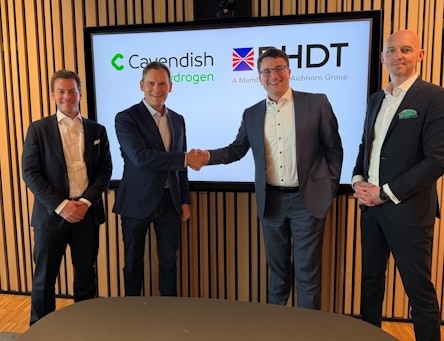
Representatives from BHDT and Cavendish Hydrogen have agreed on a strategic partnership and investment in the hydrogen sector. © BHDT GmbH
(Austria) BHDT GmbH has acquired a stake in the Norwegian company Cavendish Hydrogen ASA, a provider of hydrogen refueling stations. As part of the transaction, Cavendish Hydrogen will issue 17,7 percent new shares. Following completion of the capital increase, BHDT will hold approximately 15,0 percent of the shares and will nominate one member to the Board of Directors at the Annual General Meeting on May 26, 2026, the company announced. "With this investment, BHDT is assuming the role of a long-term industrial anchor investor." The investment strengthens the company's financial position and lays the foundation for the further scaling of technologies, products, and international activities. Agreements have also been concluded for long-term cooperation in the commercial sector as well as in research and development.
+ + + + +
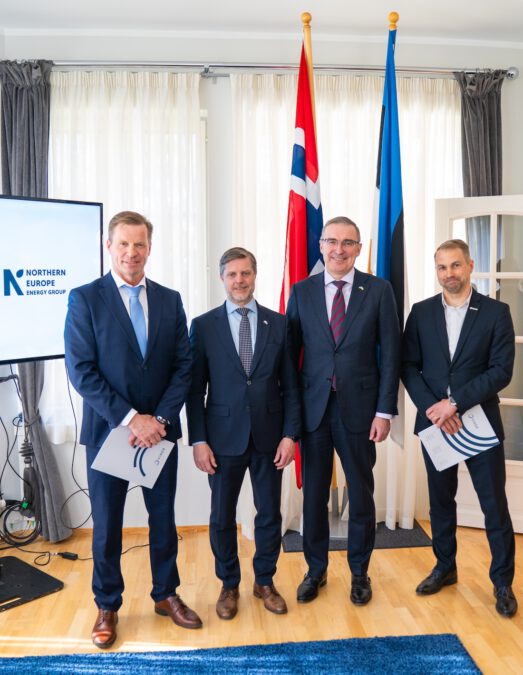
Northern Europe and Vindr Estonia agree on renewable energy supply for hydrogen production. © Northern Europe Energy Groupe AS (Nord)
(Estonia) The Nordic-Baltic energy company Northern Europe Energy Group AS (Nord) and Vindr Estonia have agreed on the long-term provision of renewable energy for a green hydrogen production plant and the potential construction of a data center in Estonia. This is an important step for some of the largest renewable energy projects in Estonia, including a hyperscale data center, power-to-X facilities for eSAF (electron solar energy storage) and green ammonia in Urissaare, in the municipality of Häädemeeste in Pärnu County, near the Latvian border. The plans envisage investments of more than one billion euros. Northern Europe Energy develops power-to-X projects, hydrogen production, battery energy storage systems (BESS), data centers, and related infrastructure. The Häädemeeste project is "a major investment project of strategic regional importance" for Northern. Vindr develops renewable energy projects in Norway, Sweden, Estonia and Latvia, including a portfolio of onshore wind energy projects with a cumulative annual production of 1.500 gigawatt hours.
+ + + + +
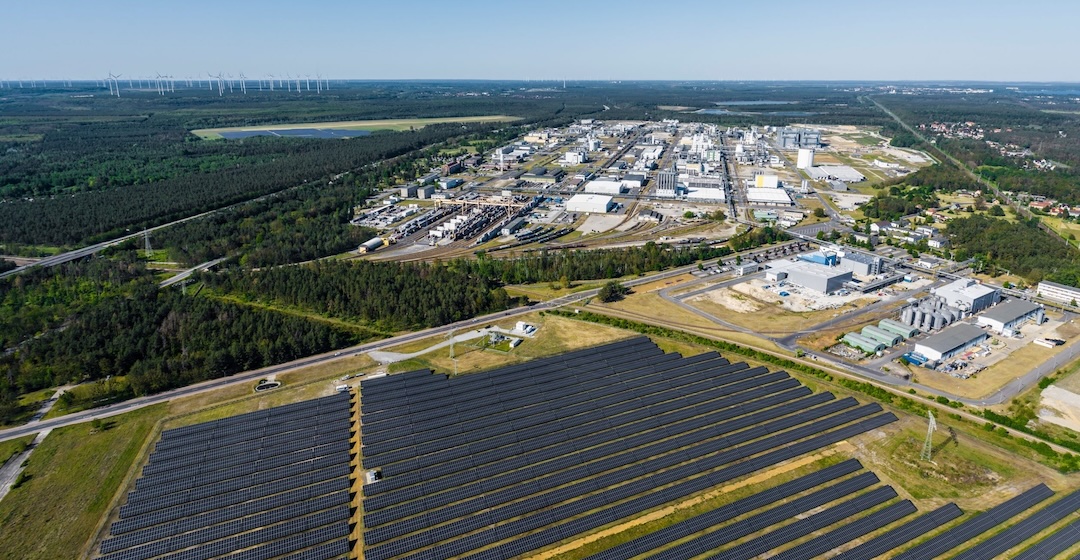
Sunfire is building an electrolysis test plant at the BASF site in Schwarzheide. © BASF Infra Service & Solutions Lausitz GmbH
(Germany) The Dresden-based company Sunfire will build a test facility in the Lausitz Industrial Park in Schwarzheide to further validate its high-temperature electrolysis technology (SOEC). The client is the chemical company BASF. Commissioning is planned for the end of this year. The aim is to gain further practical experience for use in large-scale industrial projects. "The test facility strengthens industrial value creation in the region and our industrial location," says Jürgen Fuchs, Chairman of the Management Board of BASF Infra Service & Solutions Lausitz GmbH. This will provide "valuable insights from the real industrial environment," says Sunfire CTO Christian von Olshausen. "The good infrastructure, the available space, and the industrial expertise on site enable practical long-term tests at an industrial scale." The SOEC technology utilizes high operating temperatures of around 850 degrees Celsius and achieves efficiencies of up to 89 percent. This allows the SOEC electrolyzers to achieve "particularly low levelized cost of hydrogen" (LCOH). BASF employs more than 900 people at the Lausitz industrial park in Schwarzheide.
+ + + + +
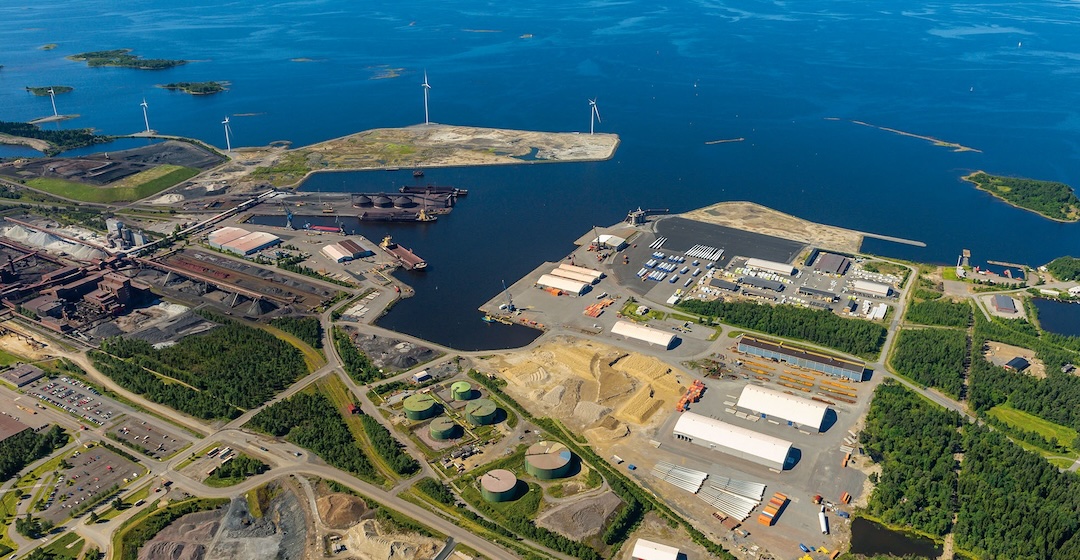
A consortium consisting of Northern Europe, Infinergies Finland, and Raahen Satama is investigating the potential development of power-to-X plants in the port of Raahen. © Northern Energy Group
(Finland) Raahen Satama Oy, Northern Europe Energy Group AS, and Infinergies Finland Oy intend to jointly explore the development of large-scale Power-to-X plants and related industrial projects in the Port of Raahe. The parties will examine the technical, economic, and environmental feasibility, access to designated land areas, collaboration with local stakeholders, and project concepts focused on scalable and commercially viable Power-to-X solutions. "This is the first step towards developing the new Deep Port area as a green industrial zone," says Raahen CEO Seppo Vehkaoja. The Port of Raahe and the City of Raahe strongly support this strategic agreement, emphasizing its crucial role in ensuring smooth maritime transport operations in the future. The cargo port, managed by the municipal company Raahen Satama Oy, comprises three areas, including the year-round accessible deep-water port. Among other things, processed goods, steel, wood and wind turbine components are handled, with approximately 600 ship calls per year.
+ + + + +
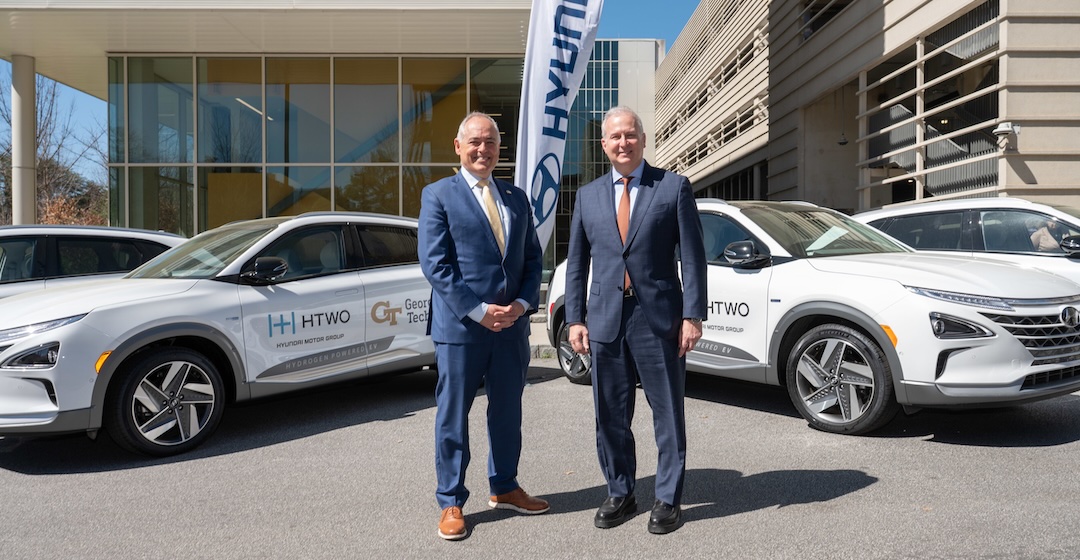
Hyundai donates FC SUV and refueling infrastructure (from left): Ángel Cabrera (President of the Georgia Institute of Technology) and Ken Ramírez (Executive Vice President at Hyundai Motor Group). © Hyundai Motor Group
(USA) Hyundai Motor North America is donating four "Nexo" fuel cell SUVs to the Georgia Institute of Technology (Georgia Tech) in Atlanta, and the Hyundai Motor Group is also donating an electrolyzer and refueling station. The vehicles and infrastructure will support campus operations and interdisciplinary research. Key areas of focus include research into hydrogen-based systems and mobility solutions, their performance, the integration of fuel cells into existing infrastructure, and the assessment of the regulatory and social impacts of hydrogen adoption. The institute offers 57.000 hours of study programs from 146 countries in fields such as business, computer science, design, engineering, humanities, and natural sciences. Georgia is home to Hyundai Motor Group Metaplant America (HMGMA) and a hub for zero-emission transportation through HTWO Logistics, which operates Hyundai's Xcient fuel cell heavy-duty trucks in its logistics operations near Savannah. “By combining the university’s excellent research with Hyundai’s global experience, we are creating the foundation for practical solutions that will drive the energy transition and inspire future leaders in the field of mobility,” says Ken Ramírez, Executive Vice President and Head of Global Energy and Hydrogen at Hyundai Motor Group. He is himself a graduate of Georgia Tech and currently a member of the university’s advisory board.
+ + + + +
(Japan) According to media reports, automaker Suzuki and Austrian supplier AVL have developed a prototype of the "Swift" model with a hydrogen combustion engine. The vehicle is based on the conventional Swift and uses a modified 1,4-liter four-cylinder engine. Unlike models from Toyota or Hyundai, which rely on fuel cells, the hydrogen in the Suzuki is injected directly into the cylinder and burned as fuel. This retains the mechanical drive system of the gasoline engine.
+ + + + +
Photo above
iStock / © Danil Melekhin



