

Canada: Underwater drone with fuel cells travels 2.000 kilometers +++ Egypt: Polish-Egyptian joint venture plans $5 billion investment in ammonia plant +++ UK: Researchers generate hydrogen from plastic waste and old car batteries +++ Paraguay: Atome invests in fertilizer plant with 260.000-ton capacity +++ China: Pilot project blends ten percent green hydrogen into the natural gas network +++ USA: Nel delivers containerized PEM equipment to Mesure Process
A selection of PtX topics summarized at the end of the week
+ + + + +
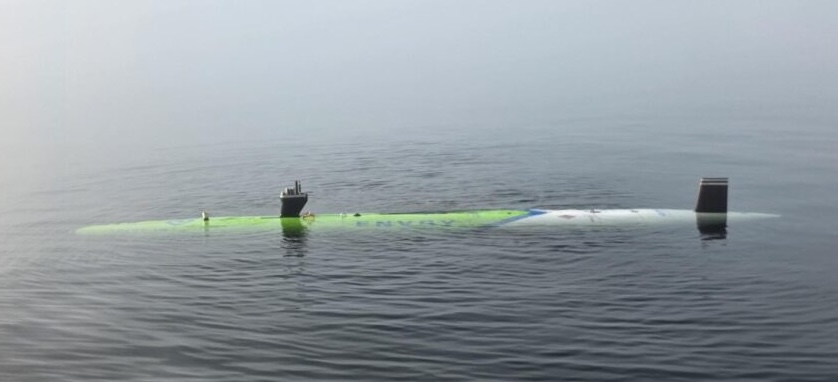
The underwater drone "Envoy" completed a 385-hour test course. © Cellula Robotics Ltd
(Canada) Cellula Robotics Ltd., a company specializing in maritime systems, has completed a test run of more than 2.000 kilometers with a fuel cell-powered autonomous underwater vehicle (AUV). The vehicle, named "Envoy," operated for 385 hours (16 days) without surfacing. The test program involved more than 4.000 turns and maneuvers, each of which increased energy consumption compared to linear movements. The drone, measuring just over eight meters in length and one meter in diameter, has a displacement of 3,7 tons. Depending on the configuration, it can dive to depths of 1.000, 3.000, or 6.000 meters. These dimensions are roughly equivalent to the battery-electric version, which, however, can only remain underwater for 168 hours and travel 930 kilometers. The fuel cell technology was developed in collaboration with Infinity Fuel Cell and Hydrogen, Inc., a US company that develops air-independent electrochemical systems for space and underwater applications.
+ + + + +
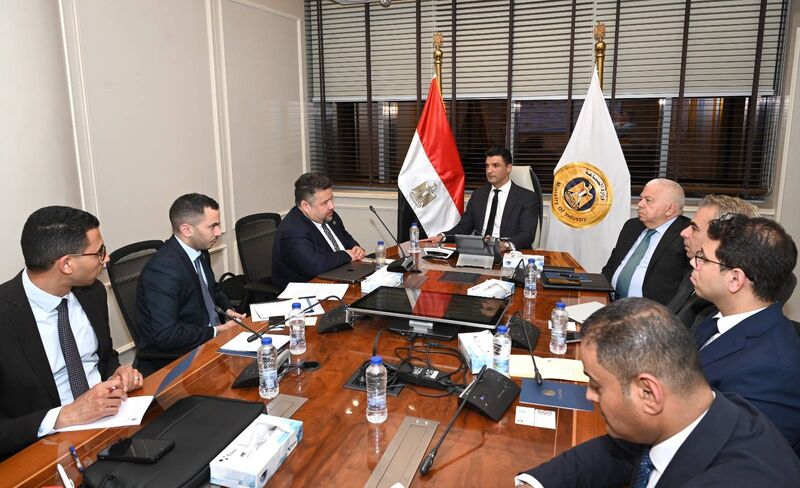
A delegation from the Polish-Egyptian joint venture Egypt Amun Green Ammonia JSC discusses plans for a five-billion-dollar ammonia plant on the Red Sea with the Egyptian Minister of Industry. © Hynfra PSA
(Egypt) The Polish company Hynfra PSA has discussed plans and a timeline for the construction of an ammonia plant with Egyptian Industry Minister Khaled Hashem. Production is slated to begin in 2031 with an annual output of 400.000 tons and subsequently scale up to one million tons in several phases. Investments are estimated at approximately five billion dollars and could rise to ten billion dollars by the time full production capacity is reached. The project developer, Egypt Amun Green Ammonia JSC, a joint venture between Hynfra and the Egyptian company Coxswains for Marketing & Commercial Trading, opened an office in Cairo in early April. The plant site in Ras Banas, in the southeast of the country, benefits from exceptionally high levels of solar radiation and consistently strong winds from the direction of the Red Sea. Renewable energy facilities with a capacity of 2.000 megawatts will be installed on a 100-square-kilometer site. The energy generated will be used directly, without having to feed it into the power grid, to produce hydrogen and ammonia. An export port will also be built on the Red Sea. Hynfra announced a similar project for Mauritania last year (100.000 tons of ammonia, $1,5 billion investment). There was also an announcement regarding large-scale industrial ammonia production in India.
+ + + + +
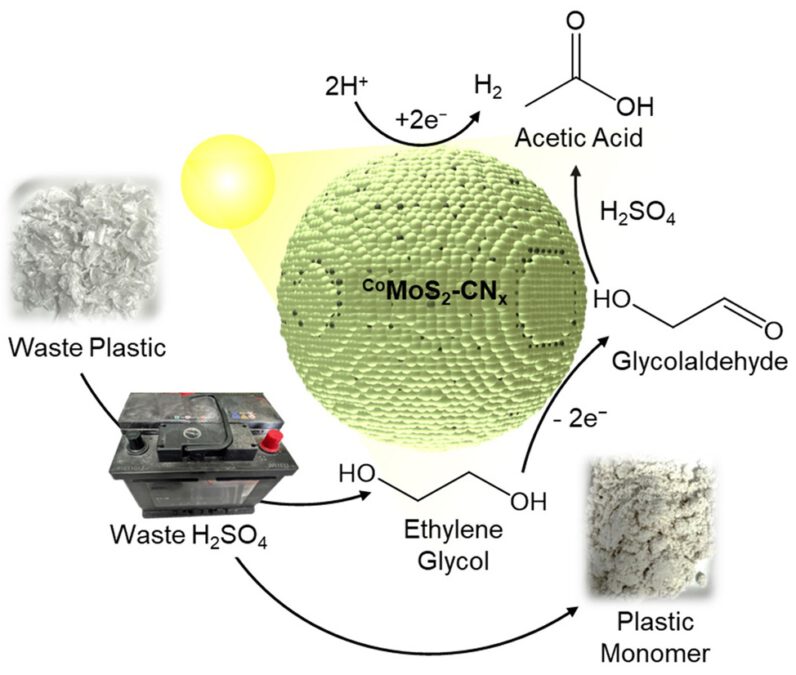
Upcycling: Using solar energy and acid from used car batteries, hydrogen and acetic acid are produced from plastic waste. © University of Cambridge
(Great Britain) Scientists at the University of Cambridge have developed a new method for extracting hydrogen from plastic waste. Using a photocatalyst (such as an LED or sunlight), they achieved "efficient photoreforming" (PR) of plastics like polyethylene terephthalate (PET), nylon (polyamide 66), and polyurethane (PU). The chemical process requires acid (such as sulfuric acid) as a catalyst, which in this case also comes from waste, specifically from used lead-acid car batteries. The result is hydrogen and other chemicals such as acetic acid or terephthalic acid, which could be sold to industry as raw materials for the production of cleaning agents or PET. Background to the research: From 1950 to 2023, global plastic production increased from two million to over 400 million tons annually. However, only 18 percent of plastic waste is recycled and 24 percent is incinerated. The rest accumulates in landfills or natural ecosystems, where it remains for decades. The study “Solar reforming of plastics using acid-catalyzed depolymerization” is published in the journal “Joule” and is available free of charge as a PDF (106 pages).
+ + + + +
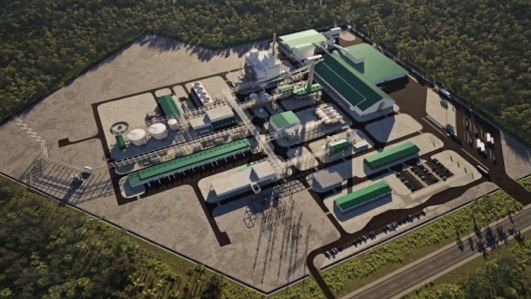
Graphic representation of the planned fertilizer factory in Villeta, Paraguay. © Atome plc (Screenshot)
(Paraguay) British company Atome plc has announced the final investment decision (FID) for a fertilizer plant with a capacity of 260.000 tons. The plant will be located in the port city of Villeta on the country's west coast. Production will utilize green hydrogen, with the necessary electricity generated from hydroelectric power plants. Commissioning is scheduled for October 2029, and the Norwegian chemical company Yara International ASA will be the customer. The Swiss engineering firm Casale SA will handle the engineering, procurement, and construction (EPC) work. Financing of $665 million (€567 million) is being provided by a conglomerate of global financial institutions, led by the International Development Bank. These institutions include the European Investment Bank, the hydrogen investor Hy24, the German KfW, and Sudameris Bank (Paraguay). The financiers cite the current situation in the Strait of Hormuz and the blockades on oil and gas exports as a key reason for their involvement.
+ + + + +
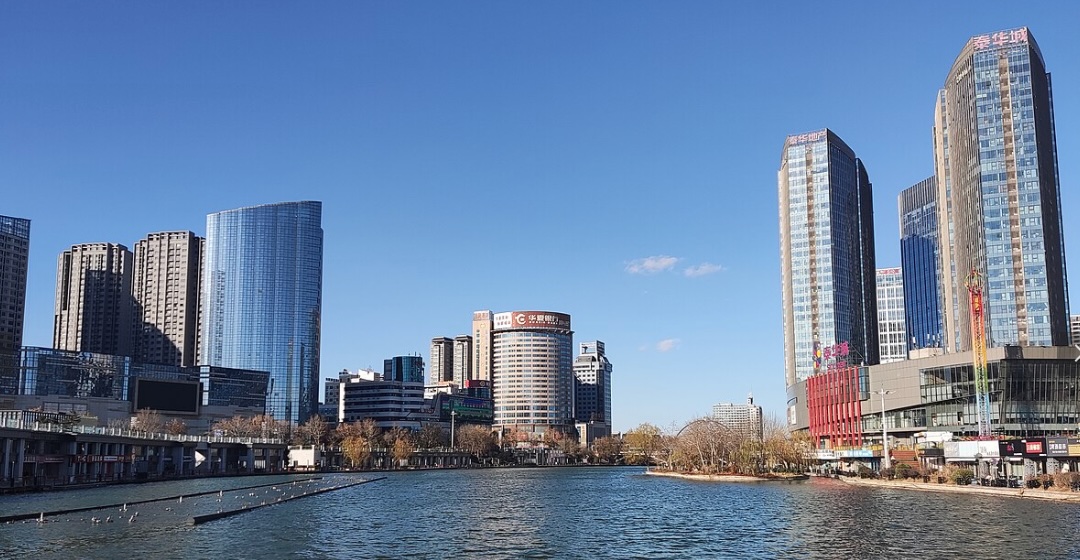
In the Chinese metropolis of Weifang, ten percent green hydrogen is being added to the natural gas network as part of a pilot project. © Wikipedia (by Ngguls, CC BY-SA 4.00)
(China) In the megacity of Weifang in Shandong province, a pilot project aims to reduce the natural gas consumption of 100.000 households by blending it with 10 percent hydrogen. Last year, China consumed a cumulative 426,5 billion cubic meters of natural gas. According to the South China Morning Post, using a 10 percent hydrogen blend in urban gas networks could save approximately 15 billion cubic meters of natural gas per year nationwide. The Weifang project includes electrolysis plants capable of producing 5.000 cubic meters of hydrogen per hour, as well as a 5,2-kilometer pipeline. By the end of 2025, China's green hydrogen production capacity will exceed 220.000 tons per year, representing more than half of the global total, the newspaper reports. The country has also built more than 540 hydrogen refueling stations, accounting for 40 percent of the global total.
+ + + + +
(USA) Nel Hydrogen US, a subsidiary of the Norwegian company Nel ASA, has received an order from the French company Mesure Process SAS to supply containerized PEM electrolyzers to Europe. The company estimates the total value of the order at approximately seven million dollars. The capacity was not disclosed. Mesure Process's parent company, Synqo Energies SA (formerly MPH Énergie until the end of 2025), is acting as the EPC partner. The PEM electrolyzer is intended to supply renewable hydrogen for filling stations and is expected to go into operation in 2027.
+ + + + +
Photo above
iStock / © Danil Melekhin



