

Germany: Bosch develops new fuel cell solution for buses +++ Germany: Tool for checking BMV funding for hydrogen refueling stations and commercial vehicles +++ Canada: New Flyer orders 500 H2 bus engines from Ballard Power +++ Germany: University of Hamburg collaborates with Yamanashi University in Japan on green hydrogen +++ Oman: SLG delivers 80 MW electrolyzers to ACME +++ Germany: National Hydrogen Council provides input on the Master Plan for Hydrogen and E-Fuels in Transport
A selection of PtX topics summarized at the end of the week
+ + + + +
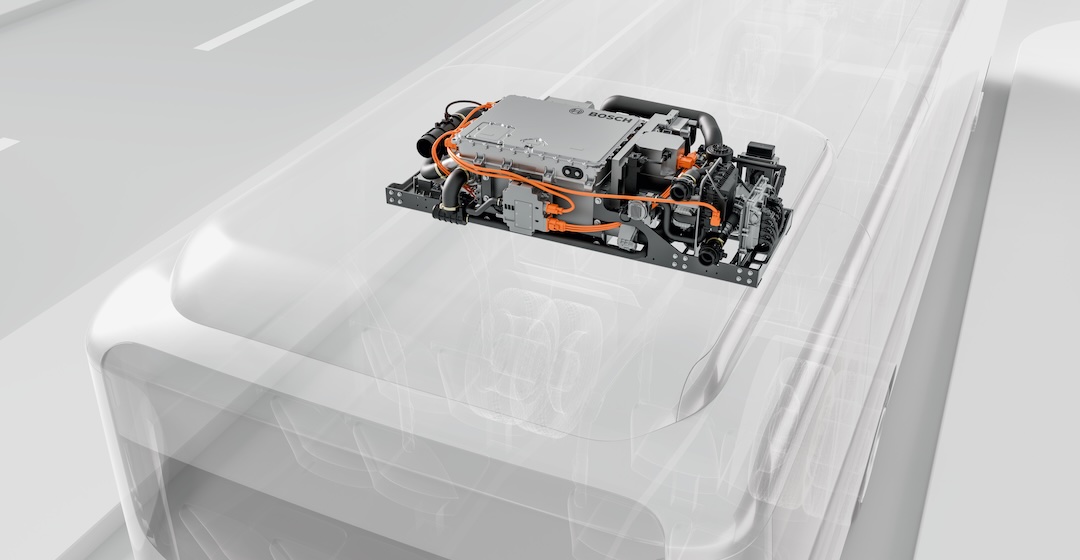
With a height of 40 centimeters, the FCPM C100 fuel cell system can be mounted on the roof of city buses. © Bosch
(Germany) Bosch has unveiled a new variant of its fuel cell drive system, designated "C100," suitable for all bus types, particularly city buses. This expands the company's "Fuel Cell Power Module" (FCPM) portfolio, which offers a power range from 100 to 300 kilowatts. Its low-profile design, with a height of only 40 centimeters, allows for roof mounting, typical for the European market. The system is designed for city buses between 12 and 18 meters in length and is based on the FCPM C190 variant for intercity and coach buses. The latter will enter test operation in demonstration vehicles in the first half of 2026 and will be installed in the rear, similar to a diesel engine. The FCPM C300, with a system output of 300 kilowatts, is also suitable for heavy trucks. In 2025, Bosch announced the market launch of its Hybrion PEM electrolysis stack for hydrogen production. Furthermore, Bosch is working on the technology for hydrogen engines and offers corresponding components for intake manifold and direct injection.
+ + + + +
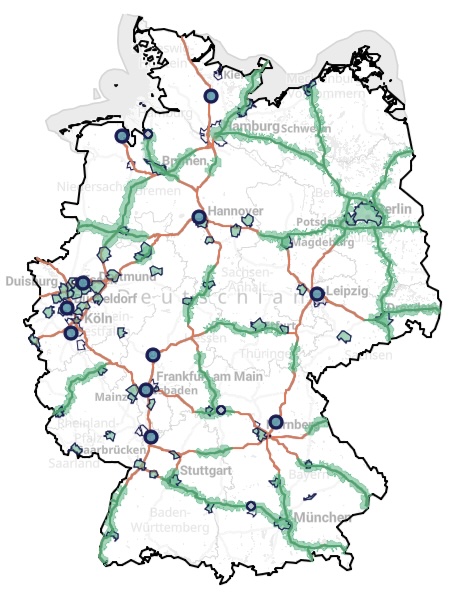
Green areas are potentially eligible for funding: However, the map is for informational purposes only and is not legally binding. © Now GmbH (Screenshot)
(Germany) The federally owned Now GmbH has launched an interactive online tool that allows users to check whether a location meets the spatial requirements for the combined funding of hydrogen refueling stations and commercial vehicles. As previously reported, the Federal Ministry of Transport and Digital Infrastructure (BMVI) recently published the funding guidelines for the development of an initial network of hydrogen refueling stations in combination with the purchase of hydrogen-powered commercial vehicles. The BMVI is providing a total of €220 million for this purpose. With the new tool , users can select which funding option they want to use to assess a hydrogen refueling station location. If the planned location is in a green-colored area, it is eligible for funding after this non-binding assessment. The map displays the entire area of Germany down to street level but is intended solely for orientation purposes.
+ + + + +

NFI launched its new series of emission-free hydrogen-powered buses “Xcelsior CHARGE FC” onto the market in September 2022. © NFI Group
(Canada) Ballard Power Systems Inc. will deliver 500 FCmove-HD+ fuel cell engines with a total output of 50 megawatts to New Flyer of America Inc., a subsidiary of NFI Group Inc. Deliveries will begin this year, and the engines will be installed in Xcelsior CHARGE FC buses. This will position New Flyer "well to accelerate zero-emission operations across North America," says Oben Uluc, Ballard's Vice President of Sales and Marketing. The vehicles will replace diesel buses, says David White, Executive Vice President of Supply Management at New Flyer. Back in 2024, New Flyer increased its order with Ballard from 100 to 200 engines under a long-term supply agreement . Today, Ballard-powered fleets worldwide have grown to more than 2.200 fuel cell buses, with a total of over 250 million kilometers driven, 98 percent uptime, and no reported safety incidents.
+ + + + +
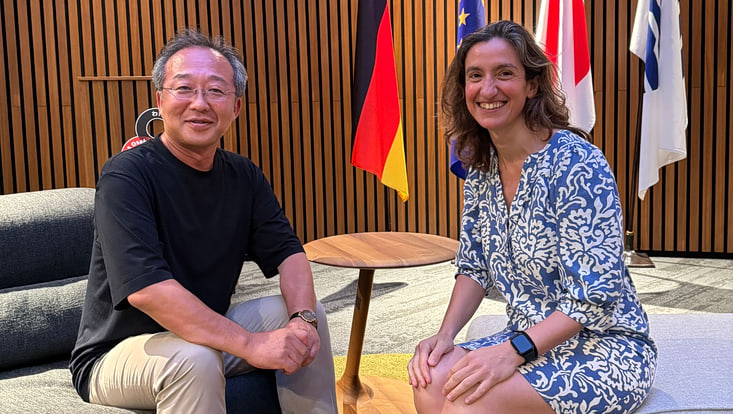
Two of the four initiators of the new cooperation: Katsuyoshi Kakinuma, University of Yamanashi, and Mehtap Özaslan, University of Hamburg, in the German Pavilion at the World Expo 2025 in Osaka. © ITEC / Hasché
(Germany) The University of Hamburg and the University of Yamanashi (Japan) are strengthening their collaboration in the field of research on green hydrogen and power-to-liquid synthetic fuels (e-fuels) within the framework of a new "Japanese-European Clean Energy Material Research Hub." Mehtap Özaslan is leading the project for the University of Hamburg. "Currently, there is a consolidation phase in the field of green hydrogen – many are waiting for new funding," says the professor of technical electrocatalysis in the Department of Chemistry. The energy carrier has not yet become as widespread as hoped, and the current political uncertainty is making things more difficult. However, policymakers in Germany, the EU, and Japan agree that green hydrogen is needed. "We have to move away from oil and natural gas." During her time at the Technical University of Braunschweig, the chemist had already established a research presence in Japan with the German-Japanese Green Hydrogen Material Laboratory, which began in 2022. Japan has been committed to green hydrogen for a long time. There are “many companies in the field of materials and components there that are also of interest to us in Europe,” says Özaslan: “Japanese companies are looking for partners in Europe and vice versa.” The collaboration will begin with research, material exchange, and joint publications. A double degree program is planned for master's students, in which they would receive a degree from both universities.
+ + + + +
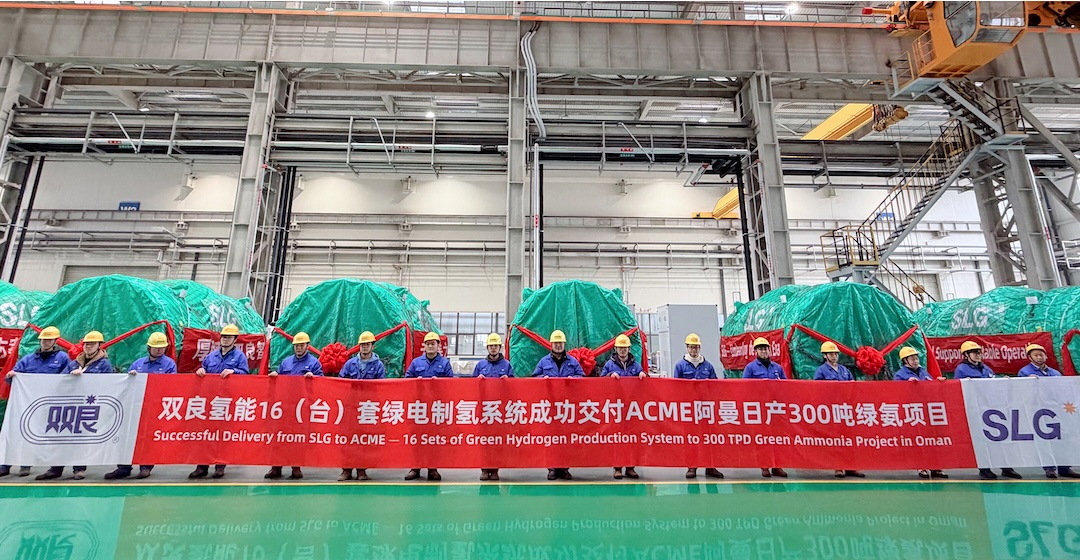
SLG is supplying 16 electrolyzers to ACME for the "300 Green Ammonia" project in Duqm. © SLG
(Oman) The Chinese company Shuangliang International Co. Ltd. (SLG) has delivered 80-megawatt electrolyzers to the Indian conglomerate ACME Cleantech Solutions Pvt. Ltd. The equipment is destined for the "300-TPD" project in Oman. ACME plans to use it to produce 300 tons of green ammonia daily in the special economic zone of the port city of Duqm. Commissioning is scheduled for 2027. In March 2022, the Norwegian project developer and operator of renewable energy plants, Scatec ASA, and ACME established a 50:50 joint venture to develop, build, and operate the plant. According to the plans at the time , the electricity for hydrogen production would come from a newly constructed 500-megawatt solar power plant. Once fully operational, the plant would produce 1,2 million tons of ammonia. The electrolyzer capacity was to be expanded to 3,5 gigawatts by then, it was stated at the time. In March 2024, ACME and the Norwegian fertilizer company Yara International ASA signed an agreement for the delivery of 100.000 tons of ammonia annually.
+ + + + +

The National Hydrogen Council argues that a comprehensive, expandable network of hydrogen refueling stations is essential for the market breakthrough of hydrogen. © H2 Mobility
(Germany) In a paper on the planned Master Plan for Hydrogen and E-Fuels in the Mobility Sector, the National Hydrogen Council (NWR) emphasizes the "strategic importance of hydrogen for transport, industry, and Germany's technological sovereignty." Hydrogen, especially in the truck sector, is not a niche topic, "but alongside electromobility, an important building block for climate protection, security of supply, and industrial competitiveness," says Felix Christian Matthes, acting chairman of the National Hydrogen Council. According to the paper, the energy carrier is a "key to important mobility segments" and plays "a crucial role in segments with particularly significant challenges in the transition to climate neutrality"—including road-based heavy goods transport, aviation and shipping, as well as parts of the rail sector. Battery-electric and hydrogen-based drives should be understood as two complementary technologies, as they serve different application profiles and together increase the resilience of the transport system. A prerequisite for market success is a comprehensive, expandable hydrogen refueling network – including 350-bar, 700-bar, and, in the future, liquid hydrogen refueling. This must be supported by the government at an early stage. Continuing the National Innovation Program for Hydrogen and Fuel Cell Technology (NIP) beyond 2026 is necessary to advance research, industrialization, and scaling. The paper "Master Plan for Hydrogen and E-Fuels in the Mobility Sector: Input from the NWR" is available free of charge as a PDF (22 pages).
+ + + + +
Photos
iStock / © Danil Melekhin



