

Germany: Bundestag approves draft law to accelerate hydrogen projects +++ Scotland: H2-powered double-decker bus fleet in Aberdeen fails +++ Germany: Bilfinger installs plant components for 100 MW electrolyzer in Lingen +++ Germany: Construction of the Hamburg–Rosengarten hydrogen pipeline approved +++ Great Britain: GBRf plans to convert diesel locomotives to hydrogen +++ Germany: Funding for 52 FC buses from Ruhrbahn +++ Austria: Research on PEM electrolyzers without PFAS and iridium +++ Germany: Risk assessment for ammonia storage in the port +++ Germany: Research on converting green hydrogen into methane
A selection of PtX topics summarized at the end of the week
+ + + + +

The German Bundestag approves the Hydrogen Funding Act. © German Bundestag
(Germany) The German Bundestag has passed the draft Hydrogen Acceleration Act (HydrogenBG). The coalition partners, the CDU/CSU and SPD, voted in favor, while the opposition parties voted against. The law allows projects along the entire hydrogen supply chain, from production and transport to storage, to be classified as "of overriding public interest" in order to shorten deadlines and accelerate planning and approval processes (we will report in detail / ed.).
Make our readers aware of your products! Contact us!
Your advertising will have virtually no wasted reach! Our newsletter subscribers are project developers, investors, engineers, and companies – in short: experts. We would be happy to provide you with a customized offer ( media kit ).
+ + + + +

The first hydrogen-powered double-decker buses entered service in Aberdeen in 2021 – now the fleet is being retired. © First Bus UK
(Scotland) Aberdeen's city council has halted plans to further expand the world's first hydrogen-powered double-decker bus fleet. The city had originally intended to purchase 25 buses in cooperation with oil giant BP. Instead, electric buses will now be used, reports the BBC . The existing hydrogen buses have been gradually taken out of service since September 2024 due to technical problems with refueling at two local stations. According to a 2021 statement from British bus operator First Bus UK, the £8,3 million project was financed by the city of Aberdeen, the Scottish government, and the European Union, with an investment of approximately £500.000 per vehicle. The first hydrogen production and bus refueling station was opened in Aberdeen in 2015 as part of a £19 million green transport demonstration project.
+ + + + +
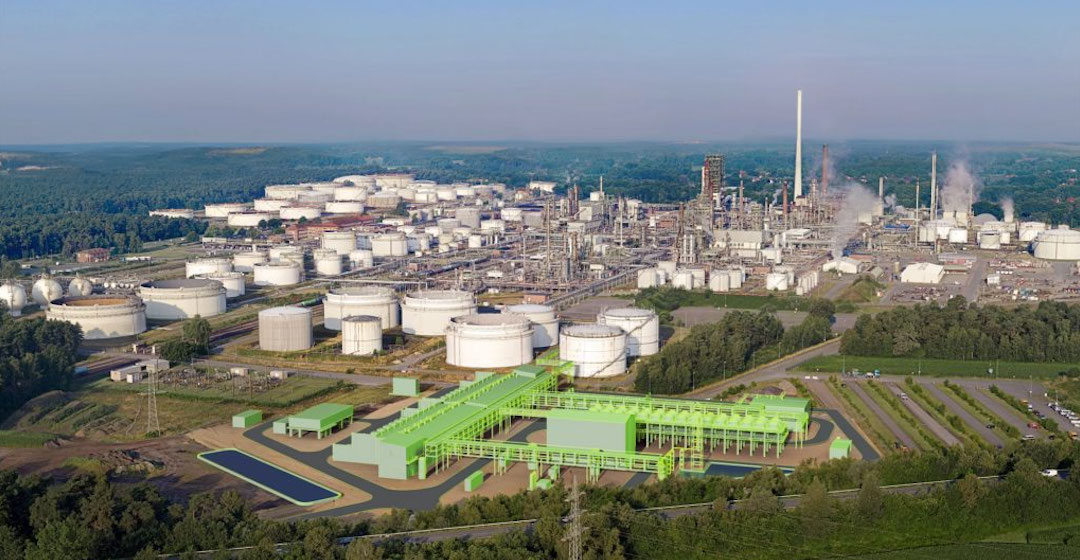
The BP refinery in Lingen is to be supplemented by a hydrogen production facility with an output of 100 megawatts. © BP Europe SE
(Germany) Mannheim-based industrial services provider Bilfinger SE, as part of a consortium, has been awarded a contract by oil company BP for the installation of a 100-megawatt electrolyzer for the production of green hydrogen in Lingen, Lower Saxony. The plant will have a capacity of 11.000 tons per year. The hydrogen could then be supplied to industrial customers via a connection to the hydrogen core network and also used in the neighboring refinery for the production of lower-emission fuels. Bilfinger has been commissioned with the prefabrication, assembly, and installation of pipelines and plant components, thermal insulation, and the installation of HVAC (heating, ventilation, air conditioning) systems. Back in September 2024, Bilfinger, together with Sunfire GmbH, received a contract from energy company RWE AG to expand the electrolysis capacity of the "GET H2 Nucleus" project in Lingen to 300 megawatts in a third development phase.
+ + + + +

Route of the hydrogen pipeline from the planning approval procedure in November 2024. © State Office for Mining, Energy and Geology Lower Saxony
(Germany) The Lower Saxony State Mining Authority has approved the continued construction and operation of the hydrogen pipeline from Hamburg-Moorburg to the municipality of Rosengarten in the Harburg district. The pipeline will have a total length of just over twelve kilometers. An existing 7,5-kilometer pipeline will be repurposed and reused for this purpose. Only about 4,5 to 5 kilometers will need to be newly constructed. Construction work has already begun on Hamburg territory. According to current plans, the pipeline should go into operation in 2027 and will then transport hydrogen produced by the 100-megawatt electrolysis plant in Moorburg.
+ + + + +

GBRf plans to convert diesel locomotives to hydrogen vehicles. © HyOrc Corporation
(Great Britain) The railway company GB Railfreight (GBRf), together with the US company HyOrc Corp., plans to retrofit part of its fleet of older diesel locomotives with zero-emission propulsion technology. In the pilot project "Phoenix," emissions will be gradually reduced through the use of natural gas (LPG) before the locomotives are converted to 100 percent hydrogen. A key advantage is that this avoids the need for costly electrification infrastructure. Retrofitting part of the rail freight fleet with multi-fuel technology "offers a practical, low-risk path to decarbonization," says Alex Kirk, Commercial Director at GB Railfreight. According to Lisa Carter, CFO of HyOrc, the possibility of obtaining funding for the retrofitting of the existing systems through the "Connected Places Catapult" is currently being explored.
+ + + + +

Transport Minister Patrick Schnieder (left) presents Ruhrbahn Managing Director Ahmet Avsar with the funding certificate for the procurement of 52 hydrogen buses. © Ruhrbahn GmbH
(Germany) The German Federal Government is funding the purchase of 52 fuel cell buses for Ruhrbahn GmbH with €11,6 million. "With the new hydrogen buses, we are consistently developing our mobility services," said Managing Director Ahmet Avsar at the handover of the funding certificate. The investment is based on a comprehensive analysis of the long-term direction of the fleet. As part of the "H2 Zero Emission" project, battery and hydrogen drives were compared. For Ruhrbahn, fuel cell propulsion is particularly suitable from an economic and organizational perspective for the majority of its routes. The new vehicles will replace older diesel vehicles. Nineteen hydrogen-powered buses have already been in operation at Ruhrbahn since 2025. With the additional vehicles, the hydrogen fleet will grow to 78 buses by 2027/2028. A total of 315 solo and articulated buses are currently in service for Ruhrbahn.
+ + + + +

Merit Bodner from the Institute of Chemical Engineering and Environmental Technology at TU Graz. © Helmut Lunghammer / TU Graz
(Austria) Graz University of Technology (TU Graz) is participating in an international consortium led by the University of Southern Denmark, which is researching the production of electrolyzers without the use of long-life chemicals and with less iridium. According to the consortium, while PEM (Proton Exchange Membrane) electrolysis is particularly well-suited for the production of green hydrogen when electricity supply fluctuates due to wind and solar power, it relies on environmentally hazardous per- and polyfluoroalkyl substances (PFAS), which the EU intends to ban soon. The three-year EU project SUPREME aims to eliminate these drawbacks in order to make electrolysis technology more environmentally friendly and significantly more cost-effective. "If we succeed in eliminating harmful substances in the production of green hydrogen and also bring it to a similar price level as fossil hydrogen, we will have taken an important step towards a green transition," says Merit Bodner from the TU Graz Institute of Chemical Engineering and Environmental Technology. Furthermore, this makes it more attractive for other applications, such as storing surplus energy from renewable sources. Also involved are the Turkish Science and Technology Council TÜBITAK, the British metals and catalyst company Ceimig, the German Fraunhofer ISE, and the Norwegian hydrogen company Element One Energy AS (EoneE).
+ + + + +

Bremerhaven (pictured) and Wilhelmshaven plan to develop safety concepts for the use of ammonia as a ship fuel. © Bremenports GmbH & Co. KG
(Germany) The Northwest Metropolitan Region is funding a joint project between Bremerhaven and Wilhelmshaven to assess the risks associated with ammonia bunkering. The project will examine potential health and environmental hazards, technical requirements, and the necessary infrastructure for effective emergency response. While ammonia has long been used in industry, transport, and cargo handling, and established safety concepts exist for these applications, its use as a marine fuel is largely uncharted territory for ports, shipping companies, and the logistics sector. Specific regulatory requirements for ammonia bunkering in ports are still under development. The goal is to develop preventative safety concepts for the future use of ammonia as a marine fuel. It is expected that around 30 percent of all ships will be powered by ammonia by 2050. The ports want to prepare for this development early on in order to be "ammonia-ready" within two to three years.
+ + + + +

In Gicon's trickle-bed process, regeneratively generated electricity that cannot be fed into the grid due to capacity limitations is used for the electrolytic production of hydrogen and subsequent methanization. © Großmann Ingenieur Consult GmbH
(Germany) As part of the three-year research project "WeMetBio 2," a consortium aims to use energy from wind or solar power plants to produce hydrogen, which will then be converted into methane similar to natural gas. To this end, a demonstration plant will be built at the biogas plant site near Flensburg and operated under practical conditions for twelve months. Using a trickle-bed process developed by Großmann Ingenieur Consult GmbH (Gicon) in Dresden in cooperation with the Brandenburg University of Technology Cottbus-Senftenberg, regeneratively generated electricity that cannot be fed into the grid due to capacity limitations will be used for the electrolytic production of hydrogen. This hydrogen will then be converted into methane with CO2. A portion of the raw biogas produced at the biogas plant will be used as a CO2 source to operate the plant. The resulting biomethane has a high purity of over 95 percent and can be fed into the natural gas grid as CNG (Compressed Natural Gas) or LNG (Liquefied Natural Gas). The process can be flexibly adapted to the fluctuating generation of renewable energies. The findings are intended to serve as a blueprint for future applications. In addition to Gicon and TU Cottbus-Senftenberg, Nissen Biogas GmbH and Flensburg University of Applied Sciences are also involved.
+ + + + +
Photo above
iStock / © Danil Melekhin



