

Chile: Consortium examines feasibility of PtL plant +++ Germany: Gascade begins preliminary work for HYLU hydrogen pipeline +++ USA: Initiative to coordinate hydrogen standards +++ Finland: Cooperation with Germany in the hydrogen economy +++ Germany: TU Braunschweig and Ostfalia University of Applied Sciences receive funding for liquid hydrogen research +++ Malaysia: Semarek commissions Gicon to plan and build a hybrid power plant +++ Germany: Research on hydrogen production at sea +++ Saudi Arabia: NEOM reaches financial conclusion for hydrogen project +++ Germany: Discussion paper from the hydrogen initiative IN4climate.NRW +++ England: Residents skeptical of hydrogen plans for the Tees industrial region +++ Germany: €54 million in funding for ITZ-H2 in Pfeffenhausen
A selection of PtX topics summarized at the end of the week
+ + + + +
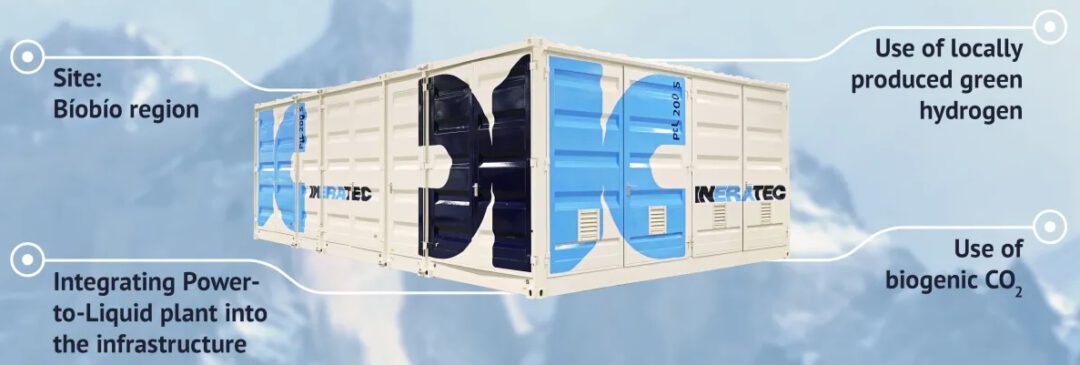
A consortium led by Ineratec is investigating the potential of an eFuels factory in Chile. © Ineratec GmbH
(Chile) A consortium led by Karlsruhe-based Ineratec GmbH plans to investigate the potential for producing sustainable fuels in the Biobío region. Partners include the forestry company Arauco, the liquefied gas supplier Abastible, the Chilean energy company Copec, and its subsidiary Copec Wind Ventures. The planned power-to-liquid (PtL) plant will be built in Arauco's Biobío industrial complex. The project envisions the use of biogenic CO2 captured from Arauco's operations, as well as green hydrogen produced locally by Abastible. Copec will be responsible for fuel logistics and downstream applications. The project will be "partially" financed by the Chilean economic development agency CORFO. The costs for the basic technical planning are covered. Further details are not being disclosed.
+ + + + +
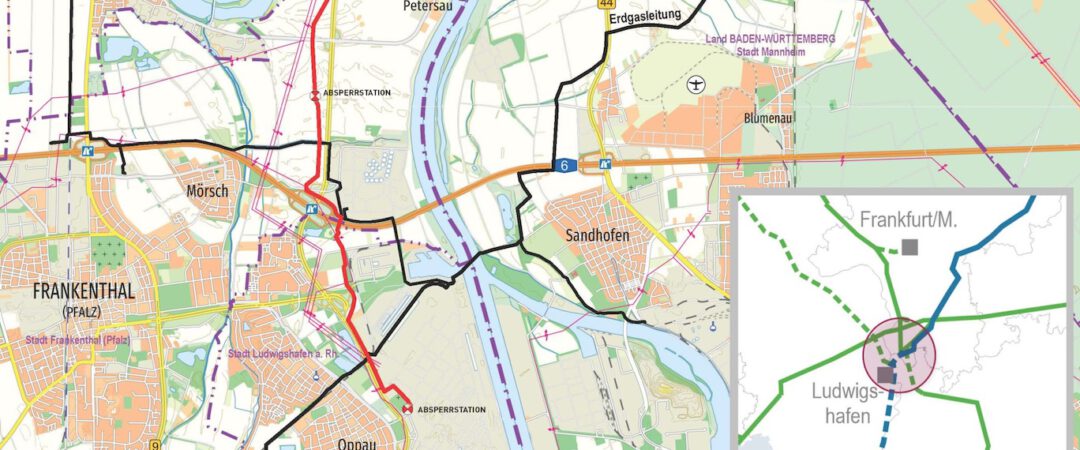
Gascade is commencing mapping, soil surveys, and ordnance investigations for the planned HYLU hydrogen pipeline. © Gascade Gastransporte GmbH
(Germany) Gascade Gastransport GmbH has begun preparatory work for the planning approval procedures in Hesse, Baden-Württemberg, and Rhineland-Palatinate for the construction of an approximately 15-kilometer-long hydrogen pipeline from Lampertheim to Ludwigshafen am Rhein (HYLU), including a hydrogen gas pressure regulating and metering station (WDRM). The pipeline will transport the energy carrier in the converted MIDAL long-distance gas pipeline. Initially, mapping work, investigations of the facility locations, and the pipeline corridor will be carried out. The main mapping period is between March and July 2026. "These preliminary works do not constitute a preliminary decision for the planned project," Gascade emphasizes, but merely serve to ensure the proper preparation of the application documents. The preliminary work, which is scheduled for completion by autumn 2026, includes surveying, soil investigations, and ordnance surveys. HYLU is part of the nationwide core hydrogen network approved by the Federal Network Agency and is scheduled for completion by the end of 2029.
+ + + + +
The American National Standards Institute is seeking input from the hydrogen industry to develop standards. © ANSI
(USA) The American National Standards Institute (ANSI) has launched an initiative to coordinate hydrogen standards. Phase I will focus on creating a database. ANSI is requesting input from the industry through a Request for Information (RFI) process. Interested parties can complete a prepared Excel spreadsheet (due March 6, 2026). Webinars on the topic will be held on March 16 and 31. A technical workshop is planned for spring as part of Phase II. The project is financially supported by the international standards organization ASTM International (USA), the Compressed Gas Association (CGA), and the Canadian standards organization CSA Group. ANSI is a private organization whose mission is to enhance the global competitiveness of the US economy by promoting standards and conformity assessment systems. Its members include companies, government agencies, professional, industry, and consumer associations, and labor unions. ANSI is the official US representative to the International Organization for Standardization (ISO) and the International Electrotechnical Commission (IEC).
+ + + + +

Herkko Plit, Chairman of Hydrogen Cluster Finland: “Germany and Finland should become the powerhouse of the EU hydrogen economy.” © P2X Solutions Oy
(Finland) Finland and Germany intend to expand their cooperation in the hydrogen economy. A joint declaration of intent was recently signed by German Federal Minister for Economic Affairs and Energy Katherina Reiche and German Minister for the Environment, Nature Conservation, Nuclear Safety and Consumer Protection Sari Multala. Finland aims for a 10 percent share of EU clean hydrogen production and at least an equivalent share of hydrogen end-use applications, says Multala. The value chains of the hydrogen economy are never local, but always international; therefore, the benefits of investment are realized through companies, countries, and regions. As the largest market, Germany, together with some of the leading hydrogen technology companies, has a significant influence on the development of the EU's hydrogen roadmap, according to a statement from the business organization Hydrogen Cluster Finland. Finland is among the most competitive locations for green hydrogen production in the EU. “The goal is to make our two countries, together with partners around the Baltic Sea, the powerhouse of the EU’s hydrogen economy,” says Herkko Plit, CEO of P2X Solutions Oy and Chairman of Hydrogen Cluster Finland, an association of around 90 companies and industry associations.
+ + + + +
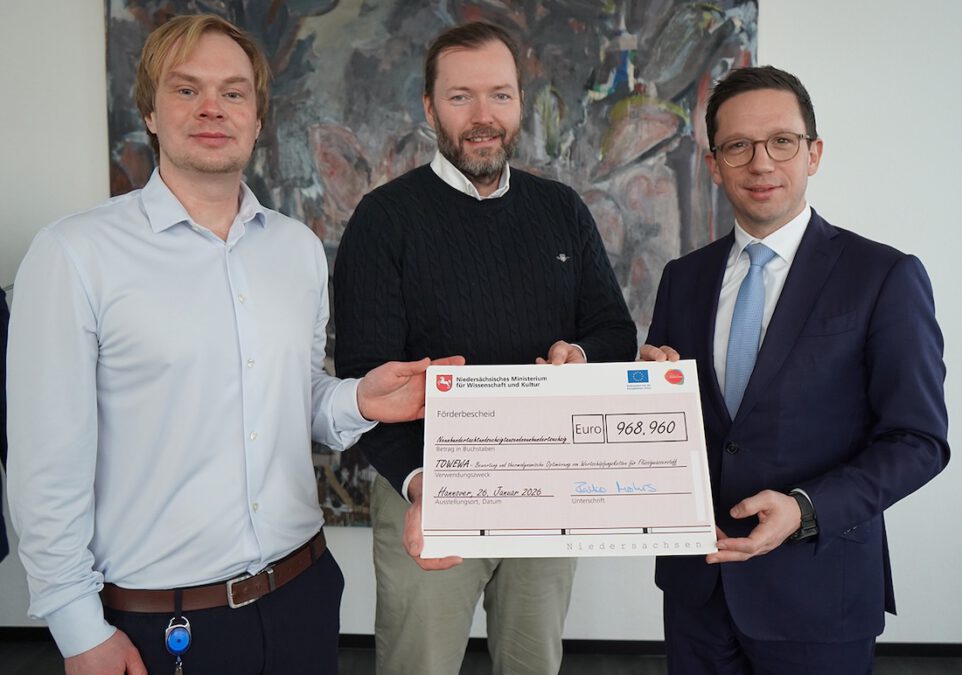
Falko Mohrs (right), Lower Saxony's Minister for Science and Culture, symbolically presents the check to Junior Professor Michael Heere and Professor Daniel Schröder (both TU Braunschweig) for the launch of the TOWEWA innovation network. © MWK
(Germany) The Technical University of Braunschweig (TU Braunschweig) will receive approximately €970.000 in funding from the state of Lower Saxony, while Ostfalia University of Applied Sciences and TLK-Thermo GmbH will receive a further €180.000. Within the TOWEWA innovation network, the institutes are researching how value chains for liquid hydrogen (LH2) can be designed with significantly reduced energy losses. The focus is on concepts for optimizing the liquefaction, storage, transport, and use of hydrogen, for example, in the aviation, shipping, and heavy-duty transport sectors. Ostfalia University of Applied Sciences will concentrate primarily on hydrogen refueling stations. A key element of the project (running until June 30, 2028) is the development of novel processes for recovering previously unused energy during the regasification of liquid hydrogen. TU Braunschweig also announced that new simulation and evaluation methods will be used to comprehensively analyze and optimize hydrogen systems.
+ + + + +
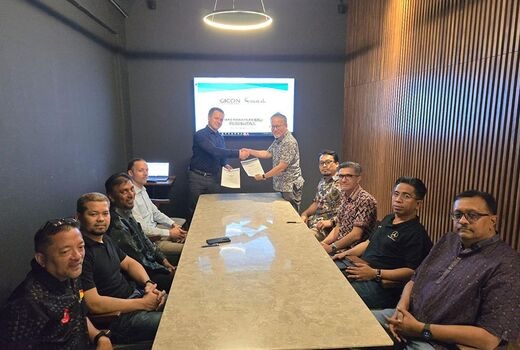
Gicon is planning a hybrid power plant for Semarak RE in Malaysia. © Gicon
(Malaysia) The Dresden-based engineering services provider Großmann Ingenieur Consult GmbH (Gicon) will develop what Semarak Renewable Energy a Bhd. (Semarak RE) will reportedly call "the first ecological hybrid power plant." The plant will combine renewable energy sources such as photovoltaics, wind, and geothermal energy with hydrogen and biogas production. The collaboration will focus on a feasibility study for all technologies, environmental impact assessments, and an integration plan. The hybrid power plant is planned for a 1.300-hectare site and is expected to generate its first green electricity and produce sustainable fuels in 2028.
+ + + + +

The idea of producing hydrogen directly at sea is not new, but further research is still needed. In 2023, the Fraunhofer ISE presented the possibilities in its report "OffsH2ore – Offshore Hydrogen Production Using Offshore Wind Energy as an Island Solution" (as we reported). The starting point is a hypothetical wind farm in the North Sea, directly connected to a 500-megawatt electrolysis platform. © Project report, Fraunhofer ISE
(Germany) In the "Wind2hydrogen" project, researchers are exploring ways to convert energy from offshore wind turbines directly into hydrogen at sea. The Bremerhaven University of Applied Sciences, the University of Bremen, and Bremerhaven-based EnPro GmbH are all involved. The project focuses on the planning and development of a floating hydrogen production plant. Such a platform must operate autonomously and withstand the harsh environmental conditions at sea. The researchers have investigated suitable water treatment processes. "A market analysis allows us to identify existing components. This enables us to leverage existing technologies during development, leading to faster market readiness," says research associate Marc-Kevin Baer. "It's possible that the technical requirements developed in the study will exceed the current market offerings and will later need to be addressed by industry based on the final set of recommendations," says project manager Uwe Werner. In the coming months, the researchers plan to develop a model that can simulate various hydrogen platforms. A concrete design for a test facility is expected to be available by the end of the project next year. Background: In 2025, approximately 1.600 offshore wind turbines fed about six percent of Germany's annual electricity supply into the grid. To bring this energy ashore, submarine cables must be laid; this is a cost driver and potentially environmentally damaging. It would be more cost-effective to convert the generated electricity directly into hydrogen on-site and store it. The project, which runs until May 2027, is funded by the Bremerhaven Society for Investment Promotion and Urban Development (Bremerhavener Gesellschaft für Investitionsförderung und Stadtentwicklung mbH) and co-financed with funds from the "ERDF Bremen 2021 to 2027" program.
+ + + + +

Oxagon becomes part of the new city of Neom. © Neom
(Saudi Arabia) NEOM Green Hydrogen Company (NGHC) has announced that it has secured financing from 23 local, regional, and international banks and financial institutions for its $8,4 billion green hydrogen plant. Located in the floating industrial complex Oxagon, the plant is expected to produce up to 600 tons of green ammonia per day starting in late 2026. Annual production capacity is estimated at 1,2 million tons. Electricity will be generated from solar and wind power plants with an installed capacity of four gigawatts. The Oxagon port and logistics center will be powered entirely by clean energy. NGHC is a joint venture between NEOM, Acwa Power, and the US gas supplier Air Products.
+ + + + +
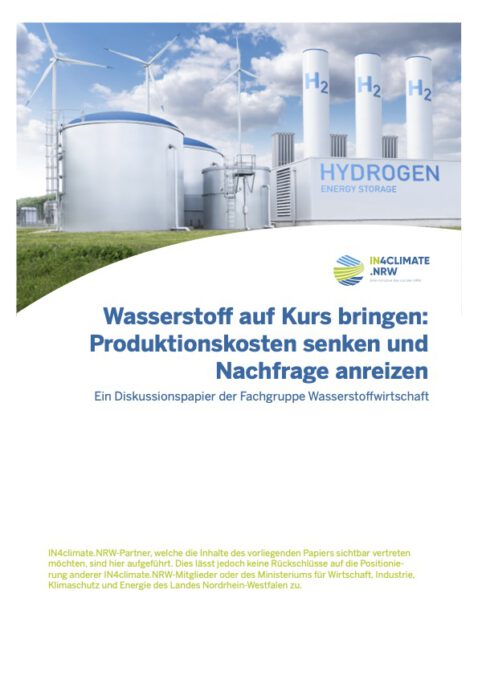
North Rhine-Westphalia has good prerequisites for an economical hydrogen supply. © NRW.Energy4Climate GmbH
(Germany) A discussion paper from the IN4climate.NRW initiative analyzes current developments for the economic ramp-up of hydrogen in North Rhine-Westphalia (NRW). The state has excellent prerequisites: an energy-intensive industry with high demand, its advantageous geographical location within the European Hydrogen Backbone, its central connection to the core hydrogen network, as well as local hydrogen storage potential and port connections. 50 megawatts of electrolysis capacity are already operational in NRW, with over 200 megawatts of additional capacity approved or under construction. Initial industrial projects and signed supply contracts for refueling stations in the Rhine-Ruhr region demonstrate the industry's readiness for transformation. Now, the focus is on "removing regulatory obstacles at the EU level and, in cooperation with the federal government, creating suitable conditions for the rapid scaling of a resilient hydrogen economy," says Katharina Schubert, Managing Director of NRW.Energy4Climate. The discussion paper , "Getting Hydrogen on Track: Reducing Production Costs and Stimulating Demand," is available free of charge as a PDF (40 pages).
+ + + + +
(England) Protium Green Hydrogen Supply's plans for hydrogen production in the Teesside industrial region are apparently facing considerable skepticism from local residents. According to the BBC , there are fears of flooding and increased traffic among people living just 75 meters from the planned facility. Stockton Councillor Richard Eglington stated that it is an ongoing planning application, and residents can still voice their opinions. Another councillor also expressed concern about the "proximity to residential areas," the report said. Furthermore, a bridge is in poor condition and impassable for heavy goods vehicles, forcing trucks to drive through residential areas. "Industry is good for jobs and our future, but it needs to be planned with the local community," the BBC quoted Chris McDonald, the UK's Minister for Industry and Labour MP for the region. He said he would work with concerned residents to ensure there is "no negative impact" on the Port Clarence community. “If we want to build the industries of tomorrow here in Teesside, it has to be done safely, transparently, and with the support of the community.” The mayor of Tees Valley also supports the project, saying it is “exactly the kind of investment Teesside needs.” The consultation period for the plans submitted by Protium Green Hydrogen Supply for a site on the River Tees in Stockton has been extended to February 26.
+ + + + +
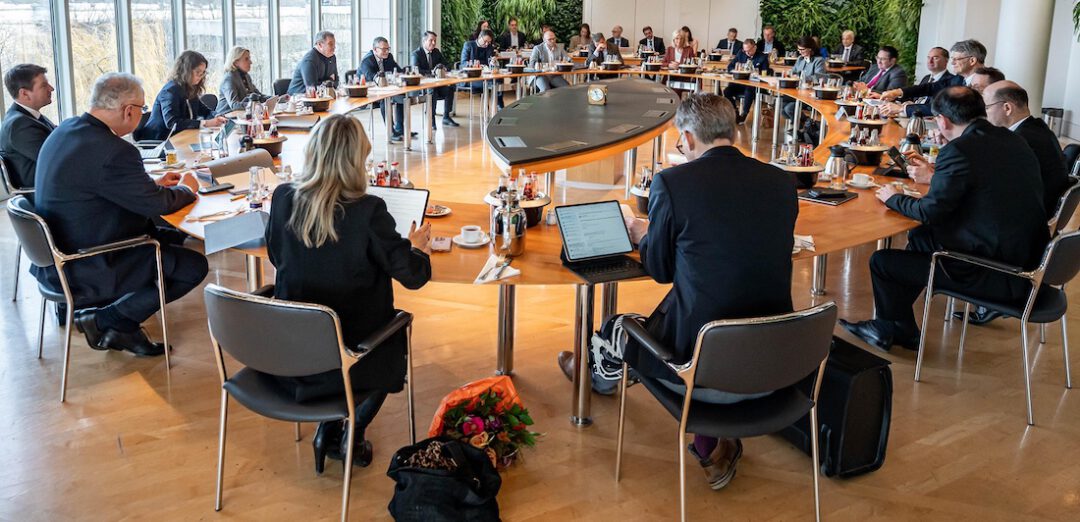
Federal Transport Minister Patrick Schnieder presented funding awards totaling €54 million to representatives of the planned ITZ-H2 technology center in Pfeffenhausen during a visit by the Bavarian State Government cabinet to Munich. © Bavarian State Chancellery / Marc Conzelmann
(Germany) Federal Transport Minister Patrick Schnieder has presented funding grants totaling €54 million in Bavaria. This funding will be used to establish a decentralized Hydrogen Innovation and Technology Center (ITZ-H2) in Pfeffenhausen, including a hydrogen liquefier and test benches. "Thanks to the initial funding from the federal government and the contributions from the Free State of Bavaria, the basic infrastructure, as well as certification facilities for components in the areas of tanks, refueling, and propulsion, can be built," said Bavarian Economics Minister Hubert Aiwanger. With the universities of Ingolstadt, Regensburg, and Landshut, a "strong research network" is available locally to provide the scientific expertise of the industry. With ITZ-H2, the Federal Ministry of Transport is implementing a key measure of the Federal Government's National Hydrogen Strategy. The Pfeffenhausen site, together with the centers already established in Chemnitz and Northern Germany, will specifically support small and medium-sized enterprises, start-ups, and the supplier industry in further developing hydrogen technologies and bringing them to market maturity. The Hydrogen Technology Application Centre (WTAZ) in Pfeffenhausen focuses on liquid hydrogen, H2 combustion engines, tanks and refueling systems, as well as the construction of a vehicle test bench.
+ + + + +
Photo above
iStock / © Danil Melekhin



