

Netherlands: Plug Power delivers 32 tons of hydrogen to Hynetworks in Rotterdam +++ Chile: Acciona commissions fuel cell generator +++ Germany: New hydrogen filling station in Lübeck +++ USA: Air Products receives $140 million contract from NASA for hydrogen supply +++ Germany: €350 million in funding for Concrete Chemicals' e-SAF plant +++ Germany: NOW drops hydrogen from its name +++ Germany: €1,6 million for Hydrogen Innovation Center in Chemnitz +++ Germany: Researchers develop stainless steel with low hydrogen diffusion
A selection of PtX topics summarized at the end of the week
+ + + + +

Plug Power has filled the first section of the future European hydrogen network in Rotterdam. The final pipes of the pipeline were laid in September 2025. © Hynetwork
(Netherlands) Plug Power Inc. has completed the first hydrogen filling of Hynetwork Services BV's 32-kilometer pipeline in Rotterdam. The energy carrier, certified as RFNBO according to EU regulations – a total of 32 tons – was delivered by trailer, each capable of carrying more than 1.000 kilograms. Hynetwork, a subsidiary of the Dutch state-owned gas network operator Nederlandse Gasunie NV, is implementing the hydrogen network in the Netherlands. The Rotterdam segment is the first section of the future European Hydrogen Backbone and connects the port area with industrial demand centers. The long-distance gas pipeline was laid in September 2025, and the final connection work was completed in January ( as previously reported ).
+ + + + +

Acciona commissions a fuel cell-powered generator for a copper mine owned by the state-owned company Codelco in Chile. © Acciona SA
(Chile) The Spanish conglomerate Acciona SA has replaced a diesel generator with a fuel cell generator at the world's largest underground copper mine, "El Teniente," owned by the state-owned company Codelco in the Andes Mountains. The unit, manufactured by the French company Energy Observer Developments SAS (EODev) and distributed in Chile by KH2, is reportedly the first of its kind in the country to use hydrogen for off-grid power generation. This will reduce fossil fuel consumption by 5.067 liters per quarter. The pilot project is using the electricity for expansion work at the Carén reservoir, about 80 kilometers south of Santiago. Acciona has already completed several projects to reduce emissions during construction, including during the construction of a prison complex in San Sebastián, northern Spain, where a mobile fuel cell generator powered construction machinery, as well as during road construction in Cádiz and bridge construction in Seville.
+ + + + +

MB Energy has opened a hydrogen filling station in Lübeck in the presence of Mayor Jan Lindenau. © MB Energy
(Germany) Energy supplier MB Energy GmbH has opened a hydrogen refueling station for heavy-duty vehicles in Lübeck. The facility, developed by Hypion GmbH, has a daily capacity of 2.000 kilograms and could refuel approximately 50 trucks. Construction began in July 2025. The station is located near the A1/A20 motorway interchange. This brings the MB Energy Group's total number of hydrogen refueling stations to three. The station is being funded by the German Federal Ministry of Transport with €5,1 million. It will be operated as part of the Tankpool24 network, which includes over 2.000 refueling stations in Europe and more than 750 in Germany.
+ + + +
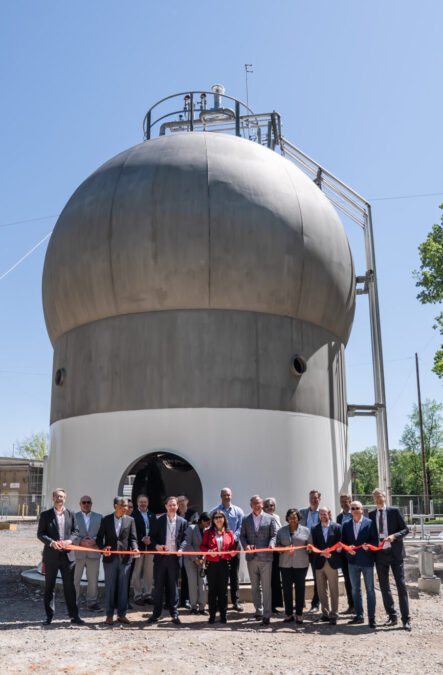
Liquid hydrogen tank on the NASA site in Alabama. © CB&I
(USA) Industrial gas manufacturer Air Products has announced it has signed contracts with NASA for the delivery of liquid hydrogen worth $140 million (€118 million). Delivery locations include the Kennedy Space Center and Cape Canaveral Space Force Station in Florida, the Marshall Space Flight Center in Huntsville, Alabama, and NASA's Stennis Space Center in Bay St. Louis, Mississippi. As previously reported, last year Air Products delivered 50 trailers containing a cumulative total of over 730.000 gallons of liquid hydrogen to the Kennedy Space Center to fill the world's largest spherical hydrogen tank, measuring 27 meters high and 24 meters in diameter.
+ + + + +

Headquarters of Concrete co-owner Enertrag in Dauerthal, Brandenburg. © Enertrag SE
(Germany) Concrete Chemicals GmbH has received €350 million in funding for the construction of what it describes as "Germany's largest industrial-scale production plant for sustainable aviation fuels" (e-Sustainable Aviation Fuels, e-SAF). The plant will be located in Schwedt, Brandenburg. The funding has already been approved at the state level, and the review by the European Commission is in its final stages. Concrete Chemicals produces synthetic kerosene using a power-to-liquid (PtL) process. This process utilizes biogenic CO2 and renewable hydrogen. The consortium plans to collaborate with Leipa Georg Leinfelder GmbH, a manufacturer of paper and cardboard products based on recycled paper in Schwedt, to source local CO2. The PtL plant will have an annual capacity of 37.000 tons (30.000 tons of e-SAF and 7.000 tons of e-naphtha). The investment decision is planned for 2027, with commissioning scheduled for 2030. The location and design will later allow for connection to the national hydrogen core network. Concrete Chemicals is a joint venture between the project developer Enertrag SE and the mineral oil company Zaffra.
+ + + + +

New name, new logo: NOW coordinates funding programs for drive technologies of the German Federal Government. © NOW GmbH
(Germany) The federally owned "National Organisation Hydrogen and Fuel Cell Technology" (NOW) is changing its name to "National Organisation for the Transformation of Mobility." This change, along with its logo, aligns the name and logo with the "public image" of its "product portfolio, which has grown over many years." NOW was originally founded in 2008 to coordinate the National Innovation Programme for Hydrogen and Fuel Cell Technology (NIP) on behalf of the German Federal Government. Today, its technological responsibilities encompass hydrogen, batteries, renewable fuels, and the expansion of the charging infrastructure in Germany.
+ + + + +
(Germany) The EU is funding the construction of an electrolyzer at the hydrogen campus in Chemnitz with €1,2 million. An additional €420.000 is being provided for converting the pipeline infrastructure from natural gas to hydrogen. The hydrogen center is intended to support industrial transformation processes towards climate-neutral technologies. With a focus on small and medium-sized enterprises (SMEs) and startups, the project aims to develop new business areas in the field of hydrogen technologies and bring them to market maturity. The 240-kilowatt electrolyzer is being built by the energy supplier Eins Energie in Sachsen GmbH & Co. KG and can be expanded to two megawatts in the future. In addition, there is a hydrogen storage facility with a capacity of approximately 115 cubic meters (about 330 kilograms of hydrogen). The hydrogen will be used to supply the "Hydrogen Campus Chemnitz" development area. The first customer will be the Hydrogen Innovation Center (HIC). For this purpose, a 550-meter section of an existing natural gas pipeline will be converted to hydrogen.
+ + + + +
(Germany) A research team at the Max Planck Institute for Sustainable Materials GmbH has announced the development of a "cost-effective and high-performance" stainless steel for the hydrogen economy ($4,15 per kilogram). The implementation of small amounts of nickel, manganese, and copper results in "extremely low hydrogen diffusion coefficients." This "effectively prevents hydrogen diffusion" and avoids hydrogen-induced damage. Experimental and simulation results showed, among other things, that nitrogen segregation reduces "the tendency toward hydrogen segregation and the associated brittleness." "The challenge was to develop a stainless steel that remains mechanically reliable even in the presence of hydrogen while also offering high corrosion resistance," says Dierk Raabe, co-author of the study. "At the same time, the material had to be cost-effective and compatible with established manufacturing processes. Since grain boundaries are the most vulnerable defects, we focused on preventing hydrogen penetration precisely at these points." The design can be extended to other alloys and materials. The results have now been published in Science Advances 12 (2026) under the title "Segregation passivation makes cost-effective stainless less resistant to corrosion and hydrogen embrittlement" .
+ + + + +
Photo above
iStock / © Danil Melekhin



